Talent is no longer enough. In today’s crowded market, a strategic personal brand is what separates a gifted musician from a sought-after soloist.
- Your brand is about taking control of your narrative, from your social media presence to your artist biography.
- Success lies in balancing authentic artistic interpretation with smart, targeted marketing—not just chasing vanity metrics.
Recommendation: Stop thinking like just an artist; start thinking like the CEO of your own career.
For generations, the path for a classical soloist was clear: dedicate thousands of hours to mastering your instrument, win a prestigious competition, find a good agent, and let them handle the business. The music, it was assumed, would speak for itself. But in a world saturated with content, where festival directors and audiences are overwhelmed with choice, this passive approach is a career-limiting liability. Your technical brilliance is the entry ticket, not the grand prize.
Many artists believe that marketing is a distraction from their art, a necessary evil best left to others. They see a professional website and some headshots as the full extent of their branding duties. This misses the point entirely. A powerful personal brand isn’t about selling out; it’s about taking ownership. It’s the conscious act of shaping how the world perceives your unique artistic value, ensuring your music reaches the ears it’s meant for. The real question isn’t *if* you should build a brand, but *how* you can do it authentically and strategically.
But if the real key wasn’t just endless practice or having an agent, but building the *business of you*? This guide is designed for the rising soloist who understands their artistry is a world-class asset that needs a world-class strategy. We’ll deconstruct the essential elements of a modern artistic brand, moving beyond the practice room to explore narrative, positioning, and strategic career alignment. We will even draw lessons from seemingly unrelated creative fields to give you a decisive edge.
This article provides a complete framework for building your personal brand. Below, we’ll explore everything from mastering your digital presence to crafting a compelling biography and making strategic career decisions.
Summary: Personal Branding Strategy for the Modern Soloist
- Why does a conductor need Instagram when they have an agent?
- How to write a biography that appeals to festival directors, not just academics?
- Virtuoso Technique vs Unique Interpretation: which sells more tickets today?
- The marketing trap of spending more time on TikTok than on repertoire
- When to release a debut recording: aligning with concert seasons
- Why charging by the hour penalizes efficient designers?
- Company Route vs Freelance Portfolio: which school prepares you better for today’s market?
- Contemporary Dance Training in the UK: Which Conservatoire Suits Your Style?
Why does a conductor need Instagram when they have an agent?
The most common objection to personal branding is, “That’s what my agent is for.” This is a fundamental misunderstanding of the modern music business. An agent’s job is to leverage the opportunities your brand creates; your job is to create a brand that generates those opportunities in the first place. Think of it as narrative control. If you don’t tell your own story, someone else will—or worse, there will be no story to tell.
Social media is not just a promotional tool; it’s a direct line to your audience, curators, and collaborators. It’s where you share your process, reveal your personality, and build a community around your artistic vision. A conductor on Instagram isn’t just posting concert dates; they’re offering a glimpse into their score study, sharing a moment from a rehearsal, or explaining their passion for a little-known composer. This builds a human connection that an agent’s press release never can. The digital world is hungry for this authenticity, as proven by a 60% increase in #classicalmusic hashtag usage on TikTok in a single year.
This paragraph introduces the conductor on Instagram, a modern symbol of artistic branding. The illustration below visualizes this bridge between traditional authority and contemporary accessibility, where the tools of the trade now include both a baton and a smartphone.
As the image suggests, this isn’t about replacing the concert hall with a social media feed. It’s about using one to enrich the other. As Lauren O’Brien, Digital Communications Officer at HarrisonParrott, explains, this direct engagement is crucial for discovery.
Social media is an essential tool to shed light on music and musicians that a new audience may have never heard of before.
– Lauren O’Brien, Digital Communications Officer at HarrisonParrott
Your agent can close a deal, but they can’t create the genuine human interest that makes a festival director seek you out. That power now rests with you. Your digital presence is the first audition you’ll have, and it happens long before you step on stage.
How to write a biography that appeals to festival directors, not just academics?
Your artist biography is arguably the most important piece of marketing copy you will ever produce. Too often, musicians treat it as an academic C.V.—a dry, chronological list of teachers, competitions won, and venues played. While this information has its place, it fails to answer the single most important question a festival director or promoter has: “Why should my audience care?” An effective biography is not a record of achievements; it is a compelling story that establishes your unique value proposition.
A festival director is a curator and a storyteller. They are looking for artists who fit into the narrative of their season, who bring a distinct point of view, and who have a story that can be used in marketing materials to sell tickets. Your biography is your primary tool for giving them that story. As project manager Irma de Jong states, the task is one of translation.
A good biography is nothing more than making an appealing story from your curriculum vitae.
– Irma de Jong, Project Manager at Cicerone Music & Art
This means moving beyond facts and injecting personality and purpose. Instead of “Ms. Smith studied with Professor Jones at the Royal Academy,” try “Under the mentorship of Professor Jones, Ms. Smith honed her passion for uncovering forgotten Baroque masterpieces.” The first is a fact; the second is a story. It frames your expertise and gives the reader a reason to be interested. This biography becomes the cornerstone of your Electronic Press Kit (EPK), a vital tool for any outreach.
Action Plan: The Three-Act Biography Framework
- Create a comprehensive base biography: Draft a master version of no more than 700 words. Structure it with clear headlines and paragraphs that detail your artistic mission, key collaborations, and unique repertoire. This is your source document.
- Compose a condensed program version: Write a tight, 350-word version. Focus on the most compelling narrative points and impactful achievements. This is what will appear in most concert programs and promotional materials.
- Develop an “elevator pitch” bio: Craft a powerful 1-to-3-sentence version for social media profiles, quick introductions, and website headers. It must instantly communicate who you are and what makes you unique.
- Use the interview method: To avoid dry, factual writing, have a friend interview you about your journey, your passions, and your “why.” Transcribe the conversation and use the natural, narrative language as the raw material for your biography.
- Integrate social proof and purpose: Weave in short, powerful press quotes as headliners within the text. Conclude with a personal artist mission statement to add a layer of authenticity and conviction.
A great biography transforms you from a list of accomplishments into a living, breathing artist with a mission. It’s not about embellishment; it’s about strategic storytelling.
Virtuoso Technique vs Unique Interpretation: which sells more tickets today?
Let’s be blunt: technical perfection is the baseline expectation for any professional soloist. In an age where flawless recordings are available at the click of a button, simply playing the notes perfectly is not a differentiator. Audiences, and by extension the promoters who book you, are searching for something more. They crave a unique perspective, an emotional connection, a memorable experience. This is where your interpretation becomes your core brand asset.
Virtuosity is impressive, but interpretation is what makes you unforgettable. It’s the “how” and “why” behind your playing. It’s your phrasing in a Chopin nocturne, your choice of tempo in a Beethoven sonata, your passion for championing contemporary composers. This is your artistic DNA, and it’s infinitely more marketable than claiming to have the fastest fingers. While technical mastery is essential for credibility, it’s your unique artistic voice that builds a loyal following and sells tickets in the long run.
The modern audience connects with artists who have a clear point of view. They want to understand what you, as an individual, bring to a piece of music that has been played a million times before. Your brand is built on this promise of a unique experience. This doesn’t diminish the importance of technique; it places it in its proper context as the vehicle for your artistic message, not the message itself.
Case Study: Esther Abrami and the Power of Re-contextualization
French violinist Esther Abrami is a prime example of how artistic interpretation, amplified by modern platforms, can create a powerful brand. By combining her virtuoso technique with a fresh, accessible presentation, she has built a massive online following, including 380,000 fans on TikTok and over 275,000 subscribers on YouTube. Her video performance of Piazzolla’s *Libertango*, which garnered over a million views, is a masterclass in this approach. As one analysis of her success shows, she proved that this music could captivate a mass audience by presenting her unique, passionate interpretation through a contemporary lens, making the art form feel immediate and relevant.
The debate is not about choosing one over the other. The strategic question is how you frame your narrative. Your marketing should lead with your unique interpretation, with your virtuosity serving as the undeniable proof that you have the skill to back up your artistic vision.
The marketing trap of spending more time on TikTok than on repertoire
Once convinced of the need for a digital presence, many musicians fall into a dangerous trap: they become content creators first and artists second. The pressure to feed the algorithm on platforms like TikTok and Instagram can be immense, leading to a frantic chase for likes, shares, and followers—often at the expense of deep, meaningful practice and repertoire development. This is the fast track to artistic burnout and brand dilution.
The goal is not to be on every platform, posting multiple times a day. The goal is strategic presence. It’s about finding the one or two platforms where your target audience congregates and creating high-quality content that genuinely reflects your artistic identity. Quality will always trump quantity. A single, beautifully filmed video that reveals your unique approach to a piece of music is worth more than a hundred low-effort “day in the life” posts. As branding consultant Kayla Collingwood wisely notes, the real goal is connection, not clicks.
Engagement and real human connections are more valuable than vanity metrics.
– Kayla Collingwood, Classical musician and branding consultant
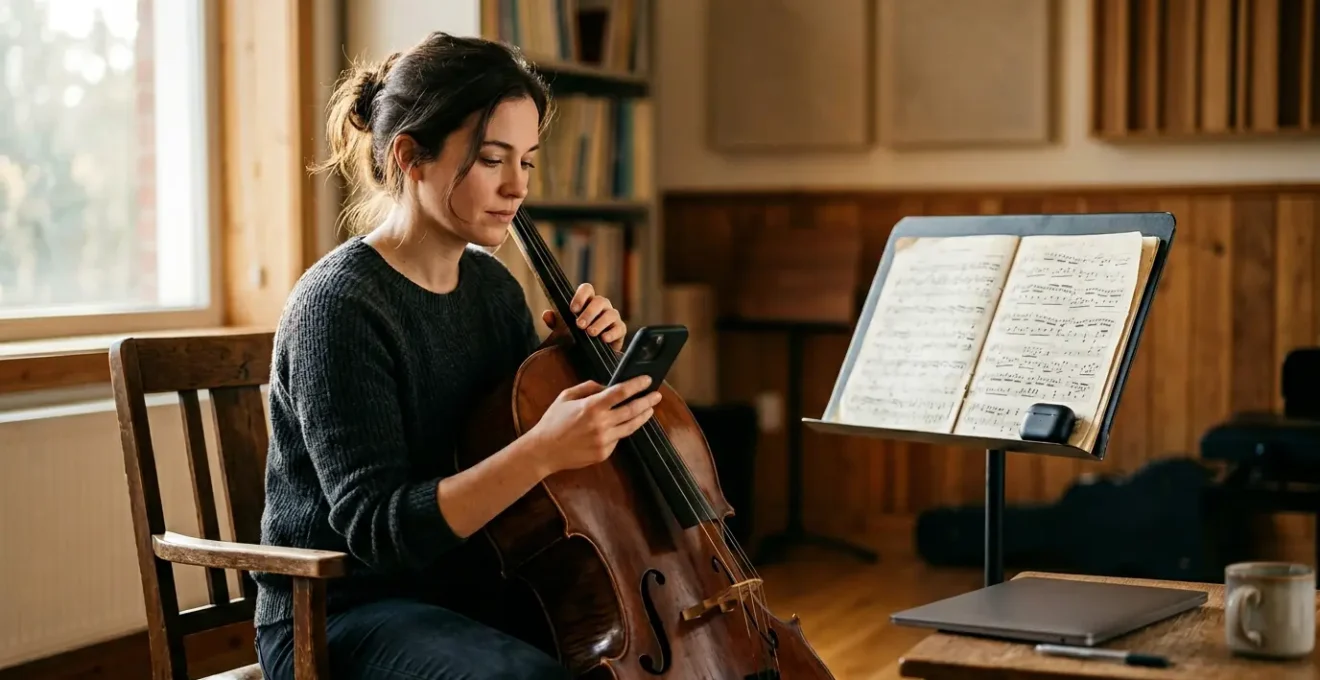
This paragraph explains the delicate equilibrium between artistic practice and digital marketing. The image below captures this concept, showing the tools of art and communication coexisting in the same creative space, suggesting integration rather than competition.
The key is to integrate content creation into your existing artistic workflow, not to treat it as a separate, time-consuming chore. Frame it as a byproduct of your art. The hours you spend in the practice room are not just for you; they are a source of compelling content. A short clip of you working through a difficult passage, a post explaining your research into a composer’s life, or a live Q&A about your upcoming program—these are all authentic, valuable pieces of content that reinforce your brand as a serious artist without stealing time from your core work.
Adopt a “Minimum Viable Brand” strategy: focus on doing two or three things exceptionally well rather than ten things poorly. Audit your content’s performance, see what resonates, and eliminate what doesn’t. Your time is your most valuable asset; invest it where it yields the highest artistic and strategic return.
When to release a debut recording: aligning with concert seasons
A debut recording is a monumental milestone in a soloist’s career. It is your artistic statement, your calling card, and a permanent testament to your work. However, its impact can be maximized or nullified by one crucial factor: timing. Releasing an album into a vacuum is a wasted opportunity. The most successful releases are not isolated events; they are the central pillar of a broader, integrated strategic plan, carefully aligned with your performance calendar.
The old model of “record, release, and hope for reviews” is obsolete in the digital age. Today’s landscape, where research from the Royal Philharmonic Orchestra reveals that 64% of adults say music streaming sites have fundamentally changed their relationship with music, demands a more dynamic approach. Your album is not just a product; it’s a content engine and a narrative driver. The ideal time to release it is just ahead of, or during, a significant period of concert activity, particularly if those concerts feature repertoire from the album.
This creates a powerful synergistic loop. The album release generates press and online buzz, which helps sell tickets for your upcoming concerts. The concerts, in turn, become live promotional events for the album, driving streams and sales. You can offer signed copies at the merchandise table, and your performance provides a powerful, emotional context for the recorded work. This alignment allows you to dominate the conversation around your work for a sustained period, building momentum that a standalone release could never achieve.
Therefore, the decision of when to release should be made in close consultation with your agent and any presenters you are working with. Plan at least 12-18 months in advance. Coordinate your recording schedule with your booking season to ensure the album lands at a moment of maximum visibility and relevance. A strategically timed release transforms a recording from a simple document into a powerful career-building event.
Why charging by the hour penalizes efficient designers?
At first glance, this question from the world of graphic design seems irrelevant to a classical soloist. But it contains a profound strategic lesson about value. When a designer charges by the hour, they are paid for their time. The faster and more skilled they become, the less they earn for the same result. This model punishes expertise and efficiency. The lesson? You should be compensated for your value, not your time.
Now, apply this to your career. When you set a fee for a performance, are you thinking about the hours of rehearsal? Or are you thinking about the unique experience you are delivering, the years of accumulated mastery, the emotional impact on the audience, and the prestige your name brings to the concert series? Charging for your time—be it for a recital, a masterclass, or a collaboration—is the musician’s equivalent of the designer’s hourly rate. It devalues your unique artistic contribution and turns your gift into a commodity.
Value-based pricing means understanding the total worth you bring to a presenter. This includes not only your performance but also your brand’s ability to attract an audience, your willingness to participate in pre-concert talks, and your social media reach. An emerging artist might command a lower fee, but a soloist with a powerful brand and a proven ability to sell tickets delivers far more value than just the 90 minutes they are on stage. They are a strategic partner in the success of the event.
This shift in mindset is crucial. Stop thinking of your fees as compensation for your labour. Start thinking of them as an investment a presenter makes to access your unique artistic equity—the tangible value your brand and artistry bring to their stage.
Company Route vs Freelance Portfolio: which school prepares you better for today’s market?
Again, let’s borrow a powerful analogy, this time from the career paths of other creatives. The “company route” is like taking a tenured position in a top orchestra—it offers stability, a steady paycheck, and a built-in institutional brand. The “freelance portfolio” route is the path of the modern soloist—a dynamic, self-directed career built project by project, collaboration by collaboration. Neither is inherently better, but they require fundamentally different branding strategies.
The artist on the “company route” builds their reputation within a larger, established structure. Their brand is linked to the institution’s prestige. Their career progression is often linear and internal. While they still have a personal brand, it’s developed in the context of a collective identity. This path prioritizes depth of expertise within a specific framework.
The soloist, however, is the CEO of their own “freelance portfolio” career. Your brand *is* the business. You need a brand strong enough to stand on its own, recognizable and compelling to a wide range of partners—from festival directors and chamber groups to record labels and universities. This path requires agility, entrepreneurial spirit, and a brand that is both consistent in its core values and flexible enough to adapt to diverse projects. It’s about building a portfolio career where each engagement adds a new, interesting layer to your overall brand story.
Most conservatoires are excellent at preparing you for the technical demands of either path. However, the “freelance” or soloist path requires an additional skill set in marketing, networking, and strategic planning that is often self-taught. Understanding which path you are on—or which you aspire to—is critical. It will dictate how you build your biography, what you post on social media, and how you define your long-term career goals.
Key takeaways
- Your agent is a partner, not a replacement for your own branding efforts. You must control your own narrative.
- An artist biography should be a compelling story that communicates your unique value, not just a list of achievements.
- While virtuosity is essential, it is your unique artistic interpretation that builds a loyal audience and sells tickets.
Contemporary Dance Training in the UK: Which Conservatoire Suits Your Style?
Our final lesson comes from the world of contemporary dance. An aspiring dancer in the UK doesn’t just choose the “best” conservatoire; they choose the one that best aligns with their physical style, artistic philosophy, and career aspirations. A school known for its athletic, commercial style (like Urdang) attracts a different dancer than one known for its avant-garde, conceptual approach (like London Contemporary Dance School). The choice of school is a dancer’s first major branding decision. It signals to the world what kind of artist they aim to be.
This is the ultimate lesson in brand alignment for a soloist. Just as a dancer chooses a school, you must strategically choose your partners. The festivals you play, the composers you champion, the record label you sign with, and even the musicians you collaborate with are all part of your brand narrative. Performing at a cutting-edge new music festival sends a different brand signal than a residency at a traditional summer festival. Neither is “better,” but they communicate different things about your artistic identity.
Building a powerful brand is about making a series of coherent choices. When your choice of repertoire, your visual identity, your biography, and your performance partners all tell the same consistent story, your brand gains immense power and clarity. This alignment makes it easy for your ideal audience and collaborators to find you and understand what you stand for. It removes ambiguity and replaces it with a clear, compelling artistic identity.
Your career is a curated collection of these choices. Look at every opportunity through the lens of brand alignment: “Does this engagement reinforce the story I am trying to tell? Does it move me closer to the artist I want to be known as?” When the answer is consistently “yes,” you are no longer just building a career; you are building a legacy.
Now that you have the strategic framework, the next step is to conduct a full audit of your own brand. Systematically review your online presence, your biography, and your past engagements to identify areas of misalignment and opportunity. Begin today to make the conscious, strategic choices that will transform your artistic talent into a sustainable, impactful career.