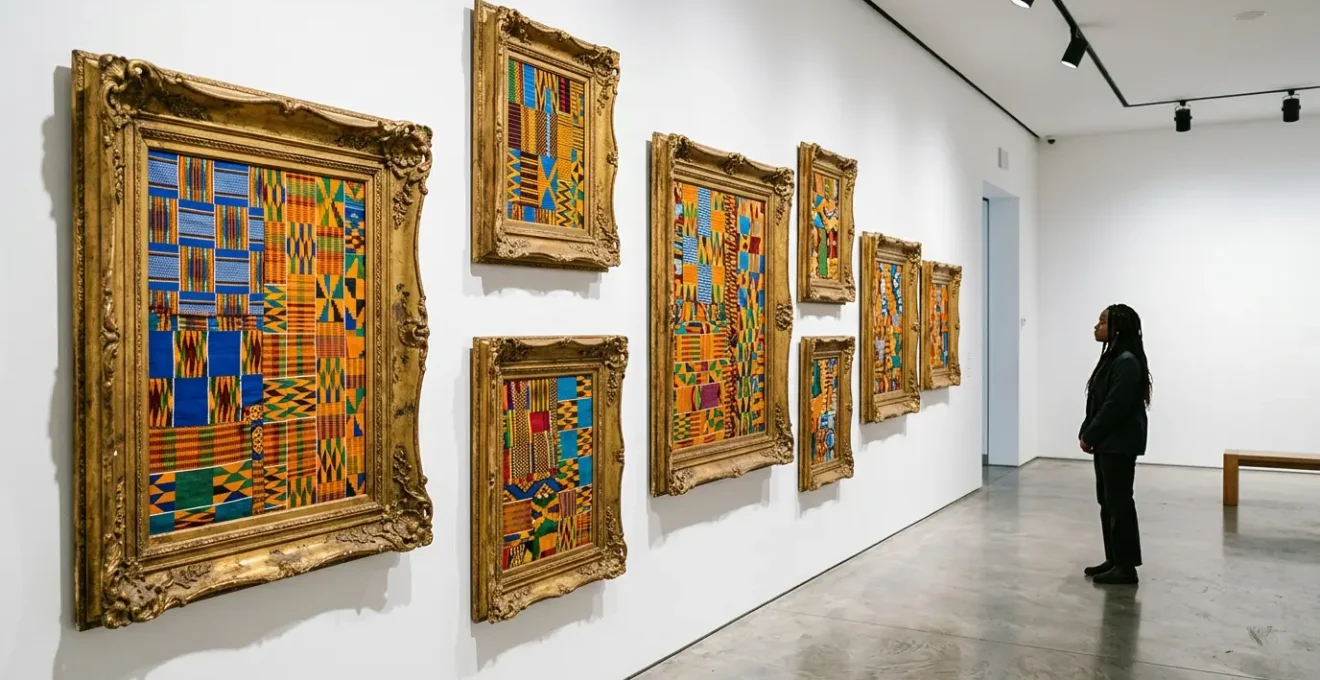
The rise of “hybrid” art is not a simple blending of cultures; it’s a deliberate act of aesthetic insurgency against colonial narratives.
- Artists are not just mixing styles; they are using “critical fabulation” to rewrite histories that have been silenced or ignored.
- This requires a new framework for evaluation from curators and collectors, moving beyond surface aesthetics to understand an artwork’s philosophical depth and political strategy.
Recommendation: Instead of asking “What cultures does this represent?”, begin by asking “What historical narrative is this work dismantling or rebuilding?”
The term ‘hybridity’ has become ubiquitous in the British art world, particularly when discussing the work of diaspora artists. It is often presented as a celebratory “melting pot”—a harmonious fusion of cultures creating a vibrant, new aesthetic. This comfortable narrative, however, misses the point entirely. It pacifies what is, in reality, a deeply strategic and often confrontational act of cultural and historical reclamation. The artists gaining prominence today are not merely mixing styles; they are engaged in a form of aesthetic insurgency.
This work moves beyond simple representation or exploring one’s identity. It employs what can be termed critical fabulation: the act of using artistic practice to fill the voids and challenge the biases of the official colonial archive. These artists are hijacking the very language and tools of the institutions that historically excluded or exoticised them—museum classification, portraiture, historical documents—to deconstruct and reassemble the narrative of Britishness itself. They are not adding a new chapter to the story of British art; they are questioning who holds the pen.
This shift demands a more sophisticated engagement from all of us, from curators and collectors to students and the gallery-going public. To truly understand this work, we must move past the surface of fusion and learn to recognise the strategies at play. This analysis will unpack these mechanisms. It will explore how artists are weaponising hybridity, how institutions can present these complex histories without defanging them, and how we can develop a critical framework to evaluate art that is designed not just to be seen, but to be questioned.
To navigate this complex and evolving landscape, this article provides a structured analysis of the key questions and strategies at play. The following sections will guide you through the dominant themes, the ethical considerations for collectors, and the practical methods for evaluating this vital new wave of conceptual art.
Summary: Decoding the New Aesthetics of British Art
- Why is ‘hybridity’ the dominant theme in this year’s Turner Prize shortlist?
- How to present colonial histories alongside modern fusion works without causing offence?
- Cultural Exchange vs Appropriation: where is the line for white collectors?
- The diversity mistake of buying one ‘fusion’ piece to tick a box
- How to use fusion art to engage younger, diverse audiences in galleries?
- How to question a conceptual artist to test the depth of their philosophy?
- Why does keeping the original setting alienate 60% of young viewers?
- Conceptual Artist or Charlatan: How to Evaluate Non-Visual Art for Collection?
Why is ‘hybridity’ the dominant theme in this year’s Turner Prize shortlist?
The prominence of ‘hybridity’ in major awards like the Turner Prize is not an aesthetic trend but a reflection of a deeper philosophical inquiry. It signals a generational shift where artists are moving beyond simply ‘representing’ their heritage. Instead, they are using the space between cultures as a critical zone to dismantle established narratives. The work is hybrid not because it mixes materials from India and the UK, for example, but because it interrogates the very historical and political relationship that connects those two places. It is a calculated response to a history of classification and control.
This approach is less about creating a harmonious blend and more about asking profoundly unsettling questions. As Turner Prize nominee Jasleen Kaur’s work suggests, the focus is on the power dynamics of storytelling. In her exhibition commentary, she builds on post-colonial arguments, pointedly asking: ‘Who is doing the writing of history?’ This question is the engine of contemporary hybrid art. It’s a refusal to accept the colonial archive as complete or objective, and an assertion of the right to write back into it, to disrupt it, and to create new meanings from its fragments.
Case Study: Pio Abad’s ‘Critical Fabulation’
Artist Pio Abad’s work is a masterclass in this strategy. His exhibition ‘To Those Sitting in Darkness’ directly references Mark Twain’s 1901 essay criticising the US conquest of the Philippines. Abad doesn’t just make art about this history; he performs a “forensic reconstruction and critical fabulation.” He digs into archives, unearths suppressed stories of oppression and corruption, and re-presents them within the gallery space. This is not passive hybridity; it is an active, research-based practice of historical intervention, using the gallery as a forum for truths the history books have omitted.
Therefore, hybridity dominates because it is the most potent tool available for artists engaged in this form of institutional and historical critique. It allows them to operate within the system while simultaneously subverting its logic, creating works that are aesthetically engaging but ideologically explosive.
How to present colonial histories alongside modern fusion works without causing offence?
The question of “causing offence” is often a misplaced anxiety, masking a deeper fear of disrupting the comfortable, often sanitized, narratives that traditional museums have perpetuated. A more productive question is: “How can we create a space for productive discomfort?” The goal of this art is not to be easy. Its purpose is to challenge, to provoke thought, and to expose the uneasy truths embedded within colonial history. To shy away from this is to do a disservice to the artist and the audience. Presenting these works effectively means leaning into the tension they create.
Consider the power of absence. Instead of a direct confrontation, an artist might create an intervention that highlights what is missing from the traditional museum display—the voices, the stories, the bodies of the colonised. This strategy, as suggested by the image of empty frames, doesn’t erase history but rather makes its omissions deafeningly loud. This can be more powerful than a didactic label. It invites the viewer to question the very nature of the collection, to ask, as one Art UK editorial on postcolonial art suggests, who the “true winners” of colonial enterprises really were.
This approach carries institutional risk. Many museums are deeply reliant on an older, traditional visitor base and donor class. Indeed, an industry report highlights that 30% of museum revenue comes from private donors, a demographic that often overlaps with the most frequent visitor group (the 60+ age bracket). Alienating this core audience with challenging work is a real financial concern. However, failing to engage with these histories is a greater failure of relevance and ethics, guaranteeing institutional obsolescence.
Cultural Exchange vs Appropriation: where is the line for white collectors?
For collectors, particularly white collectors, navigating the world of post-colonial and diaspora art presents a significant ethical challenge. The line between appreciation and appropriation is a constant point of negotiation, and the fear of misstepping can lead to inaction. However, the distinction is not mystical; it is rooted in power, context, and credit. Appreciation involves a deep engagement with a culture, learning its history, respecting its symbols, and, crucially, ensuring that the original creators and communities benefit. Appropriation, in contrast, involves stripping cultural elements of their context for aesthetic gain, often by a dominant culture from a marginalized one, without consent or compensation.
The key is to shift the mindset from one of acquisition to one of stewardship and support. A responsible collector is not just buying an object; they are investing in an artist’s career, a gallery’s program, and a community’s voice. This requires due diligence that goes far beyond authenticating the artwork itself. It requires authenticating the *relationship* between the artwork, its creator, and its cultural origins. It means asking difficult questions about the provenance, not just of the object, but of the ideas within it.
For collectors seeking to engage ethically, a clear framework is needed. It’s not about a simple “yes” or “no,” but a nuanced process of self-interrogation and research. The following checklist provides a practical guide to evaluating a potential acquisition, ensuring that your collection is built on a foundation of respect and genuine exchange, not exploitation.
Your Action Plan: The Ethical Provenance Framework
- Power Imbalance Assessment: Honestly evaluate if there’s a significant power difference between the culture of the artist and your own. Appropriation is most problematic when it flows from a dominant culture benefiting from a marginalized one.
- Context and Meaning Check: Have you researched the original meaning and context of the cultural elements in the work? Ensure they are not being trivialized, distorted, or used in a way that would be disrespectful to the source community.
- Consent and Credit Verification: Does the artist have a legitimate connection to the culture they are referencing? Is credit being given where it’s due, and is the source community, where applicable, involved or consenting to this use?
- Impact and Harm Evaluation: Consider if this type of work, or its acquisition by you, could cause harm. Does it reinforce harmful stereotypes? Does it create economic disadvantage for the original creators by devaluing their authentic work?
The diversity mistake of buying one ‘fusion’ piece to tick a box
One of the most pervasive traps for well-intentioned institutions and collectors is tokenism: the acquisition of a single “fusion” piece to check the diversity box. This approach fundamentally misunderstands the nature of the art. It treats a complex, deeply researched, and often painfully personal work as a decorative symbol of inclusivity. This not only devalues the specific piece but also ignores the systemic issues the artwork is often designed to critique. A single acquisition does not decolonise a collection; in many cases, it merely serves to inoculate the institution against deeper, more meaningful change.
These artworks are not interchangeable. They are the product of specific histories, personal journeys, and rigorous intellectual labour. To treat them as a generic category of “diverse art” is to replicate the very colonial practice of categorising and flattening complex cultures into manageable, exotic objects. The power of this art lies in its specificity. When a curator or collector acquires a piece, they are not just acquiring a style; they are taking on the responsibility of understanding and conveying the intricate web of references and critiques embedded within it.
Case Study: The Layered Parody of Yinka Shonibare
Consider the work of Yinka Shonibare. His use of “African” wax-print fabrics to dress headless mannequins in Victorian attire is a quintessential example of hybrid art. A surface-level reading sees a colourful fusion. But the depth is in the details: the fabric is not authentically African but was mass-produced by the Dutch, based on Indonesian batik designs, and sold in West Africa. It is a symbol of complex global trade and colonial relationships. As Shonibare himself states, “Victorian for me actually means conquest and imperialism. And the way to confront my fear was to actually parody that fear.” His work is a multi-layered confrontation with history, identity, and fear. To reduce this to a “fusion piece” is to miss its entire critical genius.
A genuine commitment to diversity in collecting is not about sprinkling a few “ethnic” pieces into a predominantly white, European collection. It is about fundamentally re-examining the collection’s core narrative and being prepared to acquire works that actively challenge and complicate that narrative from within.
How to use fusion art to engage younger, diverse audiences in galleries?
For galleries seeking to survive and thrive, engaging younger, more diverse audiences is not a choice but a necessity. The complex, multi-layered nature of fusion art, while challenging for some, is actually a powerful gateway for these demographics. This is an audience raised on remixes, mashups, and digital culture; they are fluent in the language of hybridity. The key is to move beyond the static “white cube” presentation and embrace interactive, dialogic, and digitally-integrated methods of engagement.
Technology, when used thoughtfully, can be a bridge. It can provide layers of context without cluttering the gallery walls with text. Imagine using augmented reality to overlay historical photos, text translations, or artist interviews onto a physical object. The use of virtual reality can also be transformative. For example, a report on museum technology notes that The Cleveland Museum of Art’s VR implementation shows a 30% uptick in younger demographics engaging with their collections. These tools don’t replace the art; they provide new, intuitive pathways into its complex world.
Engagement, however, is not just about technology; it’s about community and conversation. The most successful strategies are those that turn the gallery from a place of quiet reverence into a site of active dialogue. This means programming events that are directly relevant to the themes in the art and the communities it speaks to and about. It requires a strategic and authentic presence on the platforms where these audiences already congregate.
Galleries can no longer afford to be passive repositories. By leveraging the inherent dynamism of fusion art and adopting modern engagement strategies, they can transform themselves into vital hubs for cultural conversation, connecting with the next generation of art lovers and creators on their own terms.
How to question a conceptual artist to test the depth of their philosophy?
Evaluating the depth of a conceptual artist’s philosophy requires moving beyond “What does it mean?” to “How does it work?” A sophisticated conceptual practice is not just about having a big idea; it’s about the rigor, intentionality, and strategic intelligence with which that idea is executed. The work’s power lies in the “how”—the specific choices of material, form, and context that the artist deploys to activate their concept. Your line of questioning, therefore, should be aimed at unpacking these strategic choices.
A useful theoretical lens is Homi K. Bhabha’s concept of mimicry as a ‘strategic reversal of the process of domination’. As Bhabha outlines in his seminal work on postcolonial theory, this is a strategy “which appropriates the Other as it visualizes power.” In an artistic context, this means the artist deliberately adopts the forms and language of the dominant culture or institution—not to assimilate, but to expose and subvert its internal contradictions. Your questions should probe for this strategic intent. Ask the artist why they chose a specific form associated with colonial power (e.g., the historical portrait, the ethnographic display, the legal document) and how they are subverting it.
Case Study: Pio Abad’s Satirical Acquisition Numbers
Pio Abad’s series of drawings, titled with museum acquisition numbers like ‘1897.76.36.18.6, n.1’, perfectly illustrates this. Each work depicts a Benin Bronze alongside a mundane object from his own life, like a Nutella pot or an ultrasound scan of his daughter. The title itself is a piece of conceptual art, mimicking the cold, bureaucratic language of the museum to classify objects of immense cultural trauma alongside items of intimate, personal value. This forces the viewer to confront the absurdity and violence of the museum’s “machinations.” Abad stated this reminds viewers that all relics are intimately tied to real people. A good question for him would not be “Why a Nutella pot?” but rather, “What is the function of placing the museum’s own codification system in the title of the work?”
To test an artist’s depth, focus your questions on the mechanics of their strategy. Ask about their research process, their choice of materials as symbolic agents, and their understanding of the context in which the work will be seen. A charlatan has a vague idea; a rigorous conceptual artist has a strategy, and they can articulate it.
Why does keeping the original setting alienate 60% of young viewers?
The assertion that traditional museum settings alienate a majority of young viewers is not hyperbole; it is the observable outcome of a profound cultural and economic disconnect. The “original setting”—the grand, silent, and often intimidating halls of a traditional gallery—was designed for a different era and a different audience. Today, it acts as a significant barrier for younger and more diverse demographics, alienating them on both an emotional and a practical level. The figure, whether precisely 60% or not, points to a crisis of relevance.
The emotional barrier is one of belonging. These spaces are often perceived as exclusive, elitist, and unwelcoming. This is not just a feeling; it’s a widely reported experience. A stark survey by Avant Arte revealed that 90% of a surveyed group felt that the art world is not a welcoming or inclusive space. When a space feels like it wasn’t built for you, you are unlikely to enter it, let alone feel comfortable enough to engage deeply with the art. The hushed reverence, unwritten rules of conduct, and perceived intellectual barrier create a sense of being an outsider, which is the antithesis of a meaningful cultural experience.
The second barrier is intensely practical and economic. The traditional museum visit—requiring travel, admission fees, and significant leisure time—is a luxury that many cannot afford. As research from Arts Professional reveals, the cost-of-living crisis has had a disproportionate impact on the leisure activities of younger audiences and those in less affluent areas. When choosing how to spend limited time and money, a potentially alienating trip to a museum often loses out to more accessible and guaranteed forms of entertainment and connection.
The “original setting” is therefore not a neutral backdrop. It is an active agent of exclusion, reinforcing cultural and economic barriers that keep new audiences away. Breaking this cycle requires a radical rethinking of the museum environment, from its architecture and atmosphere to its pricing and programming.
Key Takeaways
- Hybridity as a Critical Tool: Understand that fusion in post-colonial art is rarely about harmony. It is a deliberate strategy to critique, deconstruct, and rewrite historical narratives.
- Ethics Beyond Aesthetics: For collectors and curators, ethical engagement means moving beyond the object’s appearance to rigorously investigate its context, the artist’s intent, and the power dynamics at play.
- Institutional Disruption is the Goal: The most vital contemporary art is not made to sit comfortably within the museum’s existing framework. It is designed to challenge it, forcing institutions to confront their own histories and biases.
Conceptual Artist or Charlatan: How to Evaluate Non-Visual Art for Collection?
The ultimate question for any collector or curator faced with conceptual art, especially non-visual or hybrid forms, is one of value: is this a work of profound intellectual depth or a case of the emperor’s new clothes? The framework developed throughout this discussion—focusing on strategy, research, and institutional critique—provides the tools to make this distinction. A “charlatan” offers a vague concept with little substance, relying on ambiguity to feign depth. A true conceptual artist, however, demonstrates rigor, intentionality, and a deep understanding of the systems they are engaging with. The value is not in the object, but in the precision of the intellectual and aesthetic intervention.
Ultimately, the responsibility for discerning this value lies with the institutions and collectors themselves. As Lehmann Strobel points out, museums have a unique ethical burden: “Their reputations depend on maintaining the highest ethical standards… museums must weigh the ethical implications of their actions to a far greater extent than their private counterparts.” This means that the act of collecting post-colonial conceptual art is itself a test of the institution’s integrity. To acquire a work that critiques colonial history is to publicly commit to engaging with that critique. It is an act of institutional self-reflection.
The urgency of this self-reflection is made starkly clear by the data. The art world must ask itself who it is for. If it continues to cater only to its traditional base, it is choosing cultural irrelevance. The demographic data for museum visitors provides a sobering reality check on the current state of affairs.
The table below, based on recent survey data, shows a clear pattern of visitor demographics across different types of museums. For art museums in particular, the data highlights a significant lack of diversity among their core, frequent visitor base, which underscores the systemic challenge that the artists discussed here are confronting. A collection’s value in the 21st century will be measured not just by its masterpieces, but by its courage to reflect and challenge the world we live in.
| Museum Type | % White Frequent Visitors | Most Diverse Casual Visitors |
|---|---|---|
| Art Museums | 85% | African American/Black & Asian |
| Natural History | 81% | Asian/Asian American |
| Science Centers | 79% | Asian/Asian American |
| Children’s Museums | 76% | More diverse overall |
Applying this critical lens is the essential next step. It involves actively seeking out these works, engaging with their challenging questions, and supporting the artists and institutions brave enough to dismantle the old aesthetics and build something new in their place.