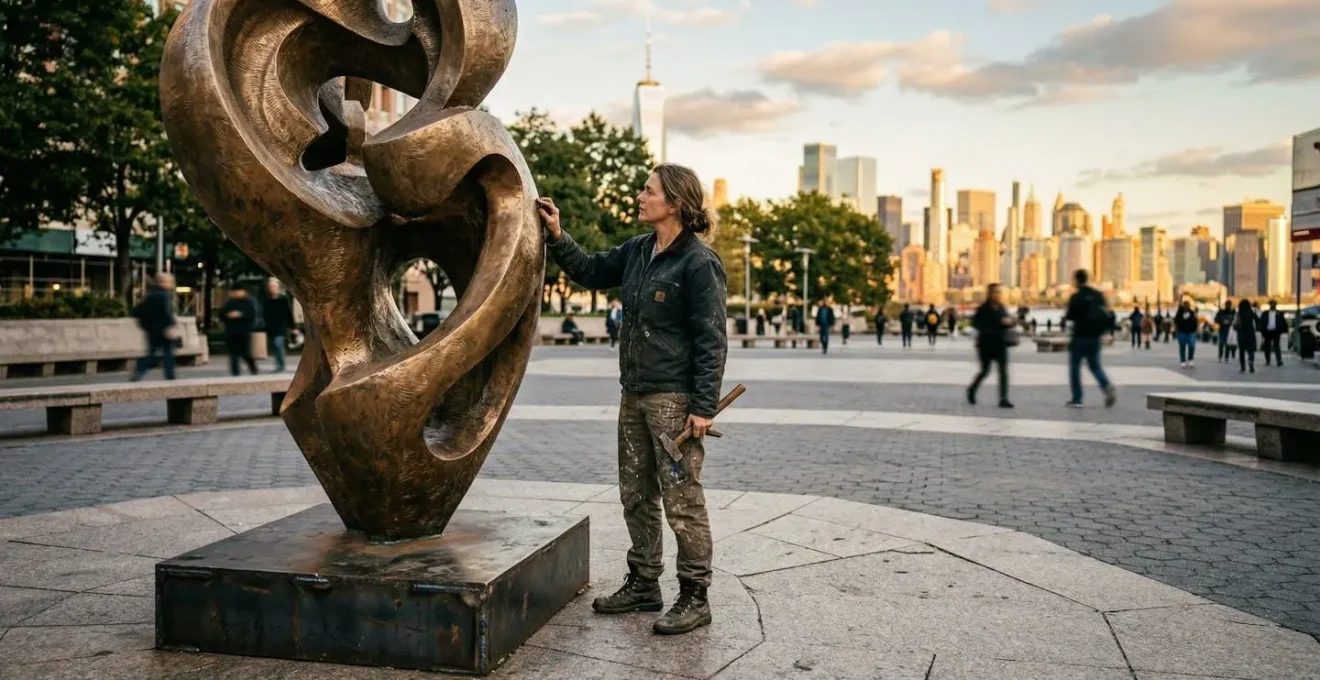
Commissioning public sculpture is not an act of patronage but a strategic investment in civic infrastructure that carries quantifiable returns and procedural risks.
- Successful projects begin with a robust business case, demonstrating a clear return on investment through increased local economic activity and tourism.
- The greatest risks—public backlash and budget overruns—are mitigated through structured community engagement and rigorous lifecycle costing of materials from the outset.
Recommendation: Shift focus from simply “choosing art” to managing the procurement, planning, and long-term maintenance of a valuable public asset.
For a local council, developer, or public art officer, the prospect of commissioning a new sculpture can feel like a daunting civic duty. The public narrative often oscillates between celebrating cultural enrichment and scrutinising the use of public funds. It’s a process fraught with potential pitfalls: budget debates, planning hurdles, and the ever-present risk of a piece that fails to resonate with the very community it’s meant to serve. The standard advice often revolves around vague notions of “finding a good artist” or “engaging the community,” but these platitudes offer little practical guidance for navigating the bureaucratic realities of public procurement and long-term asset management.
The truth is that commissioning a significant piece of public art has less in common with a gallery acquisition and more with a small-scale infrastructure project. It demands a shift in mindset. But what if the key to success wasn’t just about artistic taste, but about mastering a strategic and procedural framework? What if we treated sculpture not as a mere decoration, but as a long-term civic asset with a predictable lifecycle, a measurable return, and manageable risks? This guide moves beyond the abstract to provide an operational framework for commissioners. It is designed to de-risk the process, from calculating initial ROI and writing a bulletproof ‘Open Call’ to planning for 20 years of maintenance and securing the necessary funding.
This article provides a step-by-step walkthrough of the strategic considerations involved in a successful public art commission. We will explore the economic justification, the procurement process, material selection, community engagement, planning timelines, and the crucial aspects of funding and long-term preservation.
Summary: A Strategic Framework for Public Sculpture Commissioning
- Why does a £50k sculpture generate more than that in local tourism value?
- How to write an ‘Open Call’ that attracts serious sculptors, not hobbyists?
- Corten Steel vs Stone: which resists graffiti and weather better in a city centre?
- The community engagement mistake that gets a sculpture petitioned for removal
- When to apply for planning permission: the timeline most commissioners underestimate
- Why are photos of mundane high streets becoming valuable historical records?
- Why is the National Lottery Heritage Fund the primary target for community assets?
- Preserving Artistic Heritage: Funding Restoration in Listed Buildings?
Why does a £50k sculpture generate more than that in local tourism value?
Before a single concept is sketched, the primary challenge is justifying the expenditure. A £50,000 sculpture is not a cost; it is an investment in the public realm with a measurable economic return. The first step in any successful commission is to build a robust business case that frames the artwork as a catalyst for local economic activity. This moves the conversation from “Can we afford this?” to “What is the projected return on this investment?” It’s a language that resonates with finance departments and skeptical taxpayers alike.
The value is generated through several channels: increased footfall for local businesses, “art tourism” from outside the immediate area, and enhanced place-making, which can boost property values and attract further investment. Compelling evidence supports this. For example, broad research by the Urban Institute demonstrates that public art investments can generate between $1.50 and $3.00 in economic activity for every dollar spent. This isn’t abstract value; it’s tangible revenue for cafes, shops, and other local enterprises.
These figures are proven by real-world projects that function as powerful precedents for any commissioning body.
Case Study: New York City Waterfalls Economic Impact
A prime example of a major return on investment is Olafur Eliasson’s temporary installation, the New York City Waterfalls. Despite a significant installation cost of $15.5 million, the project attracted an estimated 1.4 million visitors and generated $69 million in economic impact for the city. This represents a staggering 4.6x return, driven entirely by increased tourism and local spending directly attributable to the public artwork.
While a council’s project may be on a smaller scale, the principle remains the same. A well-sited, engaging sculpture becomes a destination, a landmark, and an economic engine. The initial £50k investment is the seed capital for a much larger, sustained return to the community.
How to write an ‘Open Call’ that attracts serious sculptors, not hobbyists?
Once the investment is justified, the quality of the final artwork hinges on the quality of the artist. Attracting top-tier, professional sculptors over enthusiastic hobbyists is not a matter of luck; it is a direct result of a rigorous and professional procurement process. The ‘Open Call’ or ‘Invitation to Tender’ is your single most important tool. A vague or simplistic brief signals a lack of seriousness and will deter established artists who cannot risk their time on an ill-defined project. Conversely, a detailed, professional brief signals that you are a serious commissioner.
A robust Open Call must go far beyond a simple thematic prompt. It should function as a comprehensive project document, clearly outlining the following: a clear budget (including whether it is inclusive of VAT, foundations, and installation), a detailed site analysis (including plans, photos, and access constraints), a project timeline, public liability insurance requirements, and the specific deliverables for each stage (maquette, final design, fabrication). This level of detail ensures procurement integrity and provides artists with the confidence to invest their time in a credible proposal.
This professionalism is a two-way street. Serious artists expect a serious process, as their livelihood depends on it. They are running businesses and need to assess the viability and risk of a commission just as the council does.
The document you produce is a direct reflection of the calibre of partner you seek. A professional brief respects the artist’s time and expertise, asking for a detailed expression of interest and portfolio review at stage one, before requesting speculative design work from a smaller, paid shortlist at stage two. This tiered approach is standard industry practice and is crucial for attracting sculptors with a track record of delivering major public works on time and on budget.
Corten Steel vs Stone: which resists graffiti and weather better in a city centre?
The choice of material for a public sculpture is not merely an aesthetic decision; it is a long-term financial and operational commitment. An officer commissioning a work must think beyond the day of the unveiling and consider the lifecycle costing of the piece over decades. A material that looks spectacular on day one but requires costly, specialist maintenance or is easily vandalised can quickly become a financial burden and a public eyesore. The two most common choices for large-scale works, Corten steel and natural stone, present very different profiles in an urban UK environment.
Corten, or weathering steel, is often favoured for its evolving, industrial aesthetic. Its key advantage is the stable, rust-like layer it develops when exposed to the elements, which acts as a protective coating. This patina is self-healing to a degree, meaning minor scratches and even some types of graffiti can become obscured as the surface continues to weather. For instance, high-quality weathering steel develops its signature protective coating within approximately six months, after which its maintenance needs are minimal. Natural stone, such as granite or limestone, offers a sense of permanence and gravitas but is more vulnerable. Porous stones can be susceptible to staining from pollution and require specialist, often harsh, chemical treatments to remove graffiti, which can damage the stone’s surface over time.
The following table provides a clear comparison of the key factors a commissioner must weigh when considering materials, including a look at modern composites which offer a different cost-benefit profile.
| Material Property | Corten Steel | Natural Stone | Modern Composites (Jesmonite/GRP) |
|---|---|---|---|
| Initial Cost | High (£30k-50k for 3m sculpture) | Very High (£100k+ for granite/marble) | Moderate (£15k-30k) |
| Graffiti Resistance | Self-healing patina helps mask tags | Requires specialist removal chemicals | Surface can be pre-treated |
| Weather Resistance | Forms protective rust layer | Excellent but can stain/erode | UV degradation after 10-15 years |
| Maintenance Cost (20yr) | Minimal – patina self-maintains | High – regular sealing required | Moderate – periodic recoating |
| Texture Deterrent | Smooth surfaces vulnerable | Rough textures deter tagging | Can incorporate anti-graffiti texture |
Ultimately, the decision must balance the artist’s vision with the council’s operational capacity. Corten steel often represents a lower long-term maintenance burden, while a rough-textured granite might offer a better initial deterrent to graffiti. A thorough risk assessment of the specific site—considering factors like visibility, lighting, and local history of vandalism—is essential before any material is finalised.
The community engagement mistake that gets a sculpture petitioned for removal
Public art is, by definition, for the public. The single greatest risk of project failure is not budget or materials, but public rejection. A sculpture that is perceived as having been “imposed” upon a community without consultation is almost destined to attract controversy and, in the worst cases, petitions for its removal. The most common mistake commissioners make is misunderstanding what meaningful engagement truly is. It is not a beauty pageant where residents vote on pre-selected designs.
True, effective engagement is about co-creation of the narrative, not the final form. The goal is to create a sense of collective ownership. This means involving the community at the very earliest stage to define the *story* the artwork should tell. What local history should it celebrate? What future aspiration should it represent? What forgotten hero or industry should it commemorate? As research into successful projects like the Gromit Unleashed trails in Bristol shows, allowing the community to define the purpose and theme creates a powerful foundation of support. Once the story is owned by the community, they are far more invested in and accepting of the artist’s interpretation of that story.
Engaging the “silent majority” beyond the usual vocal community council members is a significant challenge. It requires proactive and creative outreach tactics that meet people where they are, both physically and digitally. Holding a poorly attended daytime meeting in a town hall is not sufficient.
Action Plan: Engaging the Silent Majority
- Set up consultation stalls with visual aids at local supermarkets or transport hubs during peak hours to capture a broad cross-section of residents.
- Partner with local primary and secondary schools to run workshops, gathering input from young people and, by extension, their parents.
- Utilise geographically targeted social media ads (e.g., Facebook, Instagram) within specific postcodes, linking to simple online surveys with visual preference tools.
- Host informal, drop-in evening sessions in accessible community venues like pubs or libraries to accommodate working residents.
- Create engaging online surveys that prioritise visual tools and simple questions over text-heavy forms to maximise completion rates.
By investing in this deep, story-led engagement from the outset, you are not just ticking a box; you are actively mitigating the primary risk of public opposition and building a cohort of local champions for the project before a single piece of stone is carved.
When to apply for planning permission: the timeline most commissioners underestimate
Navigating the planning process is a critical, and often underestimated, hurdle in the public art commissioning timeline. Assuming that planning permission is a quick formality is a mistake that can lead to significant delays, budget implications, and friction with the selected artist. It is essential to understand both *when* to apply and *how long* the process will realistically take. The application itself is a significant milestone that requires substantial preparatory work.
According to the Public Statues and Sculpture Association, a leading authority in the UK, the timing of the application is key. As they advise:
Your application for full planning permission should be made only once you have a finished design/model from the sculptor. It is important to do this at the right stage of the process, once the basics noted above are in place.
– Public Statues and Sculpture Association, Commissioning Guidelines
This means the artist must be contracted and have produced a finalised design, complete with dimensions, material specifications, and foundation plans, before the planning application can be submitted. This work represents a significant upfront investment of time and resources for the artist, a cost that should be factored into the project’s phased budget. Attempting to secure “permission in principle” with a vague concept is rarely successful and wastes valuable time.
Furthermore, commissioners must build a realistic buffer into their project schedule. In the UK, once a valid planning application is submitted, UK local authorities typically require an 8-13 week statutory decision period for non-major developments. However, this clock only starts once the application is validated, a process that can itself take several weeks if further information is required. Therefore, a commissioner should realistically budget at least four to six months for the entire planning permission cycle, from preparing the submission with the artist to receiving the final decision. Underestimating this timeline is a common cause of project delays.
Why are photos of mundane high streets becoming valuable historical records?
Beyond its immediate aesthetic and economic impact, a public sculpture serves a deeper, long-term function: it becomes a chronological anchor in the evolving story of a place. The photographs taken on the day of its unveiling, featuring the surrounding high street, the fashions of the crowd, and the vehicles in the background, may seem mundane at the time. Yet, decades later, these images become invaluable historical records, capturing a specific moment in the life of a community. The sculpture acts as a fixed reference point against which urban change can be measured.
This role as a historical marker has been starkly illustrated in recent times. The documentation of public art projects has provided a unique lens through which to study urban transformation and social change.
Case Study: London’s Post-Pandemic Art as a Historical Marker
The ‘Bring London Together’ project, part of Mayor Sadiq Khan’s post-pandemic ‘Let’s Do London’ campaign, deployed numerous public art installations across the city. Documentation of these works did more than just promote the campaign; it created a visual timeline of the city’s recovery. Future historians studying London’s emergence from the pandemic will look to these photographs, which show the art alongside evolving social behaviours—masked crowds giving way to unmasked gatherings, empty streets becoming vibrant once more. The art installations became the chronological anchors for this period of profound urban evolution.
For a commissioning body, this understanding imparts a further responsibility: the duty to document. It is not enough to simply install the work. A comprehensive plan for its documentation and archival is essential to preserving its value as a future heritage asset. This includes commissioning professional photography of the site before, during, and after installation; capturing community reactions; and ensuring all materials, from initial sketches to fabrication photos, are archived with the relevant County Record Office or submitted to national databases like Historic England’s archive. This act of preservation ensures the sculpture’s story, and the story of its time and place, endures.
Why is the National Lottery Heritage Fund the primary target for community assets?
Securing funding is the lifeblood of any public art project. While council budgets and Section 106 agreements with developers provide foundational funding, leveraging this initial capital to unlock larger grants is the hallmark of a strategic commissioner. In the UK, the National Lottery Heritage Fund (NLHF) is often the primary and most logical target for ambitious projects, precisely because it is interested in more than just “art.” The NLHF’s remit is heritage, and a well-conceived sculpture project can align perfectly with its goals.
The key is to frame the project not as the creation of a new object, but as an activity that explores, preserves, or shares local heritage. This could involve using the sculpture’s narrative to tell a forgotten local story, reviving or showcasing traditional craft skills during its fabrication, or designing the project around community engagement with local archives and historical societies. A council’s initial investment of, for example, £50,000 is not just a contribution; it is vital ‘match funding’. The ability to demonstrate this local financial commitment is a powerful signal to the NLHF that the project has strong local backing and is viable. In fact, most National Lottery grants generally require a match funding contribution of between 10% and 50%, making the council’s stake a prerequisite for a successful application.
By positioning the project in terms of its heritage outcomes—connecting people to their past, preserving skills, and telling community stories—a commissioner can transform an art project into a compelling heritage project. This strategic alignment significantly increases the chances of securing a substantial grant that can elevate the ambition and impact of the final work, often unlocking sums two to three times the initial council investment.
Key Takeaways
- Public sculpture is a long-term civic asset, not a short-term expense. Its success depends on a strategic framework covering its entire lifecycle.
- Risk mitigation is paramount. The biggest threats—public opposition and planning delays—are managed through early, meaningful community engagement and realistic timelines.
- Funding is about leverage. A council’s initial investment is the key to unlocking larger grants from bodies like the NLHF by framing the project around heritage outcomes.
Preserving Artistic Heritage: Funding Restoration in Listed Buildings?
The commissioner’s responsibility does not end when the sculpture is unveiled and the crowds have gone home. The final, and arguably most critical, phase of managing a civic asset is planning for its long-term care and preservation. A sculpture left to degrade from weather or vandalism becomes a symbol of neglect, undermining the very civic pride it was intended to foster. This is particularly true for works situated within the curtilage of listed buildings, where standards of care are even higher. A comprehensive, fully-costed maintenance plan is not an optional extra; it is a fundamental requirement of responsible ownership.
This principle of “whole-life” responsibility is a cornerstone of professional public art management globally. As a leading arts body in the US advises, planning for the future is non-negotiable. This perspective is directly applicable to the UK context, where long-term thinking is essential for the stewardship of public assets.
A plan is required for all collections, no matter the size, and many programs require their artists to submit guidelines on the upkeep, maintenance, and material details of their work before the commission is completed.
– Americans for the Arts, Public Art Network Guidelines
This plan must be a concrete, actionable document. It should include a schedule for annual inspections by a qualified conservator (ideally from a professional register like the UK’s ICON), material-specific cleaning protocols, and emergency procedures for damage. Crucially, it must also include a 20-year budget forecast. A standard rule of thumb is to allocate 2-3% of the initial installation cost annually for ongoing maintenance and conservation. This ensures that the long-term financial commitment is understood and budgeted for from day one, preventing future funding crises and ensuring the artwork remains a source of pride for generations to come.
By embracing this strategic framework—from initial ROI calculation to long-term preservation planning—a commissioning body transforms a potentially risky expenditure into a lasting and valuable civic asset. The next logical step is to formalise this process within your own organisation’s procurement and asset management strategies.
Frequently Asked Questions on The Rise of the Modern Sculptor in Public Spaces: Commissioning for Councils?
What alternatives exist to NLHF for public art funding?
Arts Council England’s National Lottery Project Grants, the Landfill Communities Fund for projects near landfill sites, Section 106 developer agreements, and Business Improvement District (BID) levies all provide viable funding streams for public art in the UK.
How can councils leverage initial investment for larger grants?
A council’s £50k investment can serve as crucial match funding to unlock grants two to three times larger. This initial commitment demonstrates strong local support and project viability, significantly strengthening applications to national funders like the NLHF or Arts Council England.
What heritage outcomes must sculptures demonstrate for NLHF?
For a successful National Lottery Heritage Fund application, projects should demonstrate clear heritage outcomes. This can include telling forgotten local stories, preserving or showcasing traditional craft skills in the artwork’s creation, or enabling deep community engagement with local history through the sculpture’s narrative and development process.