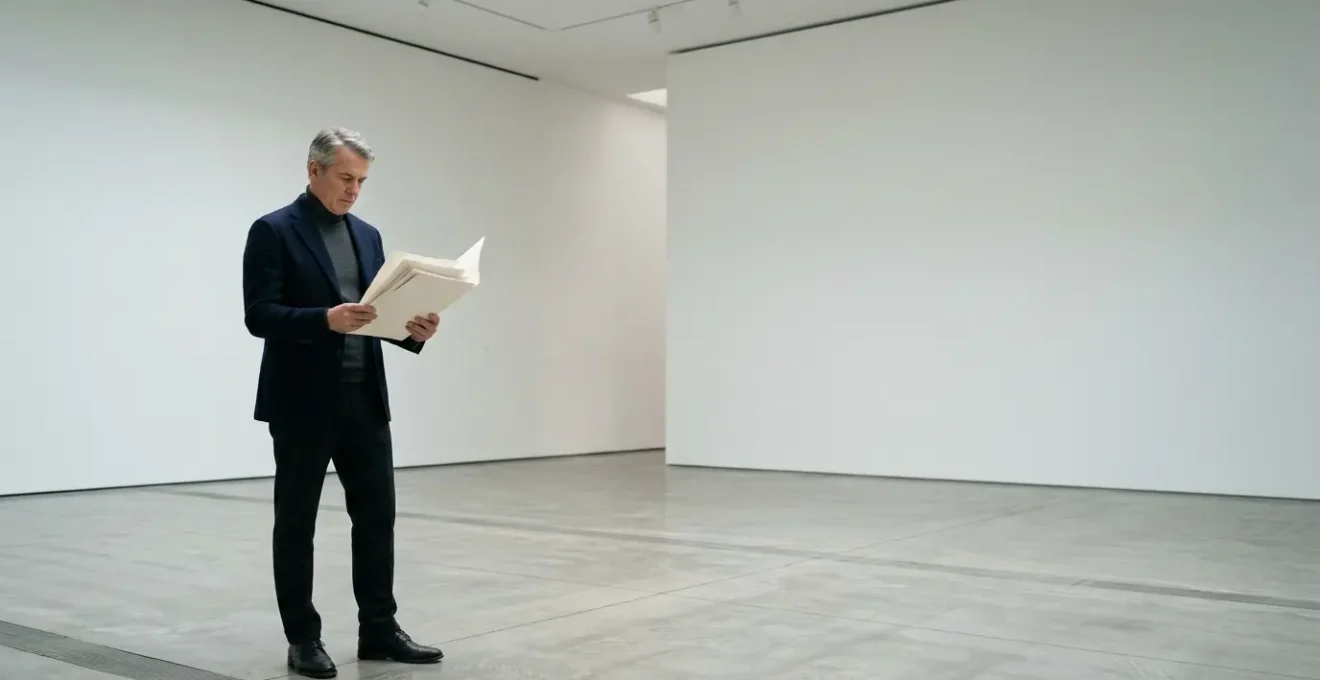
Evaluating conceptual art requires shifting the collector’s role from a connoisseur of aesthetics to a critical auditor of a philosophical system.
- The artwork’s value resides not in a physical object but in the conceptual integrity and durability of the idea, legally embodied by the Certificate of Authenticity.
- A rigorous line of questioning about the idea’s failure conditions, historical context, and potential for obsolescence is more critical than subjective appreciation.
Recommendation: Approach acquisition as an investment in a philosophical framework, not a decorative object, by stress-testing the idea before committing.
For the intellectual collector, the rise of conceptual art presents a profound epistemological challenge. When an artwork is dematerialized, existing as a set of instructions, a fleeting performance, or a mere proposition, traditional metrics of value—craftsmanship, beauty, material rarity—evaporate. The collector is left grappling with a discomfiting question: am I acquiring a groundbreaking piece of art history or simply an overpriced idea? The common advice to “read the artist’s statement” or “buy what you like” proves wholly inadequate when facing a work whose entire being is predicated on an intellectual, rather than aesthetic, foundation.
This discomfort is the very entry point to a more rigorous mode of collection. The challenge is not to find beauty in the non-object but to develop a framework for assessing the robustness of the concept itself. To mistake conceptual art for a purely subjective experience is to miss its core proposition. The work demands not passive appreciation but active intellectual engagement; a critical audit of its internal logic, its relationship to history, and its potential to endure as a significant thought-form. It requires a fundamental shift in the collector’s mindset.
This guide abandons the language of taste and preference. Instead, it offers a critical framework for evaluating non-visual and conceptual art. We will dissect the primacy of documentation, establish a methodology for interrogating an artist’s philosophy, weigh the institutional balance of idea versus craft, and analyze the tangible risks and unique display opportunities of owning an idea. The objective is to equip the collector with the tools to distinguish a durable philosophical system from a transient, shallow concept.
This article provides a structured approach to this complex evaluation. The following sections will guide you through the key criteria for assessing, collecting, and living with art that prioritizes the idea above all else.
Summary: How to Evaluate Non-Visual Art for Collection?
- Why is the Certificate of Authenticity more valuable than the object itself?
- How to question a conceptual artist to test the depth of their philosophy?
- Idea vs Craft: which matters more for future museum acquisition?
- The resale risk of buying installation art that requires a 1000 sq ft room
- How to display a conceptual instruction piece in a domestic setting?
- Why is ‘I liked it’ the death of good criticism?
- Passive Viewing vs Participatory Art: which triggers deeper self-reflection?
- Art to Provoke Introspection: Can Gallery Design Improve Mental Health?
Why is the Certificate of Authenticity more valuable than the object itself?
In the realm of conceptual art, the Certificate of Authenticity (CoA) undergoes a radical transformation. It is not merely an ancillary document verifying provenance; it is often the primary, legally binding embodiment of the artwork itself. The dematerialization of the art object shifts the locus of value from a physical artifact to a signed, notarized concept. This principle is most famously exemplified in the work of Sol LeWitt, whose wall drawings exist as instructions that can be executed, painted over, and re-executed in different locations. The only constant, and therefore the only ‘original,’ is the certificate and its accompanying diagram.
The financial implications of this shift are stark. The 2012 lawsuit involving a lost CoA for LeWitt’s Wall Drawing #448 is a landmark case. Collector Roderic Steinkamp sued Rhona Hoffman Gallery for $1.4 million in damages, arguing the loss of the certificate rendered the work essentially worthless. The court recognized that the value was inextricably tied to this single piece of paper. This is not an isolated phenomenon; according to market data, auction records from Christie’s and Phillips show values ranging from $35,250 to $254,500 for LeWitt’s certificates. The physical paint on the wall is a temporary execution; the certificate is the perpetual work.
This legal and conceptual framework was deliberately designed by the artist. LeWitt’s own standard certificate explicitly codifies this relationship, establishing a clear hierarchy where the idea and its official documentation supersede any single manifestation of the work.
This certification is the signature for the wall drawing and must accompany the wall drawing if it is sold or otherwise transferred.
– Sol LeWitt, Standard Certificate of Authenticity format
For the collector, this means the acquisition process is one of legal and conceptual due diligence. The focus is on the integrity and chain of title of the documentation, as this is the asset being acquired. The physical object becomes a secondary, and often transient, representation of the primary conceptual asset.
How to question a conceptual artist to test the depth of their philosophy?
If the artwork is a philosophical system, the collector’s primary tool of evaluation is not the eye, but the Socratic method. Engaging the artist in a critical dialogue is not an act of disrespect; it is the highest form of engagement with their work. The goal is to move beyond the surface-level artist statement and to stress-test the conceptual durability of the piece. A robust concept will not only withstand but be enriched by rigorous questioning, while a shallow one will quickly reveal its internal contradictions or lack of depth.
The discussion should be framed as an intellectual audit, probing the boundaries, resilience, and internal logic of the idea. This is not about asking “what does it mean?” but rather “how does it function as a system of thought?” The collector takes on the role of a critical partner, exploring the architecture of the concept alongside its creator.
This dialogue reveals the artist’s own depth of engagement with their idea. An artist who has truly developed a coherent philosophical framework will have considered its limitations, its relationship to the world, and its potential futures. The following checklist provides a framework for this critical inquiry.
A Critical Auditor’s Checklist: Probing the Conceptual Framework
- Failure Conditions: At what point does the execution cease to be your work? What are the specific rules that, if broken, invalidate the piece?
- Technological/Social Obsolescence: How does this concept engage with the potential for its own irrelevance? Is it tied to a specific technology or social moment that might fade?
- Temporal Evolution: Is the meaning of the work designed to be fixed to this specific moment in time, or is it intended to evolve and be reinterpreted by future generations?
- Conceptual Primacy: Can you articulate precisely why this specific idea must take precedence over any potential physical manifestation? Why is the instruction more important than the object?
- Integrity of Execution: When the work is executed by others (curators, installers, other artists), what specific mechanisms do you have in place to ensure the core concept’s integrity is not compromised?
Idea vs Craft: which matters more for future museum acquisition?
The dichotomy between idea and craft is a false one in the context of institutional collection. Museums do not simply choose one over the other; they acquire the entire conceptual apparatus. For a significant conceptual work, this includes the core idea, the Certificate of Authenticity, the artist’s preparatory notes and diagrams, correspondence related to the piece, and a complete exhibition history. Craft is not ignored, but it is redefined: it becomes the craft of conceptualization, documentation, and the strategic definition of the work’s parameters.
Institutional interest is a strong indicator of an artwork’s long-term historical significance. Museums are in the business of building a coherent narrative of art history, and their acquisition choices reflect a judgment about which works contribute meaningfully to that discourse. The scale of these acquisitions can be revealing; for instance, the MoMA’s Daled Collection acquisition included 223 conceptual works in a single transaction, demonstrating a profound institutional commitment to entire bodies of thought, not just individual objects. For the private collector, tracking which artists and which *types* of conceptual frameworks are entering major museum collections provides a crucial benchmark for a work’s potential longevity.
The museum’s perspective is one of stewardship. They are not just buying an object, but taking on the responsibility of preserving a concept for posterity. This process is complex and has led to the development of new curatorial methodologies.
Museums acquire the entire ‘package’: the CoA, artist’s notes, diagrams, and past installation history.
– Tate Research, Institutional Practices: Collecting Performance Art at Tate
Therefore, when evaluating a work for its future potential, the collector should think like a curator. The relevant question is not “is this well-made?” but rather, “is the ideological provenance of this work clear, is its documentation robust, and does it make a unique and necessary contribution to the broader dialogue of art?” A work with a compelling idea, but sloppy or incomplete documentation, presents a significant risk for future institutional interest.
The resale risk of buying installation art that requires a 1000 sq ft room
Beyond the initial purchase price, large-scale installation art carries a significant and often underestimated financial burden known as the Total Cost of Ownership (TCO). Unlike a painting that can be easily transported and stored, a room-sized installation accrues substantial costs at every stage of its lifecycle: de-installation, specialized crating, climate-controlled transport, re-installation, and ongoing storage. These costs, which can amount to a significant percentage of the initial purchase price, dramatically shrink the pool of potential secondary market buyers. A collector needs not only the capital to acquire the work but also the spatial and logistical resources to house it.
The following table, based on industry appraisal data, illustrates how these ancillary costs can accumulate, creating a significant financial barrier to resale. A recent analysis of ownership costs highlights the disparity between traditional and installation art.
| Cost Factor | Traditional Painting | Large Installation |
|---|---|---|
| Initial Purchase | 100% | 100% |
| De-installation | N/A | 5-15% |
| Specialized Crating | 1-2% | 10-20% |
| Transport | 2-3% | 15-25% |
| Re-installation | N/A | 10-20% |
| Storage (annual) | 0.5% | 3-5% |
This logistical complexity has led to the development of alternative strategies for building an artwork’s value and provenance without relying on traditional resale. One such strategy is the long-term institutional loan. By lending a large-scale work to museums for exhibition, a collector can significantly enhance its exhibition history, critical reception, and overall historical importance. This builds the work’s “ideological provenance” and makes it a more attractive asset for future acquisition by an institution, effectively bypassing the logistical hurdles of the private secondary market. This approach transforms a logistical liability into a strategic asset for provenance-building.
How to display a conceptual instruction piece in a domestic setting?
The challenge of displaying a conceptual work—especially one that exists purely as a set of instructions—is also its greatest opportunity. It liberates the collector from the traditional paradigm of displaying a static object on a wall. Instead, it invites a curatorial approach within the home, where the act of display becomes a statement in itself, reflecting the collector’s deep engagement with the work’s core ideas. The question shifts from “where does it hang?” to “how is the concept made present in my life?”
There are several sophisticated approaches to this, each emphasizing a different facet of the conceptual work. One can treat the unrealized potential itself as the aesthetic object, another can transform the work’s execution into a personal ritual, and a third can present the work as a piece of intellectual history. The choice of display method is a deeply personal, curatorial act.
Rather than a single solution, the collector can choose from a spectrum of engagement, turning the domestic space into a laboratory for the artwork’s concept. The following are three distinct strategies for integrating an instruction-based piece into a living environment:
- Display by Non-Execution: This minimalist approach treats the certificate and instructions as the definitive art object. By professionally framing only the documentation, the collector emphasizes that the unrealized potential is the aesthetic and conceptual core of the work. The art exists as pure idea, its physical manifestation held in perpetual suspense.
- Rotational Execution: This transforms the artwork into a living tradition. The work is performed or installed periodically—perhaps annually—and the process is documented. Each iteration creates a new layer of history for the piece, with the collector’s family or community becoming part of its ongoing execution. The focus is on the process and its documentation over time.
- The Dossier Display: This scholarly approach presents the artwork as an archival artifact. A museum-quality vitrine is used to display the complete “dossier” of the work: the Certificate of Authenticity, the artist’s preparatory sketches, any correspondence related to the piece, and photographs from past installations. This method highlights the ideological provenance and historical context of the work.
Why is ‘I liked it’ the death of good criticism?
In the context of conceptual art, the statement “I liked it” or “I didn’t like it” is critically inert. It is a statement about the viewer’s subjective emotional or aesthetic response, not an engagement with the artwork itself. As Sol LeWitt famously articulated, the core of the work is the idea. Therefore, any meaningful criticism must address the quality, coherence, and significance of that idea. To judge a conceptual piece on its aesthetic appeal is like judging a philosophical treatise on the quality of its typesetting; it is a category error that misses the entire point of the endeavor.
As the primary source of the work’s value is intellectual, a purely emotional response fails to perform the necessary due diligence. This is why, as a critical tool, personal preference is the enemy of rigorous evaluation. It closes down conversation rather than opening it up. It absolves the viewer of the responsibility to understand the work’s language, context, and ambition. For a collector, relying on “liking” is a direct path to acquiring insignificant work, as it bypasses any measure of conceptual durability or historical relevance.
In conceptual art the idea or concept is the most important aspect of the work.
– Sol LeWitt, Paragraphs on Conceptual Art, Artforum
Moving beyond subjective taste requires a structured framework for analysis. Good criticism of conceptual art is an argument, supported by evidence from the work and its context. It involves a methodical deconstruction of the piece’s intellectual architecture. The following steps provide a basic model for formulating a critique that transcends mere opinion:
- Articulate the Core Concept: Begin by defining, in the clearest possible terms, what the central idea or proposition of the work is.
- Situate the Work in Art History: Connect the concept to its predecessors, influences, and the specific art historical or philosophical discourse it is engaging with or reacting against.
- Analyze the Method of Execution: Evaluate how the concept has been translated into its chosen form (or non-form). Is the method of execution the most effective, or even the only, way to convey this specific idea?
- Evaluate the Philosophical Impact: Assess the work’s contribution. Does it ask a new question? Does it reframe an old one in a compelling way? Does it expose a previously unseen contradiction in our thinking?
Passive Viewing vs Participatory Art: which triggers deeper self-reflection?
The distinction between “passive” viewing and “participatory” art is often misleadingly equated with the difference between looking and touching. It is a common assumption that works requiring physical interaction from the audience are inherently more engaging and provoke a deeper response. However, some of the most profound participatory experiences in conceptual art demand intense cognitive and imaginative labor from a viewer who remains physically still. This challenges the very definition of participation, suggesting it is an internal, intellectual act rather than an external, physical one.
The work of Lawrence Weiner is a prime example of this principle. His text-based “declaration” pieces, which describe an action or state of being, appear entirely passive. Yet, to engage with them is an act of intense mental construction. The viewer must internally visualize the described scenario, effectively “executing” the work within their own mind. This cognitive participation can create a more intimate and durable self-reflective experience than a prescribed physical interaction, as the resulting mental image is uniquely personal to each viewer.
Case Study: Lawrence Weiner’s Declaration Works
Like Sol LeWitt’s wall drawings, where the owner buys a certificate with instructions, Lawrence Weiner’s text pieces demand intense cognitive participation despite appearing ‘passive’. The viewer is presented with a statement, such as “TWO MINUTES OF SPRAY PAINT DIRECTLY UPON THE FLOOR”. They must then mentally construct the action, its implications, and its aesthetic result. This process creates a deeper, more personal engagement than a purely physical interaction might allow, as the work is completed within the viewer’s own consciousness.
This form of intellectual participation aligns with the artist’s intent to democratize ownership of the work. By making the concept the central element, the art becomes accessible to anyone who engages with the idea, regardless of their ability to purchase an object. It is a radical proposition about the nature of art and possession.
They don’t have to buy it to have it. They can have it just by knowing it.
– Lawrence Weiner, On ‘Two Minutes of Spray Paint Directly Upon the Floor’
For the collector, this redefines the artwork’s function. It is not an object to be observed, but a cognitive trigger for introspection. The deeper engagement comes not from what the viewer does to the art, but from what the art’s concept does to the viewer’s mind.
Key takeaways
- The Certificate of Authenticity is not just proof of ownership; for much of conceptual art, it is the artwork itself.
- Evaluating conceptual art requires a shift from aesthetic judgment to a critical audit of the idea’s philosophical depth and durability.
- The Total Cost of Ownership for large-scale installation art is a major resale risk, making institutional loans a key strategy for building provenance.
Art to Provoke Introspection: Can Gallery Design Improve Mental Health?
While public galleries are designed for broad education and high-traffic viewing, the private home offers a uniquely powerful environment for the primary function of introspective art: slow, sustained contemplation. For conceptual art, the primary “gallery” is not the wall, but the owner’s mind. The physical environment’s role is therefore not to showcase an object, but to minimize distraction and facilitate an internal exhibition. Owning a conceptual work allows for a relationship impossible in a museum; it can be revisited across different moods, seasons, and times of day, revealing more about the viewer’s own changing psychological state than about the art itself.
This protracted engagement turns the artwork into a tool for self-reflection. A single, dedicated conceptual work can become the focus of a mental health ritual—a daily moment of contemplation dedicated to unpacking its layers. This is a stark contrast to the stimulating, multi-work environment of a public gallery, which encourages broad looking rather than deep, singular focus. The sheer volume of an artist’s conceptual output, such as when LeWitt originated 1,259 wall drawings between 1968-2007, suggests a vast universe of ideas available for this kind of deep, private study.
The true value of collecting this type of art, therefore, lies not in its decorative or social function, but in its capacity to serve as a durable, complex object of thought. It becomes a partner in an ongoing internal dialogue. By creating a specific space or time dedicated to contemplating a single conceptual piece, the collector engages in a personal introspective practice that is simply not possible in any other context. The “design” that improves mental well-being is not architectural, but ritualistic: the conscious design of a routine of engagement with a challenging idea.
To truly build a collection of consequence, the next logical step is to begin applying this critical framework. Start by analyzing works not with the question “Do I like it?” but “Is the idea durable, coherent, and significant?” This intellectual shift is the true entry point to collecting the art of our time.
Frequently Asked Questions about Conceptual Art for Collection
How does owning conceptual art differ from viewing it in galleries?
Ownership allows for ‘slow looking’ across different moods, seasons, and times of day, revealing more about the viewer’s changing state of mind than the art itself.
Can a single conceptual piece create a mental health ritual?
Yes, dedicating a specific space or daily moment to contemplate one conceptual work creates a personal introspective practice impossible in stimulating multi-work galleries.
What role does physical environment play for non-object art?
For conceptual art, the primary ‘gallery’ is the owner’s mind. Physical environment simply minimizes distraction to facilitate internal exhibition.