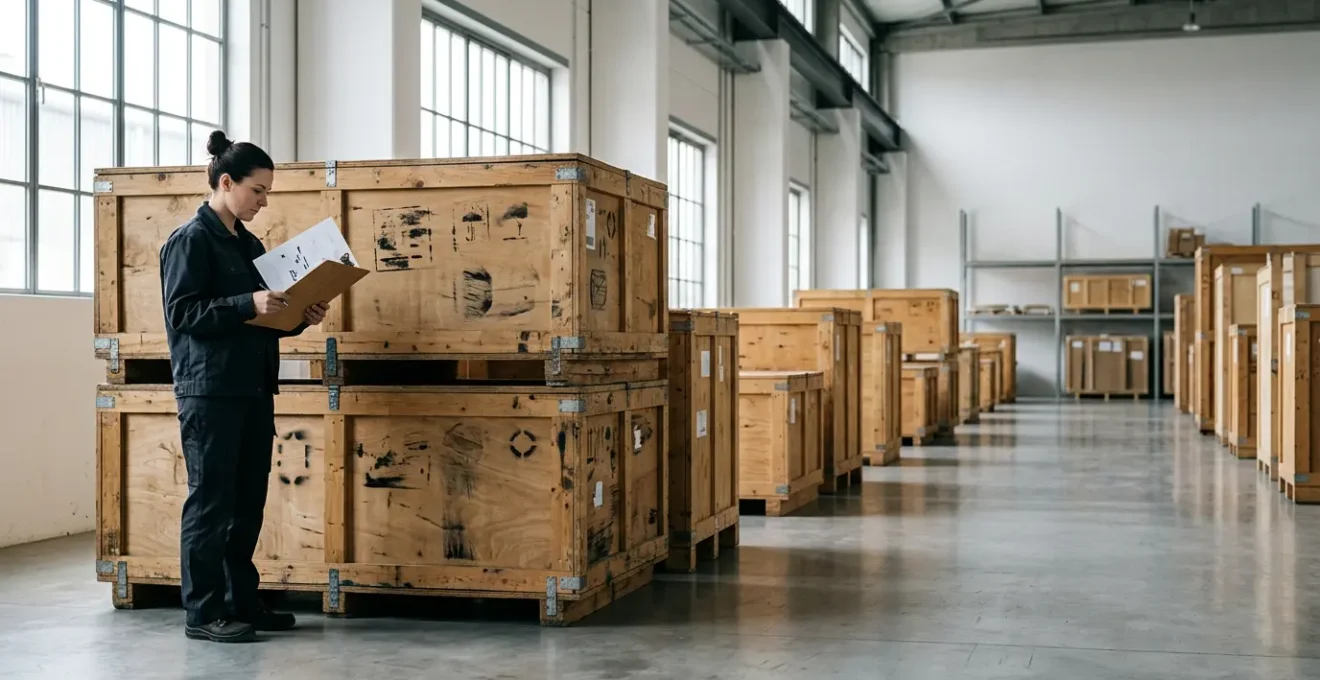
Successfully importing art into the UK post-Brexit is not a matter of simply paying tax; it is an exercise in procedural integrity to mitigate significant financial and logistical risks.
- The 5% reduced VAT rate is not automatic; it requires precise classification of the artwork under HMRC’s Chapter 97 commodity codes.
- International wood packaging standards (ISPM 15) are strictly enforced, and non-compliance can lead to the destruction of the shipping crate and its contents.
- For temporary imports, such as for exhibitions, using the Temporary Admission scheme is essential to avoid paying VAT upfront, but requires providing financial security to HMRC.
Recommendation: Treat every shipment’s documentation with forensic-level detail. The objective is not just compliance, but creating an unimpeachable paper trail that protects your investment from seizure, damage, or unexpected financial penalties.
For UK collectors and galleries, the acquisition of a new piece from an international artist should be a moment of excitement. Yet, in the post-Brexit landscape, this is often overshadowed by the apprehension of navigating a labyrinthine customs process. The risk of delays, unexpected charges, or, in the worst-case scenario, damage to a priceless work during a customs inspection is a significant source of anxiety. Many believe the solution lies in simply hiring a shipper and hoping for the best, accepting the “new complexities” as an unavoidable cost.
This approach is flawed. It treats the symptoms—the paperwork and the procedures—without understanding the underlying logic of the system. The common advice to “be aware of VAT” or “ensure your paperwork is correct” is unhelpful in its vagueness. The fundamental shift required is one of perspective. The UK customs system is not designed to be arbitrarily difficult; it is designed to be precise. It operates on a framework of rules where ambiguity is a liability and procedural accuracy is paramount. Understanding the ‘why’ behind these rules is the only effective strategy for mitigating risk.
This guide moves beyond generic advice. It will dissect the critical control points of the art importation process, from commodity codes to crate construction. By framing customs compliance not as a bureaucratic hurdle but as a strategic component of asset protection, you can regain control and confidence. We will examine the specific, actionable steps required to ensure your artwork’s journey is as seamless and secure as its creation was inspired.
This comprehensive guide details the essential procedures and regulations for importing art into the UK. The following table of contents outlines the key areas that will be addressed, providing a clear roadmap for navigating the complexities of post-Brexit customs.
Table of Contents: A Guide to Importing Art and Navigating UK Customs
- Why do you pay 5% VAT on art instead of the standard 20%?
- How to choose a shipper who handles customs clearance documentation correctly?
- EU vs Non-EU Origins: does the country of creation still affect the duty rate?
- The packaging error that leads to Border Force opening (and damaging) your crate
- How to bring art in for an exhibition without paying VAT upfront?
- The ‘Place of Supply’ error that triggers unexpected VAT bills from EU buyers
- Why must every single cable and bow be listed on your customs document?
- Touring Philharmonic Orchestras: Navigating Carnets and CITES Post-Brexit?
Why do you pay 5% VAT on art instead of the standard 20%?
The application of a reduced 5% VAT rate on imported works of art, as opposed to the standard 20%, is a specific concession designed to support the UK art market. However, this benefit is not automatic. It is contingent upon the artwork meeting the strict definition laid out by His Majesty’s Revenue and Customs (HMRC). This classification is determined by the artwork’s commodity code, which falls under Chapter 97 of the UK’s Trade Tariff. For an item to qualify, it must be correctly categorised as a work of art, such as an original painting, a limited-edition print, or an original sculpture.
An error in classification is a significant compliance failure. If an artwork is incorrectly declared under a different commodity code, or if the work does not meet the specific criteria (e.g., it is a mass-produced item), it will be subject to the standard 20% VAT rate. This can result in an immediate and unexpected tax liability of thousands of pounds, payable before the artwork can be released from customs. The burden of proof lies with the importer. Therefore, meticulous documentation, including artist attribution, medium, and a clear justification for its Chapter 97 classification, is not merely administrative but a critical financial safeguard.
As the image suggests, the process is one of rigorous documentation. Each piece must be methodically assessed against the official tariff headings to secure the reduced VAT rate. This is a foundational step in the import process, where precision directly translates into cost savings and compliance.
Ultimately, the 5% rate is a privilege of correct procedure, not an automatic right. Misclassification can invalidate this privilege, leading to significant financial repercussions and delays.
How to choose a shipper who handles customs clearance documentation correctly?
Selecting a logistics partner is one of the most critical decisions in the art importation process. A general freight forwarder may be adept at moving standard goods, but fine art requires a specialist with deep, demonstrable expertise in customs brokerage. The key differentiator is not speed or price, but procedural integrity. A competent art shipper acts as your customs representative, and their errors become your liabilities. The primary question should not be “Can you ship this?” but “Can you prove your customs compliance expertise?”
The gold standard for identifying a reliable partner is the Authorised Economic Operator (AEO) certification. This is a quality mark recognised across the EU and UK, indicating that the shipper’s role in the international supply chain is secure and that their customs controls and procedures are efficient and compliant. According to GOV.UK, AEO-certified entities benefit from a lower risk score, which can lead to fewer physical and document-based controls. This directly translates to a lower probability of your artwork being flagged for a disruptive inspection. Shippers with in-house brokerage, as opposed to those who subcontract this critical function, typically offer greater control and accountability.
Your Action Plan: Vetting Art Shippers
- Can you provide redacted examples of customs declarations filed for similar artworks?
- Do you have in-house customs brokerage or do you subcontract?
- What is your procedure if artwork is flagged for inspection?
- Do you hold AEO (Authorised Economic Operator) certification?
- Can you explain your insurance coverage during customs holds?
Using this checklist allows you to move beyond vague assurances and obtain concrete evidence of a shipper’s capabilities. A hesitant or evasive answer to any of these questions is a significant red flag.
In summary, choosing a shipper is not a procurement exercise; it is the appointment of a critical compliance partner. Prioritise expertise and certifications like AEO over cost alone.
EU vs Non-EU Origins: does the country of creation still affect the duty rate?
A common point of confusion following Brexit is the role of the artwork’s origin in determining import costs. The critical distinction to make is between customs duty and import VAT. For original works of art, collectors’ items, and antiques falling under Chapter 97, the situation is surprisingly straightforward. According to guidance from the British Antique Dealers’ Association, apart from import VAT there are no tariff duties on works of art, collectors’ items and antiques when imported into the UK, irrespective of their country of origin.
This means that whether a painting is created in France, the USA, or Japan, the customs duty rate upon entry into the UK is 0%. The “country of creation” or origin does not create a tariff disadvantage. However, this is where the simplicity ends. While the duty rate is consistent, the procedural requirements have changed dramatically, particularly for goods originating from the European Union.
Before Brexit, an artwork from an EU country could move to the UK with minimal paperwork under the principle of free movement. Now, an import from the EU is treated identically to an import from any other “third country.” This means a full customs declaration is required, and the 5% import VAT becomes due at the border. The primary impact of origin, therefore, is not on the duty rate but on the administrative burden. For non-EU artwork, the process has changed very little; for EU artwork, it represents a major increase in required documentation and upfront VAT costs.
The following table illustrates the procedural shift for artworks of EU origin, which now mirrors the process for non-EU works.
| Origin | Pre-Brexit Process | Post-Brexit Process | Key Change |
|---|---|---|---|
| EU Artwork | Free movement, no VAT on import | 5% import VAT, customs declarations required | Major increase in paperwork |
| Non-EU Artwork | 5% VAT, customs process | 5% VAT, customs process | Minimal change |
| Returned UK Goods | Automatic relief | Must prove history with Returned Goods Relief | Documentation burden |
In conclusion, focus less on the country of origin for duty calculations and more on ensuring your customs procedures are robust enough to handle what is now a standardised international import process for all non-UK works.
The packaging error that leads to Border Force opening (and damaging) your crate
While collectors often focus on the artwork itself, UK Border Force may be more interested in its packaging. Specifically, any wooden crating, pallets, or support structures used for shipping are subject to strict international phytosanitary regulations known as ISPM 15 (International Standards for Phytosanitary Measures No. 15). This regulation is designed to prevent the international spread of pests and diseases that can live in untreated wood. The rule is simple and non-negotiable: all solid wood packaging material must be heat-treated or fumigated and then stamped with an official ISPM 15 mark.
The critical detail is that any wood material thicker than 6mm used for shipping between countries is subject to ISPM 15. Since Brexit, this rule is now strictly enforced between Great Britain and the EU. A crate arriving from Paris is now treated the same as one from Beijing. Border Force inspectors carry out spot checks, and the consequences of non-compliance are severe. If a crate is found to be unstamped or improperly marked, officers have several options, none of them good.
At best, the shipment will be refused entry and ordered to be re-exported at the importer’s cost. At worst, and this is a documented risk, authorities can order the destruction of the non-compliant packaging. This could involve forcibly opening the crate to separate the artwork from the “hazardous” wood, placing the piece at extreme risk of damage. It is a catastrophic scenario that arises not from an issue with the artwork, but from a failure to verify the compliance of its container. Therefore, instructing and verifying with your shipper that only ISPM 15-compliant, stamped wood is used for crating is a non-negotiable point of asset protection.
This is a clear example of where a small oversight can lead to a disproportionately severe outcome. The ISPM 15 stamp is as crucial as the shipping label.
How to bring art in for an exhibition without paying VAT upfront?
Galleries and collectors often need to bring artwork into the UK on a temporary basis for exhibitions, art fairs, or viewing, with no immediate sale intended. Paying the full 5% import VAT in these circumstances would create a significant and unnecessary cash flow burden. To address this, HMRC provides a customs special procedure known as Temporary Admission (TA). This procedure allows goods, including works of art, to be imported with total or partial relief from import duties and VAT, provided they are intended for re-export within a specified period (typically under 6 months).
TA is not an automatic right; it is a formal authorisation. To use it, the importer must provide security to HMRC, usually in the form of a deposit or a bank guarantee, equivalent to the amount of VAT that would be due. This security is held by HMRC and is released once the artwork is re-exported from the UK and the TA procedure is discharged correctly. For established dealers with a good compliance history, it is possible to apply for a Customs Comprehensive Guarantee (CCG), which can sometimes include a waiver, reducing the need for upfront security.
The critical aspect of TA is its lifecycle. If an artwork imported under TA is sold while in the UK, the procedure must be discharged immediately. A full import declaration must be made, and the 5% VAT must be paid before the work can be delivered to the new owner. Failure to do so is a serious customs infringement. For longer-term needs or storage, a bonded warehouse may be more appropriate, as it allows for storage without VAT payment until the artwork is either sold or released into circulation.
| Criteria | Temporary Admission | Bonded Warehouse |
|---|---|---|
| Best for | Short exhibitions (under 6 months) | Long-term storage, multiple exhibitions |
| VAT Payment | Security deposit required | No VAT while in storage |
| If artwork sells | Must discharge TA and pay VAT immediately | VAT due on change of ownership |
| Administrative burden | Moderate | Lower for long-term |
Proper use of TA is an essential tool for the international art trade, but it demands rigorous administrative discipline to avoid triggering a full VAT liability.
The ‘Place of Supply’ error that triggers unexpected VAT bills from EU buyers
The complexities of VAT extend beyond the physical shipment of artworks. In the digital age, sales of art can involve electronically supplied services, such as digital prints, NFTs, or online art courses. For these transactions, the critical concept is the ‘Place of Supply’ rule, which determines which country has the right to charge VAT. Since Brexit, the rules for UK businesses selling to consumers in the EU have become significantly more complex.
When a UK-based artist or gallery sells a physical painting to a private collector in the EU, the transaction is typically treated as an export from the UK and an import into the EU member state. The UK seller does not charge UK VAT, and the EU buyer is responsible for paying import VAT in their own country. However, for digital services, the rules are different. The ‘Place of Supply’ for electronically supplied services to a private consumer (B2C) is the customer’s EU country. This means the UK supplier is responsible for charging and accounting for VAT at the rate applicable in the customer’s location.
Before Brexit, a UK business might have been able to use UK registration thresholds to avoid this. Now, those thresholds no longer apply for EU sales. The UK supplier must register for VAT in the EU. To avoid having to register in every single EU country they sell to, they can use the Non-Union MOSS (Mini One Stop Shop) scheme. This involves registering in a single EU member state and submitting one quarterly return and payment to that country’s tax authority, which then distributes the VAT to the relevant EU countries. Failing to understand this distinction can lead to the UK business building up an undeclared VAT liability across the EU, resulting in unexpected and potentially substantial bills from foreign tax authorities.
This demonstrates that a comprehensive customs and VAT strategy must account for the nature of the product itself, as digital and physical artworks operate under entirely different tax frameworks.
Why must every single cable and bow be listed on your customs document?
For touring groups, such as orchestras or bands, the customs declaration is not a summary; it is a forensic itemisation. The common mistake is to declare goods in general terms, for example, “1 Orchestra Set” or “Sound Equipment.” This is a guarantee of a customs inspection and significant delays. Customs officers work from a principle of “what you see is what is on the list.” If they open a crate and see 100 distinct items but the declaration lists only one, it creates a discrepancy that must be investigated.
Every single item temporarily exported must be listed individually on the customs document, often an ATA Carnet, which acts as a passport for goods. This means a cello, its bow, and its case are three separate lines on the declaration. A drum kit is not one item, but a collection of individual drums, cymbals, stands, and pedals, each requiring its own entry. This level of detail is non-negotiable. As noted in guidance from UK Musicians Touring The EU Guidelines, the declaration must be a complete inventory.
A customs declaration is not a summary, it’s a forensic itemization
– Dynamic Dox, UK Musicians Touring The EU Guidelines
The logic is clear: the customs authority needs to be able to verify that every item that leaves the country is the same item that returns. This prevents goods from being illicitly sold or swapped while abroad without duties being paid. A realistic nominal value must be assigned to every item, even worn accessories, as customs will not accept a zero value. Creating a master inventory spreadsheet with descriptions, serial numbers, and photographs well in advance of a tour is an essential piece of preparation.
Your Action Plan: The Asset Declaration Audit
- Document every individual item: not ‘1 Orchestra Set’ but ‘1 Cello, 1 Bow, 1 Case, 1 Music Stand’.
- Include all accessories: rosin, spare strings, mutes, tuners, and power adapters.
- List support equipment such as chairs, music stands, and cable sets.
- Assign realistic nominal values to all items, even if nominal (€1 minimum).
- Photograph each key item for a visual record that can be cross-referenced with serial numbers.
The time invested in creating a perfect inventory before departure will be paid back tenfold in time saved at the border.
Key Takeaways
- The 5% reduced VAT rate for art is conditional on correct classification under HMRC’s Chapter 97; errors revert the rate to 20%.
- ISPM 15 compliance for all wood packaging is mandatory for UK-EU shipments; non-compliance risks seizure and destruction of the crate.
- Customs declarations, especially for temporary exports like tours, require forensic itemization of every single component, not a summary.
Touring Philharmonic Orchestras: Navigating Carnets and CITES Post-Brexit?
While the ATA Carnet is the primary document for the temporary export of an orchestra’s equipment, another layer of complexity exists for instruments containing materials from endangered species. The Convention on International Trade in Endangered Species of Wild Fauna and Flora (CITES) governs the movement of such materials across borders. Many historical and high-quality musical instruments contain CITES-listed materials, such as Brazilian Rosewood (Pernambuco) in violin bows, ivory on piano keys, or mother-of-pearl inlays.
Travelling from the UK to the EU with an instrument containing these materials without the correct CITES paperwork is illegal and can lead to the seizure of the instrument. The solution is to obtain a Musical Instrument Certificate (MIC). As highlighted by Making Music, the UK’s organisation for leisure-time music groups, when travelling from UK to EU with instruments made from CITES materials, a MIC or other CITES permit is essential. This certificate proves that the materials were legally acquired and allows the instrument to be moved across borders for personal use, such as touring, for up to three years.
A pre-tour CITES audit of all instruments is therefore a critical step. This involves identifying any instrument that may contain listed materials and applying for the appropriate certification well in advance. For instruments being shipped as freight rather than carried by a musician, a different permit—a Travelling Exhibition Certificate (TEC)—may be required. Furthermore, entry and exit from the UK and EU must be through a designated CITES port. This meticulous preparation is fundamental to protecting an orchestra’s invaluable assets and ensuring the tour can proceed without the catastrophic loss of an instrument at a border crossing.
As this scene depicts, the preparation for an international tour goes far beyond musical rehearsal. It is a complex logistical operation where documentation and regulatory compliance are as important as artistic readiness.
Your Action Plan: Pre-Tour CITES Audit Checklist
- Identify all instruments containing Brazilian Rosewood (Pernambuco) in bows.
- Check for ivory key tops on pianos and keyboards.
- Document mother-of-pearl inlays on guitars and accordions.
- Apply for a Musical Instrument Certificate (MIC) for each relevant instrument.
- Ensure the tour itinerary uses only CITES-designated ports of entry/exit.
To implement these protocols effectively, the next logical step is a comprehensive review of your current shipping, travel, and documentation procedures to identify and close any compliance gaps before your next acquisition or tour.