The future of London’s galleries isn’t about acquiring the latest technology, but mastering its strategic integration to enhance, not replace, curatorial mission.
- Digital tools must be assessed for their ability to expand reach and deepen curatorial insight, moving beyond mere spectacle.
- London’s historic gallery spaces are not a barrier to innovation but a canvas for clever, non-invasive installations that respect heritage while embracing the new.
Recommendation: Focus on building a resilient and discreet tech infrastructure, and choose only the technologies that align with your gallery’s long-term cultural and financial objectives, not short-term trends.
For any forward-looking gallery owner or patron in London, the conversation around technology has shifted from a low hum to a deafening roar. The pressure to innovate is immense, fueled by the spectacular success of large-scale immersive ‘experiences’ and a constant stream of articles heralding the ‘death of the traditional gallery’. The landscape feels like a technological arms race, where standing still is akin to moving backwards.
The common advice is to simply ’embrace technology’. We’re told to build virtual viewing rooms, to explore NFTs, to make our spaces more ‘Instagrammable’. But this advice often misses the crucial context of the London art scene. It ignores the practical constraints of a Grade II listed building in Mayfair, the critical difference between fleeting entertainment and lasting cultural capital, and the complex financial and legal realities of dealing with digital assets.
The real question isn’t *if* you should adopt new visual media, but *how*. How do you integrate a monumental LED wall without drilling a single hole in a protected Georgian interior? How do you choose between investing in a Frieze stand or a metaverse space? This article moves beyond the hype to provide a grounded, strategic framework. It’s a curator’s-eye view on navigating the next five years, focusing not on the technology itself, but on the strategic decisions that will determine who thrives.
This guide will dissect the most pressing challenges and opportunities facing London galleries. From the practicalities of installation and the nuances of digital copyright to the critical analysis of which art fairs deliver real value, we will explore a complete roadmap for strategic visual innovation.
Summary: Visual Innovation in London Galleries: A Curator’s Strategic Roadmap
- Why must traditional Mayfair galleries adopt VR viewing rooms to survive?
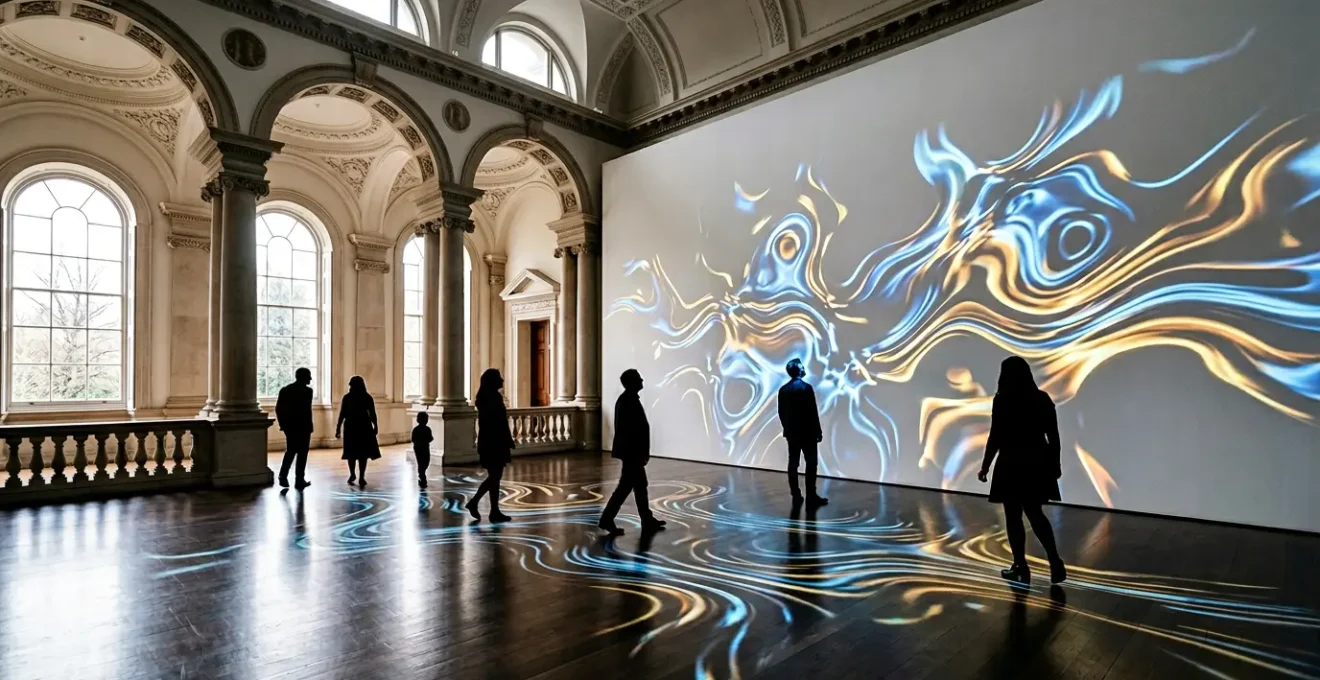
- How to install immersive LED walls in Grade II listed buildings without damage?
- Immersive Experience or Art Exhibition: which format builds lasting cultural capital?
- The error of relying on unstable Wi-Fi for cloud-based art installations
- When to invest in a new visual medium: following the early adopter curve
- Copyright Assignment vs License: which protects your future income stream?
- Frieze vs London Art Fair: which stand investment yields better client leads?
- Digital Artists and Tax: How Does HMRC Treat Crypto Art Earnings?
Why must traditional Mayfair galleries adopt VR viewing rooms to survive?
The imperative for Mayfair galleries to adopt Virtual Reality (VR) is not merely about survival, but about strategic expansion and a deeper understanding of their collector base. The traditional model, reliant on footfall and physical presence, is no longer sufficient in a globalised art market. The true value of VR lies beyond creating a simple 3D replica of a space; it’s a powerful tool for data collection and audience qualification. Recent research shows that global audience accessibility increased by 60% for galleries that have successfully integrated VR, transforming a local exhibition into an international event.
This isn’t about replacing the in-person experience, but augmenting it. A VR viewing room serves as a crucial pre-qualification step. It allows international collectors to preview works with a sense of scale and presence that flat JPEGs cannot convey, leading to more committed inquiries and efficient sales processes. Furthermore, tracking how a user navigates a virtual space—which pieces they linger on, what information they access—provides invaluable curatorial data that can inform future exhibitions and artist pairings.
The National Gallery London’s NGX project serves as a powerful case study. By partnering with King’s College London, this historic institution has pioneered experimental digital experiences, proving that embracing technology does not mean compromising on curatorial excellence. They use it to explore new narrative forms and engage audiences in ways that complement, rather than compete with, their physical collections. For a Mayfair gallery, this means seeing VR not as a gimmick, but as an essential piece of client relationship and market intelligence infrastructure.
How to install immersive LED walls in Grade II listed buildings without damage?
The challenge of integrating large-scale digital technology like an LED wall into a Grade II listed building is a quintessential London problem. The juxtaposition of cutting-edge tech with protected heritage architecture seems fraught with conflict, but the solution lies in treating the technology as a piece of sculpture rather than a fixture. The cardinal rule is zero impact. Any installation must be fully reversible, leaving the historic fabric of the building completely untouched.
The most effective approach is the use of free-standing modular structures. Think of it as building a room within a room. A custom-engineered metal frame is constructed on-site, supporting the weight of the LED panels and all associated cabling, entirely independent of the building’s walls and ceiling. This ‘box’ can be placed in the centre of a room, creating a powerful focal point while allowing the original architectural details—ornate mouldings, period fireplaces, sash windows—to remain visible, creating a dynamic dialogue between the old and the new. This method ensures 100% reversibility and typically faces the lowest hurdles for obtaining necessary approvals.
While projection mapping offers a lower-cost alternative, it often struggles with ambient light and lacks the vibrant punch of an emissive LED display. Other methods, such as tension wire systems, carry a minimal but non-zero risk of impact. The key is to shift the mindset from “attaching” technology to a building, to “placing” a self-contained technological object within a historic space. The following table breaks down the primary options available.
This comparative analysis, based on industry experience with heritage installations, highlights the trade-offs involved.
| Method | Impact Level | Reversibility | Cost Range | Approval Difficulty |
|---|---|---|---|---|
| Free-standing Modular | Zero | 100% | £50-80K | Low |
| Projection Mapping | Minimal | 100% | £30-50K | Low |
| Tension Wire Systems | Very Low | 95% | £40-60K | Medium |
| Floor-mounted Rails | Low | 90% | £60-90K | High |
Immersive Experience or Art Exhibition: which format builds lasting cultural capital?
The art world is currently grappling with a significant identity question, pitting the popular appeal of ‘immersive experiences’ against the intellectual rigour of the traditional ‘art exhibition’. The former often prioritises sensory spectacle and shareable moments, while the latter focuses on curatorial narrative and artistic intent. For a gallery whose reputation is its most valuable asset, the choice of format is a strategic decision that directly impacts its long-term cultural capital. The danger is clear: chasing trends can dilute a gallery’s brand and alienate its core collector base.
However, this is not a binary choice. The most forward-thinking institutions are finding a third way, integrating immersive elements to enhance, not overwhelm, the art itself. As curator Sarah Ransome notes in her analysis of London’s evolving scene, the goal is to create a space where “the exhibition harmonises cutting-edge technology with traditional art, celebrating heritage and future simultaneously.” This means using technology as a tool for deeper engagement, not as the main attraction.
The exhibition harmonises cutting-edge technology with traditional art, celebrating heritage and future simultaneously
– Sarah Ransome, Analysis of London’s Immersive Art Scene 2025
Moco Museum London exemplifies this balanced approach. By showcasing works by established masters like Warhol and Banksy alongside interactive digital installations, they demonstrate that the two can coexist and enrich one another. Visitors report deeper emotional connections when a multi-sensory environment is used to provide context or evoke the artist’s state of mind, rather than simply projecting a digitised painting onto a wall. Lasting cultural capital is built not by creating a funhouse, but by using new tools to tell the story of the art more powerfully and to a broader, more engaged audience. The key is curatorial control, ensuring technology always serves the art.
The error of relying on unstable Wi-Fi for cloud-based art installations
One of the most critical yet frequently overlooked aspects of integrating digital art is the infrastructure that powers it. The most breathtaking, cloud-based generative artwork or multi-channel video installation can be rendered useless by a single point of failure: unstable connectivity. For a high-stakes gallery environment, relying on the building’s shared Wi-Fi or a standard consumer broadband connection is an act of profound strategic negligence. When an artwork glitches, buffers, or simply fails to load during a private view, it doesn’t just look unprofessional; it erodes collector confidence in the gallery’s technical competence.
The solution is to build a resilient, multi-layered connectivity framework. This is the unglamorous, invisible work that makes seamless digital experiences possible. It’s an operational cost that should be factored into any digital art acquisition or exhibition budget from day one. The professional standard is a three-tiered defence system designed for maximum uptime.
The primary layer should be a dedicated fibre optic line with a guaranteed bandwidth and a Service Level Agreement (SLA) that ensures rapid support. This is the workhorse connection. The secondary layer must be an automatic failover solution, typically a high-speed 5G cellular connection, that kicks in instantly if the primary line goes down. Finally, the tertiary layer is a local, on-site media server. This server should hold a cached, ‘last good state’ version of the artwork. In a catastrophic outage, the system can default to this local version, ensuring the screen never goes black. This principle of “graceful degradation” is paramount. An artwork might run at a lower resolution from the local cache, but it will continue to run, preserving the integrity of the exhibition.
When to invest in a new visual medium: following the early adopter curve
In a world of rapidly evolving visual technologies, the most pressing question for a gallery owner is not *what* to invest in, but *when*. Chasing every new trend is a recipe for financial exhaustion and strategic chaos. Conversely, waiting too long means risking irrelevance. The key is to understand the technology adoption life cycle—often visualised as the “Hype Cycle”—and to consciously decide where on that curve your gallery is comfortable operating. This allows you to move from reactive decision-making to a proactive risk-managed investment strategy.
The cycle typically moves from an “Innovation Trigger” (the birth of a new tech), through a “Peak of Inflated Expectations,” a “Trough of Disillusionment,” a “Slope of Enlightenment,” and finally to a “Plateau of Productivity.” Each stage carries different levels of risk, cost, and potential reward. Investing at the peak is expensive and risky, while investing on the plateau is safer but offers less competitive advantage. A visionary gallery might make small, experimental bets on technologies in the “Trough,” acquiring works or knowledge when the market is quiet.
A strategic assessment of where different technologies currently sit is crucial for London galleries. VR, for example, is moving towards the Plateau of Productivity; it’s a proven tool for sales and outreach. AI-generated art is arguably at the Peak of Inflated Expectations, attracting huge media attention but with unresolved questions around originality and market stability. A grounded approach involves allocating resources according to this map.
This timeline provides a strategic overview for planning investments over the next few years.
| Technology | Current Stage (2025) | Risk Level | Investment Timing |
|---|---|---|---|
| VR Exhibitions | Plateau of Productivity | Low | Invest Now |
| AI-Generated Art | Peak of Inflated Expectations | High | Pilot Only |
| NFT Galleries | Trough of Disillusionment | Medium | Wait & Watch |
| AR Experiences | Slope of Enlightenment | Medium | Strategic Investment |
| Metaverse Spaces | Innovation Trigger | Very High | Research Only |
Copyright Assignment vs License: which protects your future income stream?
For digital artists and the galleries that represent them, the distinction between a copyright assignment and a license is not legal pedantry; it is the single most important factor determining the long-term financial viability of their work. Misunderstanding this can lead to an artist selling their entire future for a one-time payment, a mistake that is tragically common in the fast-moving digital space. A gallery’s role as a trusted advisor is paramount in navigating these waters.
A full assignment of copyright is a complete transfer of ownership. The artist sells the work and all associated rights, forever. They receive a lump sum but forfeit any future income from reproductions, adaptations, or secondary sales. This model is simple but offers zero long-term participation in the work’s success. A license, by contrast, is a contractual permission. The artist retains ownership of the copyright but grants a collector or institution specific rights to display or use the work for a defined period, often in exchange for a smaller upfront fee plus ongoing royalties.
The emergence of blockchain technology and NFTs has introduced a powerful new licensing model. Smart contracts can have royalty clauses baked into their code, ensuring that the artist automatically receives a percentage of every future resale on the secondary market. While the NFT market has been volatile, the underlying technology for tracking provenance and automating royalties is a revolutionary tool for artists. Many emerging smart contract standards indicate a future where a 10% automated royalty on secondary sales becomes the norm, fundamentally reshaping the economics of art collection.
The financial difference between these models is stark, as the following projection illustrates.
| Model | Initial Payment | Year 5 Income | Year 10 Income | Total Revenue |
|---|---|---|---|---|
| Full Assignment | £10,000 | £0 | £0 | £10,000 |
| Exclusive License (20% royalty) | £5,000 | £2,000 | £3,500 | £25,000 |
| NFT Smart Contract (10%) | £10,000 | £1,500 | £4,000 | £32,000 |
Key takeaways
- Strategic Integration Over Technology: The most successful galleries will be those that integrate technology to serve a clear curatorial and business strategy, not those that simply adopt the latest trends.
- Infrastructure is Non-Negotiable: A robust, resilient, and invisible technical infrastructure (connectivity, power, support) is the foundation of any successful digital art program.
- Timing is Everything: A proactive investment strategy requires understanding the technology adoption curve, allowing a gallery to manage risk and allocate resources effectively based on the maturity of a given medium.
Frieze vs London Art Fair: which stand investment yields better client leads?
The annual calculation of which art fairs to invest in is a high-stakes decision for any gallery. With stand costs running into the tens or even hundreds of thousands of pounds, the return on investment must be measured in more than just on-the-spot sales. The crucial metric is the quality of client leads generated. For London galleries, the choice between a global behemoth like Frieze and a stalwart with a strong domestic focus like the London Art Fair is a matter of strategic alignment, not a simple question of which is ‘better’.
The key is to define your objective before committing. Frieze offers unparalleled access to a global audience of top-tier international collectors, museum curators, and advisors. The investment is high, but the potential for a single transformative sale or for placing an artist in a major international collection makes it a powerful platform for brand positioning and global reach. The leads are often high-net-worth individuals, but they are also being courted by hundreds of other world-class galleries.
The London Art Fair, by contrast, offers a different value proposition. It has a deep-rooted connection with UK-based collectors and institutions. It’s an essential venue for building and nurturing relationships with the domestic market, from new collectors making their first significant purchases to regional museum acquisition committees. The lead volume may be different, but the quality, in terms of building a sustainable, long-term client base within the UK, can be exceptionally high. As a case study, Frameless gallery’s strategy shows a sophisticated approach, using different fairs for different goals, leading to a 40% higher qualified lead conversion from targeted selection.
Case Study: Frameless Gallery’s Multi-Fair Strategy
As the UK’s first permanent large-scale digital art exhibition, Frameless demonstrates how galleries can leverage fair participation strategically. Their presence at both established and emerging art fairs shows differentiated approaches: using Frieze for brand positioning and international collector engagement, while the London Art Fair serves for building relationships with UK-based institutional buyers. Their data shows a significant increase in qualified lead conversion from this targeted fair selection, proving the value of a nuanced, objective-led strategy.
To move beyond gut feeling, a systematic approach to evaluating leads is essential.
Action plan: Lead Quality Assessment Framework
- Score leads on collector seniority: Established (3 points) vs New (1 point)
- Measure post-fair engagement: Track the follow-up response rate within 30 days
- Track cross-pollination: Note any interest expressed in other gallery artists
- Assess commission potential: Differentiate between custom work inquiries and inventory sales
- Calculate lifetime value: Estimate the likelihood of repeat purchases based on the collector’s profile
Digital Artists and Tax: How Does HMRC Treat Crypto Art Earnings?
For digital artists and galleries operating in the UK, the excitement of the crypto art market comes with a stark and often complex reality: Her Majesty’s Revenue and Customs (HMRC). The decentralised, global nature of blockchain transactions does not exempt earnings from UK taxation. Understanding and complying with HMRC’s stance is not optional; it is a fundamental requirement for operating legally and avoiding severe penalties. The gallery’s role extends to educating its artists on these obligations.
HMRC’s current position is that crypto-assets, including NFTs, are treated as property. For most individual artists selling their own work, the profits from these sales are subject to Capital Gains Tax (CGT). According to current HMRC guidance, this means a potential Capital Gains Tax at 20% for higher-rate taxpayers on crypto art sales. However, if an artist is trading NFTs frequently and with a commercial motive (the “badges of trade” test), HMRC may classify them as a trader, in which case the profits would be subject to Income Tax and National Insurance, which are often higher rates.
Meticulous record-keeping is the only defence against a future tax inquiry. Every transaction must be documented. This includes the date, the type and amount of crypto-asset, the value in GBP at the time of the transaction, and the transaction hash (TXID). This applies not only to sales but also to swaps, airdrops, and even the “gas fees” paid to mint or transfer an NFT, which can often be claimed as an expense. Galleries facilitating these sales must have a system to provide both the artist and their own accountants with this detailed information in a clear and exportable format.
To ensure compliance, artists and galleries should follow a strict checklist:
- Document all wallet addresses used for creating, holding, and receiving funds.
- Export transaction histories from all marketplaces (e.g., OpenSea, Foundation) and exchanges (e.g., Coinbase, Kraken).
- Record the GBP value at the precise time of each transaction, using a consistent and approved source for exchange rates.
- Track all associated costs, especially gas fees, as these are generally deductible against the final gain.
- Apply the ‘Badges of Trade’ test annually with an accountant to determine whether profits fall under Income Tax or Capital Gains Tax.
The next five years will be defined by strategic choices, not technological accidents. To ensure your gallery is a leader in this new landscape, the next logical step is to audit your digital readiness and build a clear, staged investment roadmap based on the principles outlined in this guide.