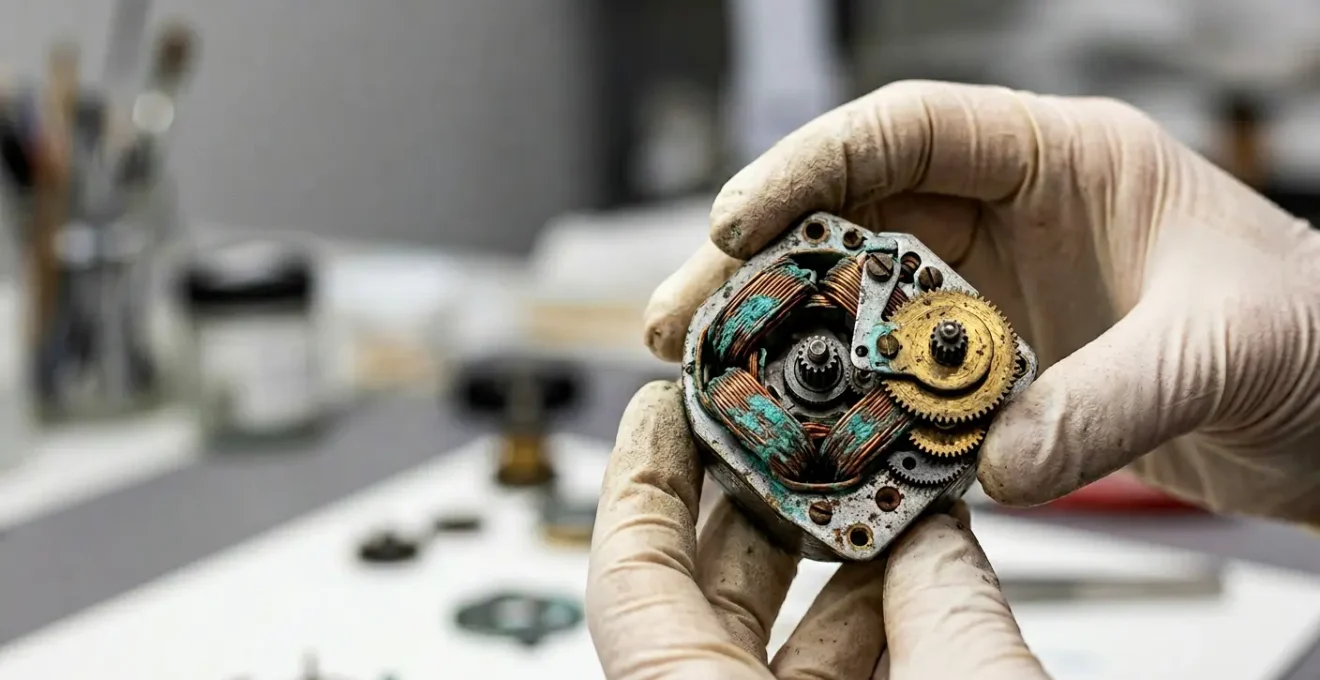
The central task of kinetic art conservation is not repair, but the strategic management of an artwork’s inherent motion and inevitable decay.
- Material authenticity (original parts) and functional authenticity (intended movement) are often in direct conflict.
- Preventive care, including scheduled rest periods and vibration isolation, is more critical than interventive restoration.
Recommendation: Adopt a philosophy of “negotiated decay,” where every decision is documented and balances the artist’s intent with the object’s long-term material survival.
A moving sculpture is a paradox. It exists in a state of perpetual performance, yet each cycle contributes to its own mechanical erosion. For conservators and collectors, the core challenge is not merely to “fix” what breaks, but to steward this delicate dance between motion and matter. The common approach often focuses on immediate repair, addressing symptoms like a seized motor or a snapped wire. This reactive stance, however, misses the fundamental nature of the medium. We are not just preserving a static object; we are curating a lifecycle.
The true work lies in navigating the inherent conflict between the artwork’s physical, historical self—its material authenticity—and the ephemeral movement that defines its character, its functional authenticity. Is it better to preserve an original 1960s motor that no longer runs, or replace it with a modern equivalent that restores the piece’s intended motion? This question moves beyond simple repair and into the realm of conservation ethics.
This guide abandons the premise of simple fixes. Instead, it proposes a philosophy of “negotiated decay.” We will explore how to make deliberate, informed decisions that prolong the life of these complex works. From forensic diagnosis of vintage electrical systems to the strategic scheduling of rest, we will detail the patient, mechanical, and delicate processes required to ensure that the pulse of kinetic art can be felt by future generations.
The following sections break down the critical decision points and technical challenges faced in the conservation of kinetic art, providing a structured approach to a complex and dynamic field.
Summary: The Pulse of Preservation: A Conservator’s Guide to the Lifecycle of Kinetic Art
- Why do vintage motors burn out when run on modern voltage?
- How to oil a mobile without staining the aesthetic surfaces?
- Replace Motor or Rewind Coil: which maintains the work’s authenticity?
- The display error of running kinetic art 24/7 that destroys the mechanism
- When to rest a moving work: scheduling downtime to prolong lifespan
- How to dust heavy impasto acrylics without trapping lint in the texture?
- How to decouple display cases from the floor to protect against traffic rumble?
- Displaying Ancient Artifacts: Seismic and Security Mount Making?
Why do vintage motors burn out when run on modern voltage?
The burnout of a vintage motor is often the first, most jarring sign of a kinetic sculpture’s fragility. The issue is rarely a simple matter of wear; it is a fundamental incompatibility between historical engineering and modern infrastructure. Motors from the mid-20th century were designed for different electrical standards. A motor built for a 50Hz European grid will run faster and hotter on a 60Hz North American grid, leading to accelerated wear and catastrophic failure. Similarly, modern line voltage can be higher than the precise specifications for which a vintage coil winding was designed, causing overheating and burnout.
Treating this problem requires a shift from a “repair” mindset to one of forensic diagnosis. Before any intervention, the motor’s original specifications must be understood. This involves meticulous research into the artwork’s history, the artist’s records, and the electrical standards of the period and region of its creation. In many cases, the artist’s own philosophy provides guidance. For instance, in the conservation of Jean Tinguely’s works, it was found that the artist himself sometimes prioritized the sculpture’s static, material history over its performance, accepting retirement when a motor could no longer be safely operated. This precedent sets a crucial benchmark for decision-making.
This diagnostic approach respects the motor not as a disposable part, but as an artifact in itself. Identifying its needs—whether through documentation, resistance measurement, or analysis of the mechanism it drives—is the foundational step in responsible conservation. It is an act of listening to the object before imposing a solution.
Action Plan: Forensic Motor Identification Protocol
- Visual Documentation: Photograph all motor markings, no matter how cryptic or degraded. Use raking light to reveal stamped or engraved specifications that are invisible under normal lighting.
- Electrical Analysis: Measure coil resistance with a multimeter. This data, when compared against historical motor specification databases, can help deduce the intended voltage requirements.
- Mechanical Analysis: Observe the mechanism’s intended speed and movement patterns. Calculate the required RPM by analyzing gear ratios and pulley systems to understand what the motor was designed to do.
- Cross-Referencing: Correlate all findings with artist archives, period electrical standards (especially 50Hz vs. 60Hz regional differences), and consult with electrical engineers specialized in vintage equipment.
- Formal Reporting: Document all findings, hypotheses, and external consultations in a technical conservation report before any intervention is planned or executed.
How to oil a mobile without staining the aesthetic surfaces?
Lubrication is a necessary evil in kinetic art. While essential for smooth, low-friction movement, the application of oil presents a significant risk to the artwork’s aesthetic surfaces. A single misplaced drop can permanently stain a matte paint finish, seep into porous material, or attract dust that turns into an abrasive grime. This is especially true for works like Alexander Calder’s mobiles, where pristine, unblemished color fields are integral to the artistic statement. The challenge, therefore, is one of extreme precision: delivering lubricant only to the mechanical interface and nowhere else.
This requires specialized tools and a patient, methodical approach. The primary instrument is a precision watchmaker’s dip oiler, which allows the conservator to apply a micro-droplet of lubricant with pinpoint accuracy. The choice of lubricant is equally critical; it must be a conservation-grade, synthetic oil with low viscosity and high stability, ensuring it will not yellow, thicken, or migrate over time. The process is performed under magnification, treating each pivot point and bearing as a micro-surgery.
For particularly sensitive or valuable surfaces, a protective barrier is employed. A case study on the conservation of a 1958 Calder mobile at McKay Lodge details a technique where conservators apply a reversible barrier of Paraloid B-72 acrylic resin around the joint before lubrication. This invisible shield catches any excess oil, which can then be removed along with the barrier using a mild solvent, leaving the original paint completely untouched. This method perfectly embodies the delicate balance of maintaining function while preserving form.
As the image demonstrates, the goal is to apply a barely-there film of lubricant directly to the point of contact. This is not about flooding a joint with oil; it is about providing just enough of a molecular barrier to prevent metal-on-metal wear. Each application is a deliberate, irreversible act that must be executed with the utmost care and control.
Replace Motor or Rewind Coil: which maintains the work’s authenticity?
This question lies at the heart of kinetic art conservation and brings the concepts of material and functional authenticity into direct conflict. When a vintage motor fails, the conservator faces a critical choice. Does one rewind the original coil, an invasive procedure that alters the original artifact but preserves its housing and form factor? Or does one replace the entire motor with a modern, more reliable equivalent, sacrificing a key original component to restore the artwork’s intended movement?
There is no single correct answer. The decision must be made on a case-by-case basis, guided by a hierarchy of evidence: the artist’s documented intent, the artwork’s history of past repairs, and the physical evidence of the object itself. Authenticity is not an abstract ideal; it is a conclusion drawn from verifiable information. Sometimes, the artist’s own actions provide the clearest path. In a documented case, the artist Joost Conijn, when faced with the conservation of his functional wood-burning vehicle ‘Hout Auto’, agreed with the museum’s decision to disconnect the engine and present it as a static sculpture. The choice to prioritize the object’s material integrity over its function demonstrates that functional retirement can be a valid and authentic outcome.
Conversely, for a work where the character and rhythm of the movement are paramount, a carefully selected modern motor might be the more “authentic” choice if it more accurately reproduces the artist’s kinetic vision. The key is that the decision is not made lightly. It is the result of extensive research, consultation, and documentation. The removed original motor is never discarded; it is cataloged and preserved as part of the artwork’s archival record, a silent testament to its history.
The display error of running kinetic art 24/7 that destroys the mechanism
One of the most common and damaging errors in displaying kinetic art is the assumption that it should be in constant motion. Running a motorized sculpture continuously, 24 hours a day, is akin to running a vintage car engine without ever turning it off. It dramatically accelerates the wear on every single moving component, from gears and belts to bearings and linkages. This practice stems from a desire to present the artwork “fully,” but it paradoxically becomes the primary agent of its destruction.
Mechanical components have a finite operational lifespan. Continuous operation subjects them to relentless metal fatigue, friction, and heat buildup. Ball bearings develop indentations and pitting, a process known as brinelling. Bushings wear down, introducing unwanted play and vibration into the system. Motors overheat, and delicate electronic components fail. This cumulative, accelerated degradation is often irreversible without extensive and invasive replacement of original parts, pushing the conservator towards the very interventions they seek to avoid.
This is not a theoretical concern. Research has repeatedly shown that kinetic artworks from the 1950s-1960s face accelerated degradation when operated continuously, as these mechanisms were never designed for such industrial duty cycles. The damage is often microscopic at first, but it compounds over time until a catastrophic failure occurs. The artwork falls silent not from age, but from exhaustion.
The visual evidence is undeniable. A pristine ball bearing, with its polished, perfect geometry, allows for nearly frictionless movement. A worn bearing, dulled and pitted from continuous stress, introduces vibration and abrasion, actively damaging the components it was meant to protect. The decision to run a work 24/7 is a decision to transform the former into the latter at an accelerated rate.
When to rest a moving work: scheduling downtime to prolong lifespan
If continuous operation is the path to ruin, then scheduled rest—or scheduled quiescence—is the cornerstone of sustainable preservation. The decision of when and how often to run a kinetic artwork is a primary conservation strategy, not merely a curatorial choice. It involves creating a deliberate operating schedule that balances the public’s desire to see the work in motion with the physical object’s need for downtime. This is where the core tension of kinetic art conservation is most actively negotiated.
As Head of Conservation at Museum Tinguely, Reinhard Bek, has expertly articulated, this is a complex ethical negotiation:
The tendency for caretakers is to move between two schools of thought: the practical conservation point of view prefers to limit an artwork’s activity to reduce wear and tear and eventual failure of parts, while advocates of the artist prefer that a work remain active to honor the artist’s intention.
– Reinhard Bek, A Question of KinEthics, Keep It Moving?
The solution is not to choose one school of thought over the other, but to synthesize them. An operating schedule could involve running the artwork for a set number of minutes each hour, or only during specific times of the day. For more robust works, activation via a motion sensor or a user-operated button can be an effective strategy, as it ensures the work only runs when it is being actively observed. This approach honors the artist’s intent for the work to be seen in motion, while dramatically reducing its total operational hours and thus extending its mechanical life.
This “Maintenance” strategy, which incorporates scheduled operation and condition-based monitoring, is one of three main preservation pathways, alongside “Retirement” (ceasing operation) and “Replication” (creating functional duplicates). The choice to implement a schedule of quiescence is an active decision to prolong the original artifact’s functional life for as long as possible, accepting that periods of stillness are a fundamental part of its preservation.
How to dust heavy impasto acrylics without trapping lint in the texture?
The preservation of a kinetic sculpture is not limited to its internal mechanics. The external surfaces, often featuring complex textures like heavy impasto, present their own delicate cleaning challenges. Dust and airborne particulates inevitably settle on these surfaces, and if the texture is deep, traditional dusting with a cloth is not only ineffective but actively harmful. Cloth fibers can snag on the peaks of the impasto, leaving behind a fine web of lint that is more visually distracting than the dust it was meant to remove.
The correct approach is a hierarchy of cleaning methods, starting with the least invasive and progressing only as necessary. The goal is to dislodge and remove particulates without ever abrading or altering the original surface. This patient, multi-step process ensures the integrity of the artist’s intended texture and finish.
The sequence of cleaning should be as follows:
- Non-Contact Air: The first step is always to use a controlled air-puffer bulb or low-pressure, filtered air stream to gently blow away loose dust. This removes the majority of surface particulates without any physical contact.
- Low-Contact Vacuum: If air is insufficient, a HEPA-filtered vacuum with an adjustable suction setting and a soft brush attachment is used. The key is to hover the brush nozzle 1-2 millimeters above the surface, using the airflow to draw particles out of the texture’s valleys without the bristles ever touching the paint.
- Tacky-Lift Sponges: For more embedded grime, specialized conservation materials like vulcanized rubber sponges (dry-cleaning sponges) are employed. These are not used for wiping; instead, they are gently pressed and rolled onto the surface. Their tacky nature lifts dust and dirt without leaving a residue or abrading the texture.
- Solvent-Dampened Swabs: This is the most invasive method and is reserved as a last resort. A soft, lint-free swab is very lightly dampened with distilled water or a tested, approved conservation solvent. It is then rolled over the surface, never scrubbed, to lift away stubborn accretions. This method always requires spot-testing in an inconspicuous area first.
Each step is a self-contained procedure, and the conservator must assess the results of one before deciding to proceed to the next. This methodical patience is essential to prevent irreversible damage to the artwork’s fragile surface.
How to decouple display cases from the floor to protect against traffic rumble?
An artwork’s environment is as critical as its own internal condition. For kinetic art, a particularly insidious threat is vibration. Constant, low-frequency vibrations from foot traffic, nearby roads, or a building’s HVAC system can be transmitted from the floor into the display case and, ultimately, into the artwork itself. This micro-vibration, while often imperceptible to us, can cause delicate components to shift, abrade against each other, and slowly work themselves loose over time. Protecting a sculpture from its own motion is only half the battle; it must also be protected from the motion of the world around it.
The solution is to decouple the display case or plinth from the floor using specialized vibration-isolation materials. This creates a buffer that absorbs and dissipates the ambient vibrations before they can reach the artwork. The choice of material depends on the specific frequency of the vibration and the weight of the object being protected. There is no one-size-fits-all solution; it requires a careful analysis of the environmental conditions.
The following table provides a selection guide for common isolation materials, highlighting their optimal use cases. The data, based on established conservation practices, helps in making an informed choice for protecting sensitive objects as outlined in recent workshops on kinetic art strategies.
| Isolation Material | Best For Frequency Type | Load Capacity | Installation Complexity | Cost Range |
|---|---|---|---|---|
| Sorbothane pads | High-frequency (HVAC, machinery) | Light to medium (up to 100 lbs per pad) | Low (direct placement) | $ |
| Spring isolators | Low-frequency (foot traffic, subway rumble) | Medium to heavy (200-2000 lbs) | Medium (requires leveling) | $$ |
| Air bladder systems | Ultra-low frequency (seismic) | Heavy (1000+ lbs) | High (requires air supply, maintenance) | $$$ |
| Neoprene cork composite | Mid-range frequency (general foot traffic) | Medium (up to 500 lbs) | Low (adhesive or layered) | $ |
| Floating plinth (internal isolation) | All frequencies (comprehensive) | Custom to object weight | High (custom fabrication) | $$$ |
For example, dense, viscoelastic pads like Sorbothane are excellent for absorbing the high-frequency hum of machinery, while more complex spring isolators are required to counteract the low-frequency rumble of heavy foot traffic. The most sensitive and valuable artworks may even warrant a custom-fabricated “floating plinth” that provides comprehensive isolation. This environmental control is a proactive and highly effective form of preventive conservation.
Key Takeaways
- The core of kinetic art conservation is managing the conflict between material authenticity (original parts) and functional authenticity (intended movement).
- Preventive care, such as scheduled rest periods and vibration isolation, is far more effective than reactive repair.
- Every intervention, from lubrication to cleaning, must follow a hierarchy of methods, starting with the least invasive to protect original surfaces.
Displaying Ancient Artifacts: Seismic and Security Mount Making?
The discipline of mount-making for priceless, static artifacts—protecting them from seismic shock and theft—provides a foundational vocabulary for displaying valuable objects. However, kinetic art demands a radical evolution of this practice. A mount for a moving sculpture cannot be a simple, static brace. It must be a serviceable, modular system that anticipates the need for future maintenance while providing unwavering structural support. The mount becomes an integrated part of the artwork’s long-term conservation plan.
The core principle is designing for access. A conservator must be able to service or replace a motor, gearbox, or power supply without de-installing the entire, often massive, artwork. This requires a modular design, where key mechanical components are housed in discrete, removable units. It’s a philosophy borrowed from aerospace engineering, applied to the unique context of fine art. Furthermore, the mount itself can become a diagnostic tool.
Effective modular mount design incorporates several key principles:
- Service Loops: All electrical and control wiring should include 15-20% of extra length, carefully dressed and secured within the mount. This allows components to be partially extracted for live testing and service without disconnection.
- Independent Modules: The mount should be designed in sections, allowing for the independent removal of the motor, power supply, or electronic controller without disturbing the main artistic structure.
- Tool-Free Access: Whenever possible, service panels should use tool-free or single-tool fasteners (like quarter-turn screws) to reduce the risk of damage during routine maintenance and simplify the process for technicians.
- Embedded Diagnostics: For critical works, the mount can incorporate concealed, non-invasive sensors like accelerometers or load cells, connected to a data logger to monitor for subtle changes in vibration or stress over time, providing early warnings of developing issues.
This forward-thinking approach to display acknowledges a simple truth: since the 1960s, the field of kinetic art conservation has evolved to require deep expertise not just in art history, but in mechanics, electronics, and digital systems. The mount is no longer just a stand; it is the life-support system that enables the artwork’s continued, sustainable motion for decades to come.
By adopting this holistic and forward-thinking approach, conservators and collectors can move from a state of reactive repair to one of proactive stewardship, ensuring the vibrant, dynamic legacy of kinetic art is preserved.