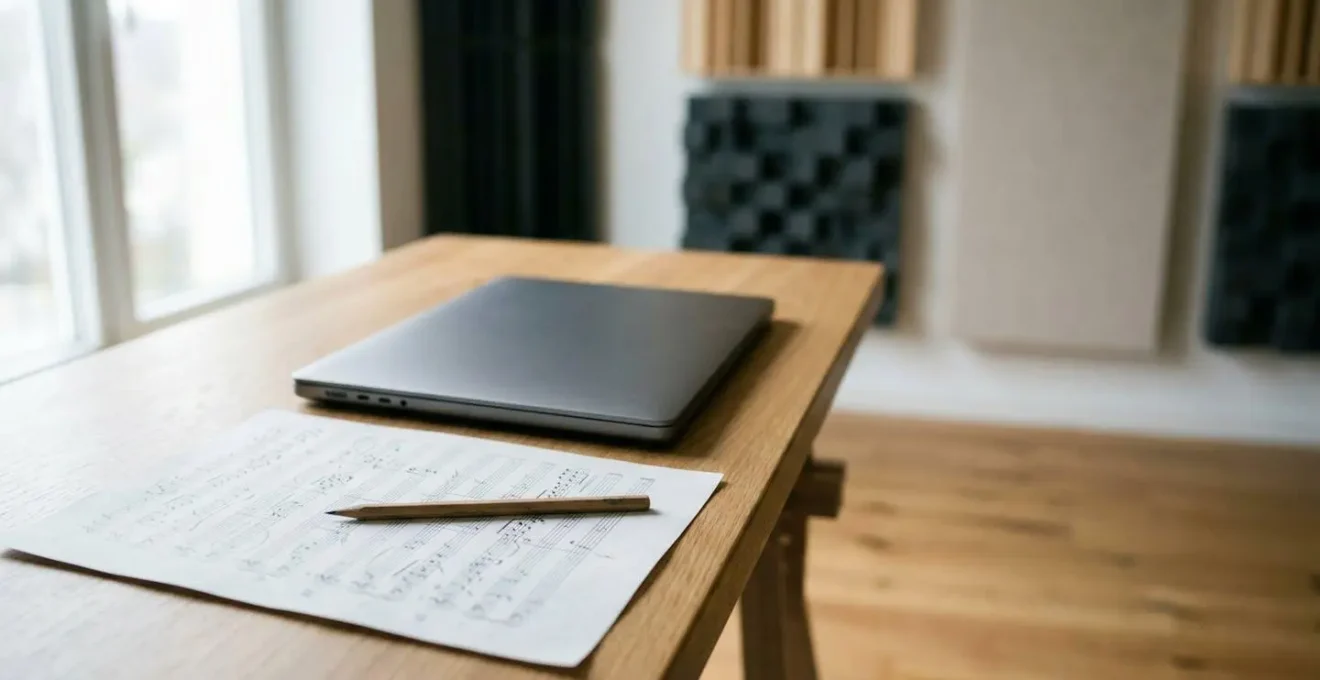
The debate over traditional theory versus modern technology in composition pedagogy is built on a false dichotomy; the most effective approach is not a balance, but a deep integration.
- Fluency in professional software (DAWs, notation) is no longer an ancillary skill but a core component of musical literacy, essential for professional communication.
- Digital Audio Workstations should be treated as pedagogical accelerants, offering immediate auditory feedback that deepens the understanding of harmony, orchestration, and structure.
Recommendation: Reframe your curriculum to teach music theory principles *through* the DAW, using technology as the primary environment for compositional practice, experimentation, and portfolio development.
The contemporary conservatoire or university music department is a place of fascinating, and often challenging, duality. In one room, a student meticulously pencils four-part harmony onto manuscript paper, wrestling with the voice-leading principles of the common practice period. In another, a different student arranges complex textures and rhythms within a Digital Audio Workstation (DAW), their screen alive with waveforms and MIDI data. For the professor of composition, this scenario presents a fundamental pedagogical question: how do we reconcile these two worlds? For decades, the conversation has been framed as a conflict between the timeless fundamentals of music theory and the encroaching demands of modern music technology.
The common advice often falls into one of two camps: the purists, who argue for a mastery of counterpoint and harmony before a student ever touches a sequencer, and the pragmatists, who insist that DAW proficiency is the only path to a viable career. This creates a perceived zero-sum game, forcing educators to choose which skills to prioritise in an already crowded curriculum. But what if this entire framework is flawed? What if the DAW is not the adversary of theory, but its most powerful and immediate pedagogical partner? The true challenge is not to balance these two domains, but to create a fully integrated ecosystem where technology acts as an accelerant for deep theoretical understanding.
This article moves beyond the ‘theory vs. tech’ debate to propose a forward-thinking pedagogical model for today’s music educators. We will explore how fluency in notation software has become as crucial as counterpoint, how to seamlessly integrate virtual instruments into traditional training, and how the demands of media scoring are reshaping the modern compositional portfolio. By reframing our approach, we can equip students with both the profound musical thinking of the classical tradition and the technical agility required to thrive as a composer in the 21st century.
This guide offers a structured approach for music educators looking to modernise their composition curriculum. The following sections provide concrete strategies and pedagogical insights for integrating technology not as a separate subject, but as the core environment for learning and creating music.
Table of Contents: Teaching Classical Composition in the Digital Age
- Why is Sibelius or Dorico fluency now as important as counterpoint?
- How to integrate VST instruments into a traditional orchestral score?
- Film Scoring vs Concert Music: which portfolio requires more technical production skills?
- The AI composition trap that gets student work disqualified
- In what order should you teach harmony: diatonic first or chromatic simultaneously?
- Stage Play vs Screenplay: which format suits your dialogue-heavy story better?
- Why do ‘counts of 8’ confuse classical composers?
- Choreographers and Composers: How to Collaborate on Original Scores?
Why is Sibelius or Dorico fluency now as important as counterpoint?
In classical music education, the mastery of counterpoint represents a deep understanding of musical syntax and voice leading. It is a foundational pillar of compositional craft. However, in the professional world, the ability to clearly and efficiently communicate musical ideas is equally fundamental. Today, that communication happens almost exclusively through digital notation software. Treating fluency in programs like Sibelius or Dorico as a secondary, vocational skill is a pedagogical misstep; it is the modern equivalent of legible musical penmanship. An illegible hand-copied score in the 19th century was unusable, and a poorly formatted, non-standard digital score is similarly unprofessional today.
This is not about prioritising technology over art, but about recognising the medium through which art is now exchanged. A composer who can write a brilliant fugue but cannot produce a professional-grade set of parts from a notation program is at a significant disadvantage. The software is the container and the delivery mechanism for their musical thought. As one contributor to a professional forum noted about training on modern software, “Training on it means being prepared to the use of one of the pro notation programs, the one that will likely be the most common in the forthcoming years.” This professional reality must inform our curriculum design.
Therefore, teaching software fluency should be integrated from the very beginning of compositional training. Exercises in harmony and counterpoint can be completed within the software, teaching students proper formatting, layout, and part-extraction skills simultaneously. This approach transforms a purely theoretical exercise into a practical simulation of a professional workflow. It ensures that when students graduate, their technical fluency matches their theoretical knowledge, making their musical ideas immediately accessible and workable for performers, conductors, and publishers.
How to integrate VST instruments into a traditional orchestral score?
The integration of Virtual Studio Technology (VST) instruments into composition pedagogy is perhaps the most powerful example of the DAW as a pedagogical accelerant. Traditionally, a student composer’s understanding of orchestration was a purely theoretical exercise, tested only by piano reductions or, on rare occasions, a reading by a student ensemble. This created a significant delay between the compositional act and the auditory result. VST instruments and high-quality sample libraries collapse this feedback loop, allowing students to hear an approximation of their orchestral ideas in real time.
This process, often called “digital orchestration” or creating a “mock-up,” is far more than a technical exercise. It is a profound ear-training tool. A student can immediately hear the difference between a clarinet in its chalumeau register and its altissimo, test the balance of a brass chorale, or experiment with unconventional instrumental doublings. This immediate feedback cultivates a practical and intuitive sense of orchestral colour and weight that was once only achievable after years of professional experience. As demonstrated by leading institutions, this skill is now a core part of advanced training. For instance, Berklee Online’s graduate-level course in film scoring explicitly focuses on creating realistic orchestral mockups that simulate live performance practices.
This close-up view of a MIDI controller symbolizes the tactile connection between the composer and the digital orchestra. The focus is on the human touch, translating musical ideas through technology.
Integrating this into a curriculum involves teaching VSTs not as sound sources, but as instruments. This means instructing students on MIDI CC automation to control dynamics (CC1), expression (CC11), and instrument-specific techniques like vibrato. It means teaching them about articulation switching to simulate bowing patterns and tonguing. This isn’t just “making it sound good”; it’s a deep-dive into the very mechanics of how instruments produce sound, a level of detail that reinforces and enhances traditional orchestration studies. The mock-up becomes the student’s audible manuscript, a living document for refining their compositional voice.
Film Scoring vs Concert Music: which portfolio requires more technical production skills?
While both film scoring and concert music composition demand immense artistic and theoretical knowledge, the portfolio requirements diverge significantly in the domain of technical production. A concert music composer’s portfolio may consist primarily of beautifully notated scores and perhaps live recordings. For a media composer, however, the MIDI mock-up is often the primary deliverable that secures work. Consequently, a film scoring portfolio demands a far greater degree of technical production acumen, including mixing, mastering, and sound design skills.
The structure of film music is dictated by external constraints: picture edits, dialogue, and specific dramatic “hit points.” This requires a composer to be fluent in a DAW environment, able to work to timecode, create seamless transitions, and deliver a polished, production-ready piece of audio. As the Indiana University Jacobs School of Music notes in its program description, their curriculum examines not only the “best musical responses to dramatic storytelling,” but also “the technical acumen needed to execute high-end competitive Midi demos that help you obtain work.” This underscores the reality that in media scoring, the demo *is* the portfolio piece.
This emphasis on production-ready mock-ups has a direct impact on employment outcomes. A composer who can deliver a demo that sounds like a finished product is more likely to be hired than one who only provides a piano sketch. The ability to manipulate sample libraries, mix orchestral elements with synthesizers, and master the final track are no longer optional extras; they are core competencies. This is reflected in the success of specialised programmes; for instance, the San Francisco Conservatory of Music’s Technology and Applied Composition (TAC) programme reports that more than 90% of their alumni are employed in their field of choice, a testament to the value of an integrated technical and artistic curriculum.
The AI composition trap that gets student work disqualified
The emergence of generative AI in music composition presents a new and complex pedagogical challenge. The “trap” for students is not merely the temptation to plagiarise, but the nuanced misunderstanding of where the line between tool and crutch lies. Simply forbidding the use of AI is an untenable and short-sighted policy. The real task for educators is to build an ethical scaffolding that teaches students how to use these powerful tools critically and creatively, rather than as a substitute for original thought.
Work is disqualified not just for blatant cheating, but for a lack of demonstrable craft and originality. If a student submits a piece largely generated by an AI, they cannot articulate the harmonic, melodic, or structural choices made. They have outsourced the very act of composition. The pedagogical focus, therefore, must shift from pure detection to a dialogue about process. Research highlights that student behaviour is driven more by internal ethics than external rules. A study on AI-assisted writing found that “Students’ ethical beliefs—not institutional policies—are the strongest predictors of perceived misconduct and actual AI use.” Our role is to shape those ethical beliefs.
This image symbolizes the crucial boundary: on one side, the organic, human element of creation; on the other, the clean, powerful, but inanimate world of technology. The educator’s job is to teach students how to navigate this divide.
Furthermore, student perceptions of misconduct are highly varied. For instance, a 2025 study in the Journal of Academic Ethics found that while using AI for an entire paper is seen as major misconduct, smaller tasks are viewed as less severe. In composition, this could translate to using AI for inspiration, to generate a harmonic progression to work from, or to orchestrate a pre-composed melody. The trap is failing to document this process and, more importantly, failing to significantly transform the AI’s output into something new and personal. The educational solution is to incorporate AI into assignments in a transparent way: “Use an AI to generate a chord progression, then write three distinct melodies over it, justifying your choices for each.” This teaches students to treat AI as a collaborator or a raw material source, not a ghostwriter.
In what order should you teach harmony: diatonic first or chromatic simultaneously?
The traditional pedagogical sequence for harmony is resolutely linear: master diatonic harmony, then introduce secondary dominants, then move to more advanced chromaticism. This method, born of the textbook and the chalkboard, is logical in a theoretical vacuum. However, in an integrated ‘theory-through-technology’ ecosystem, this rigid order may not be the most effective or musically inspiring approach. The DAW, particularly its piano roll editor, provides a visual and auditory environment where diatonic and chromatic relationships can be explored simultaneously and contextually.
Using a DAW, a student can immediately see and hear the effect of a chromatic passing note or a borrowed chord. The “snap to scale” feature can lock them into a diatonic framework, and they can then consciously move a note “off the grid” to create chromatic tension, hearing the result instantly. This transforms the learning of chromatic harmony from a set of abstract rules (“the leading note of the dominant key…”) into a tangible, cause-and-effect experience. It prioritises aural skills and compositional application over rote memorisation.
Case Study: Audible Genius’s Building Blocks Pedagogy
A compelling model for this integrated approach can be found in innovative online platforms. For example, Audible Genius’s Building Blocks course teaches music theory and harmony entirely within a DAW-like interface. It introduces concepts like chord function and voice leading through the act of composing a beat. Students learn about diatonic frameworks via scale highlighting in the piano roll, but are quickly encouraged to explore chromatic tension by manipulating automation curves for pitch bends or adding notes outside the scale to create more sophisticated melodies and basslines. This method seamlessly blends the teaching of diatonic function and chromatic colour, treating them as two sides of the same compositional coin.
This is not to say that a systematic understanding of diatonic function is unimportant. It remains the bedrock of tonal music. However, the order and method of teaching can be revolutionised. By using the DAW as the primary learning environment, we can adopt a more holistic, “just-in-time” approach to theory. We teach the theoretical concept precisely when the student needs it to achieve a desired musical effect. This makes the theory more relevant, memorable, and immediately applicable to their own creative output.
Stage Play vs Screenplay: which format suits your dialogue-heavy story better?
While seemingly a departure from musical composition, the structural distinction between a stage play and a screenplay offers a powerful analogy for the different demands placed on a composer in various media. The core question—which format is better for dialogue—is really a question of context and structural dependency. A stage play is a self-contained universe of words; the dialogue, alongside physical performance, must carry the entire narrative, emotional, and thematic weight. It is the primary structure.
A screenplay, conversely, is a blueprint for a visual medium. Dialogue is just one element in a tapestry that includes cinematography, editing, and sound design. The words are constantly in dialogue with the image. This creates a different set of constraints and opportunities. A long, eloquent monologue that might be captivating on stage could feel static and slow on screen, where the visual rhythm often dictates the pacing. The dialogue must serve the picture.
This principle of a medium’s external constraints dictating internal structure is directly applicable to music. As one analysis of film scoring pedagogy highlights, a concert piece might follow an abstract internal form like a sonata or rondo, driven by its own musical logic. In contrast, “A film cue’s structure is dictated by picture edits and on-screen action, requiring hit points, vamps, and seamless transitions that defy traditional forms.” Just as a screenwriter must write dialogue that serves the visual edit, a film composer must write music that serves the picture’s rhythm. In both cases, the narrative form is not absolute but is shaped by the demands of the final medium, whether it’s a proscenium arch or a cinema screen.
Why do ‘counts of 8’ confuse classical composers?
The “count of 8” is the fundamental unit of currency in many dance forms, particularly in commercial and theatrical choreography. It is a practical, somatic tool for dancers to learn and synchronise movement phrases. For a classically trained composer, however, this phrasing can feel arbitrary and musically unmoored, leading to confusion and frustration in collaborative settings. The root of this confusion lies in a fundamental difference in professional frameworks: composers think in terms of meter, while dancers often think in terms of phrasing blocks.
A composer is trained to understand rhythm through a hierarchical structure of beats, measures, and hyper-measures. A time signature like 4/4 or 3/4 provides a clear metrical grammar. A phrase is understood by its relationship to this underlying pulse and its harmonic cadence points. The idea of an “8-count” can seem musically meaningless if it doesn’t align with this metrical structure. For example, two measures of 4/4 naturally create an 8-beat block, which is intuitive. But a choreographer might ask for a “count of 8” over music in 3/4, which creates a syncopated, cross-rhythmic relationship that can be difficult to feel unless it is a deliberate compositional choice (e.g., a hemiola).
The confusion is not a matter of incompetence on either side, but a clash of professional languages. The dancer’s “5-6-7-8” is a pragmatic count-in, a tool for rhythmic alignment, whereas the composer’s sense of pulse is derived from the music’s internal engine of meter and harmony. Bridging this gap requires translation. The composer must learn to see the “count of 8” as a choreographic phrase marker, while the choreographer can be aided by understanding how their phrases align with or cut across the music’s metrical grid. The most successful collaborations happen when both artists work to find a shared vocabulary, using tools like timecodes or discussing phrases in terms of both counts and measures.
Key Takeaways
- The ‘theory vs. tech’ debate is obsolete; the modern pedagogical imperative is to teach theory *through* technology, using DAWs as the primary compositional environment.
- Technical production skills, particularly the ability to create high-quality orchestral mock-ups, are now a core competency for composers seeking employment in media.
- Navigating AI requires a shift from prohibitive rules to building ‘ethical scaffolding’, teaching students to use AI as a documented tool, not a ghostwriter.
Choreographers and Composers: How to Collaborate on Original Scores?
A successful collaboration between a choreographer and a composer is a dynamic partnership built on a foundation of clear communication and shared creative goals. For the modern composer, technology is the most powerful tool for facilitating this dialogue and ensuring the creative process is both efficient and artistically fulfilling. Gone are the days of a composer delivering a finished piano score and hoping for the best. Today’s workflow is iterative, flexible, and deeply integrated, with the DAW serving as the central hub for collaboration.
The composer’s primary role, beyond writing the music, is to provide the choreographer with practical, usable tools. This starts with providing high-quality mock-ups that give a clear sense of the final music’s instrumentation, texture, and emotional arc. But it extends further into providing flexible audio files. By creating tempo-mapped audio, the composer can empower the choreographer to experiment with different speeds during rehearsal using a DAW or playback software. The composer can also provide “stems”—separate audio files for different instrumental groups (e.g., strings, percussion, synths)—allowing the choreographer and sound designer to adjust the mix in the theatre to best suit the acoustics and the live performance.
This technology-driven workflow allows for a more fluid and responsive creative process. The composer can compose directly to rehearsal footage synced within their DAW, ensuring that musical “hit points” align perfectly with key moments of movement. This iterative loop—where the choreographer responds to the music and the composer responds to the movement—is the essence of true collaboration. It transforms the relationship from a simple commission into a genuine artistic dialogue.
Action Plan: A Collaborative Workflow for Composers
- Master the Tools: Learn state-of-the-art composition and recording software, including popular digital audio workstations (DAWs), notation programs, and professional plug-ins, as recommended by institutions like UNCSA’s film music program.
- Create Realistic Mock-ups: Develop proficiency with orchestral sampling libraries to create detailed mock-ups that can be shared with choreographers for clear and immediate feedback.
- Develop Production Skills: Gain skills in recording, mixing, and mastering to manage the entire audio production process, ensuring the final deliverable is of professional quality.
- Compose to Picture: Use the video synchronization features in your DAW to compose music directly to rehearsal footage, allowing for precise alignment between music and movement.
- Provide Flexible Deliverables: Export tempo-mapped audio files and instrumental stems to give choreographers and sound designers flexibility during rehearsals and technical run-throughs.
By embracing these strategies, you can transform your pedagogical approach from a balancing act into a truly integrated and forward-thinking curriculum. Begin today by incorporating one of these technological-pedagogical strategies into your next lesson plan, and witness how the ‘theory vs. tech’ debate dissolves into a dynamic, creative ecosystem for the 21st-century composer.