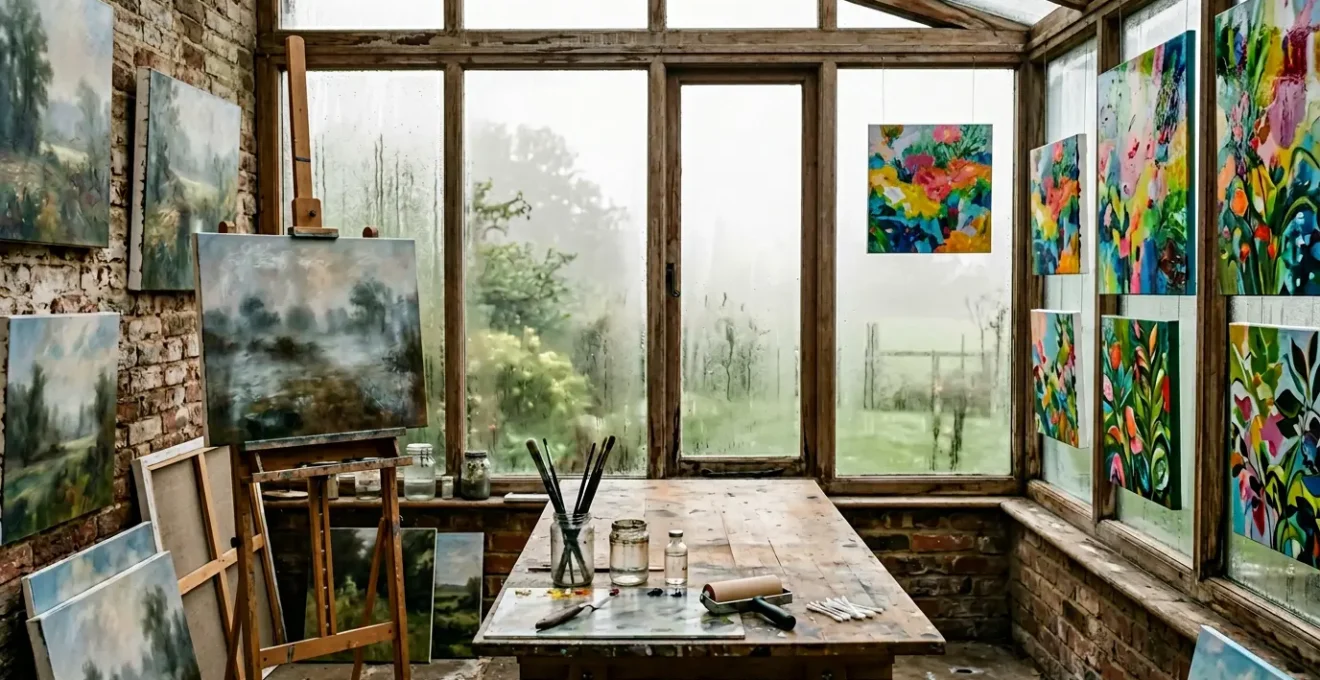
The longevity of a painting in the UK depends less on whether it’s oil or acrylic, and more on its chemical stability against constant humidity and temperature fluctuations.
- Oil paints are susceptible to ‘bloom’ (a hazy surface) in damp conditions, a direct result of fatty acid saponification.
- Acrylic paints can become brittle and crack due to dry winter heating, a response of their polymer structure to low humidity.
Recommendation: Prioritise artworks with a documented history of stable storage and consider environmental controls for your home as the primary factor in preserving long-term value.
For a UK-based art collector, the choice between an oil painting and an acrylic work often revolves around aesthetics—the deep, luminous layers of oil versus the bold, vibrant finish of acrylic. Yet, this debate overlooks a more critical factor: a silent battle being waged at a molecular level. The persistent dampness of the British climate, coupled with the dry spells of indoor central heating, creates a uniquely challenging environment for fine art. Understanding this is not just an academic exercise; it’s fundamental to protecting your investment and the emotional resonance of your collection.
Most advice focuses on the artist’s technique or the initial look of the medium. But for a collector, the real questions are about longevity. What are the hidden vulnerabilities of each medium? How will a piece look in twenty years, hanging in a British home that swings from humid summers to bone-dry winters? This is not just a matter of art, but of material science. The key to a resilient collection lies not in choosing the “superior” medium, but in understanding the specific chemical and physical weaknesses each one presents in the face of our climate, and how to mitigate them.
This guide delves into the science behind art conservation in a UK context. We will explore the specific failure points for both oil and acrylic paints, examine their impact on auction value, and provide practical strategies for collectors to ensure the longevity and stability of their most cherished pieces.
Summary: Oil Painting vs Acrylics: Which Medium Best Suits a Damp UK Climate?
- Why do oil paintings develop ‘bloom’ in unheated conservatories?
- How to dust heavy impasto acrylics without trapping lint in the texture?
- Oil depth vs Acrylic vibrancy: which commands higher prices at auction?
- The heating error that causes acrylics to become brittle and crack in winter
- How to choose between gloss and matte varnish to reduce glare from windows?
- Why do works on paper require more stringent climate control than canvas?
- Why do vintage motors burn out when run on modern voltage?
- Which Artistic Mediums Retain the Highest Value for UK Collectors?
Why do oil paintings develop ‘bloom’ in unheated conservatories?
The hazy, crystalline film that can appear on the surface of an oil painting, especially one kept in a damp or unheated space like a conservatory, is a common concern for UK collectors. This phenomenon, known as ‘bloom’, is not merely a layer of dust but a chemical reaction. It occurs when moisture in the air reacts with the free fatty acids present in the oil paint binder. This process, a form of saponification, creates tiny, soap-like crystals on the paint’s surface, scattering light and obscuring the colours and details beneath.
The UK’s climate is a primary catalyst for this issue. The key environmental factor is relative humidity (RH). While a stable environment is always best, conservation research indicates a range of 40-60% RH is optimal for preserving oil paintings. In many British homes, and particularly in areas like conservatories or basements, ambient RH can frequently exceed 70% or 80%. These high-humidity conditions significantly accelerate the rate of hydrolysis and the formation of dicarboxylic acids within the paint film, providing the perfect conditions for bloom to develop.
Furthermore, temperature fluctuations exacerbate the problem. When the surface of the painting cools, moisture from the warmer air can condense on it, directly delivering the water needed to trigger the saponification process. This is why paintings hung on cold, external walls are particularly vulnerable. Effectively, the deep, lustrous quality that makes oil paint so desirable is also chemically susceptible to the very air in a damp environment, requiring careful management to prevent long-term degradation.
How to dust heavy impasto acrylics without trapping lint in the texture?
Acrylic paintings, particularly those with a heavy impasto technique, present a different kind of conservation challenge. The thick, sculptural texture that gives these works such dynamic presence also creates a perfect trap for dust, fibres, and airborne pollutants. Unlike a smooth surface, you cannot simply wipe an impasto painting. Doing so with a standard cloth is one of the worst mistakes a collector can make, as fibres from the cloth will snag on the paint’s peaks and become permanently embedded in the artwork.
The professional approach to cleaning these textured surfaces is delicate and methodical, prioritising non-contact methods first. The primary tool is a very soft, natural-bristle brush (such as a sable or goat-hair brush) used exclusively for this purpose. The aim is to gently flick the dust off the surface, working from top to bottom, without applying pressure that could grind particles into the paint’s valleys. For stubborn dust, a can of compressed air, held at a safe distance and angled shallowly, can dislodge particles from deep crevices without touching the surface.
As the image above demonstrates, the key is precision and control. The complex topography of an impasto surface means that any cleaning attempt must respect its three-dimensional nature. It is crucial to avoid all household dusters, feather dusters, and lint-heavy cloths. If a work is particularly soiled, the only safe recourse is to consult a professional art conservator. Attempting to use water or solvents without expert knowledge can irreversibly alter the acrylic’s sheen and colour.
Oil depth vs Acrylic vibrancy: which commands higher prices at auction?
When it comes to auction value, the medium itself is rarely the sole determining factor; artist reputation, provenance, and condition are paramount. However, the inherent vulnerabilities of each medium, especially in the context of the UK climate, directly impact condition and, therefore, long-term value. While oil paintings have historically commanded the highest prices, the conversation around modern and contemporary art is shifting as conservation science reveals new challenges.
The “depth” of oil paint comes from its refractive index, but its complex, slow-drying chemical structure makes it susceptible to problems like bloom, yellowing, and cracking. These condition issues are a significant concern for auction houses and collectors. For instance, research from Tate Modern reveals that at least 24 modern oil paintings in its own collection exhibit water sensitivity issues, a major conservation red flag. A painting requiring extensive conservation work will almost always see its value diminished compared to a pristine example.
Acrylics, while more resistant to the yellowing that affects oil, are not immune to degradation. Their vibrancy is a key selling point, but as we will see, they can become brittle and crack. A key insight comes from art conservation experts who note the specific challenges of newer materials. As stated in a prominent scientific journal:
The conservation of modern oil paintings, made in the twentieth- and twenty-first century, faces challenges that are different from oil paintings produced in the previous centuries.
– Scientific Reports, Nature Journal Study on Oil Paint Degradation
Ultimately, a well-preserved acrylic will hold more value than a poorly-kept oil, and vice versa. The medium that retains the highest value is the one that has been best protected from its inherent weaknesses. For a UK collector, this means the ‘smarter’ investment is not necessarily oil or acrylic, but the one whose stability is most assured for the future.
The heating error that causes acrylics to become brittle and crack in winter
While summer humidity poses a threat to oils, the dry indoor environment of a British winter is the primary enemy of acrylic paintings. The culprit is the drastic drop in relative humidity caused by central heating. Acrylic paint is a thermoplastic, meaning its physical properties change significantly with temperature and humidity. It is composed of pigment suspended in an acrylic polymer emulsion which, when dry, forms a stable yet flexible film.
However, this flexibility is dependent on retaining a certain amount of ambient moisture. When central heating runs for extended periods, it can cause the RH in a room to plummet well below 40%. In this excessively dry environment, the acrylic polymer film loses its moisture and its flexibility. It passes below its ‘glass transition temperature’ and becomes hard, stiff, and extremely brittle. In this state, the painting can no longer safely expand and contract with the minor environmental shifts or movements of its canvas support. The accumulated stress eventually leads to microscopic fractures that can grow into visible, irreversible cracks.
This comparative table, based on museum conservation standards from sources like The National Gallery, clearly illustrates the opposing vulnerabilities of the two mediums.
| Environmental Factor | Museum Standard | Impact on Oils | Impact on Acrylics |
|---|---|---|---|
| Relative Humidity | 55 ± 5% | High RH causes bloom and oxidation | Becomes brittle in low RH |
| Temperature | 21±1°C winter; 23±1°C summer | Stable within range | Thermoplastic response to extremes |
| Light Level | 150 ± 50 lux | Yellowing of medium | More UV resistant |
The crucial takeaway is that neither medium is inherently “better”; they simply have different, and often opposite, environmental weaknesses. A collector must be aware that keeping their home warm in winter creates a high-risk environment for their acrylics, necessitating measures like humidifiers to maintain a stable RH.
How to choose between gloss and matte varnish to reduce glare from windows?
Varnishing is the final, crucial step in protecting a painting, but it also has a significant aesthetic impact, particularly concerning glare. In a typical British home with large windows, unwanted reflections can obscure the artwork, diminishing the viewing experience. The choice between a gloss and matte varnish is a trade-off between colour saturation and reflection control. A gloss varnish is optically clear, so it saturates colours, making them appear deeper and richer. However, its smooth surface acts like a mirror, creating sharp, distracting glare.
A matte varnish, on the other hand, contains matting agents that create a micro-textured surface. This texture scatters light in multiple directions, effectively eliminating glare. The downside is that this same light-scattering effect can slightly dull the colours and reduce the perceived depth of the darkest passages. For many collectors, the solution is a compromise: a satin varnish, which offers a balance of good colour saturation with significantly reduced glare.
Beyond the varnish itself, there are other professional strategies to manage reflections from windows. Glazing with specialised non-reflective glass or Perspex can be highly effective, though it’s vital to ensure a gap is left between the glass and the paint surface to allow for air circulation. Ultimately, the choice depends on the specific artwork and its placement relative to light sources.
Your Action Plan for Glare Management
- Assess the Location: Before varnishing, place the painting in its intended location. Observe how natural and artificial light hits it at different times of day to determine the severity of glare.
- Consider a Compromise: Instead of a pure gloss or matte, test a satin varnish on a similar, non-valuable surface. It often provides the best balance of colour vibrancy and glare reduction for home environments.
- Explore Professional Glazing: For highly valuable works or pieces in very bright rooms, consult a professional framer about using non-reflective laminated glass or Perspex as a primary barrier against both glare and UV light.
- Protect the Original (Acrylics): Always apply a non-removable ‘isolation coat’ to an acrylic painting before the final, removable varnish. This protects the actual paint layer from any future cleaning or varnish removal process.
- Customise the Finish: For advanced users or conservators, a custom satin finish can be created by carefully mixing gloss and matte varnishes in controlled ratios to achieve the exact desired level of sheen.
Why do works on paper require more stringent climate control than canvas?
While canvas is susceptible to environmental changes, works on paper are exponentially more vulnerable. The reason lies in the fundamental material properties of paper itself. Paper is a hygroscopic material, meaning it readily absorbs and releases moisture from the surrounding atmosphere. This makes its dimensional stability—its ability to hold its shape—highly dependent on the ambient relative humidity. A canvas is also hygroscopic, but its woven structure provides a degree of mechanical strength that paper lacks.
When RH increases, paper fibres swell, causing the sheet to buckle or “cockle.” When RH decreases, the fibres shrink, which can lead to tension and tearing if the paper is constrained, for example by its frame. This constant expansion and contraction is physically damaging. Furthermore, the presence of moisture accelerates chemical degradation, such as acid hydrolysis, which causes paper to become yellow and brittle over time. It also creates a hospitable environment for mould growth, which can cause irreversible staining known as “foxing.”
The National Gallery’s Wartime Experiment
A powerful, real-world demonstration of this principle occurred during the Second World War. When the UK’s National Gallery evacuated its collection to a slate quarry at Manod in Wales, conservators found an environment with a naturally cool and exceptionally stable temperature and relative humidity. The effect was profound. As the Gallery’s own records show, the rate of naturally occurring damage, such as flaking paint on old panel paintings, fell to an extremely low level. However, upon returning the artworks to the uncontrolled environment of the post-war London gallery, the regular pattern of flaking and degradation immediately resumed. This stark contrast provided undeniable proof that a stable climate is the single most important factor in art preservation and led directly to the recommendation for comprehensive air-conditioning in museums.
For a collector, this means that any artwork on paper—be it a watercolour, print, or drawing—requires a far more rigorous approach to climate control than a painting on canvas. Framing with archival, acid-free materials and UV-protective glass is not a luxury, but an absolute necessity to create a stable micro-environment for the fragile work within.
Why do vintage motors burn out when run on modern voltage?
This question may seem out of place in a discussion of fine art, but it offers a powerful analogy for understanding how historical artworks behave in contemporary environments. Think of a classic oil painting formulation from a century ago as a ‘vintage motor,’ engineered for a different era’s conditions. When you run this ‘motor’ on the ‘modern voltage’ of a centrally-heated, thermally-inconsistent UK home, you risk burnout. The principles of material stress are surprisingly similar.
A vintage motor was designed for a stable, lower electrical voltage. Subjecting its old wiring to the high, fluctuating power of a modern grid causes it to overheat, its insulation to fail, and the motor to burn out. Similarly, an older oil painting was created in and for an environment without central heating—a world of drafts, thicker walls, and more gradual temperature shifts. Its materials (natural binders, ground pigments, wooden supports) reached a state of equilibrium with that environment.
Placing that same painting in a modern home is like plugging it into the wrong socket. The ‘high voltage’ is the daily cycle of central heating: the air becomes extremely dry, stressing the wooden panel or canvas and the brittle paint layers. Then the heating goes off, and the house cools, drawing in damp evening air, causing the materials to swell. This rapid cycling of expansion and contraction—this “over-voltage” of environmental stress—is far more damaging than a constant state of being slightly too damp or too dry. It accelerates cracking, delamination, and the breakdown of the painting’s fundamental structure, just as modern electricity destroys a vintage motor.
Key takeaways
- The UK climate presents opposite threats: high humidity damages oils (‘bloom’), while low-humidity central heating damages acrylics (cracking).
- The stability of the support material is critical; works on paper are far more sensitive to humidity changes than works on canvas.
- Long-term value is directly tied to condition. A well-preserved artwork in a stable environment will always be a better investment, regardless of medium.
Which Artistic Mediums Retain the Highest Value for UK Collectors?
After examining the specific material science of oils and acrylics, we can return to the collector’s ultimate question: which medium is the better investment for long-term value retention in the UK? The answer is nuanced. It is not the medium, but the stability. An artwork’s ability to resist the degradation caused by the British climate is the most critical factor in preserving its financial and aesthetic value over decades.
An oil painting, with its potential for luminous depth, can be a superb investment, but only if the collector can protect it from the high relative humidity that causes bloom and supports mould growth. This requires more than just a dry room; it demands a stable environment, ideally with RH kept below 65%. An acrylic, with its brilliant, modern colours, can also be an excellent investment, but only if it is shielded from the extreme dryness of winter central heating that leads to embrittlement and cracking. This may necessitate using a humidifier to keep RH from dropping below 40%.
Therefore, the ‘best’ medium is entirely relative to the collector’s own environment and their commitment to conservation. A collector living in a modern, well-sealed flat with climate control might find oils perfectly manageable. Conversely, someone in an older, draftier house might discover that acrylics are less susceptible to the ambient damp, provided they manage winter heating. The greatest risk to value is not choosing oil over acrylic, but ignoring the environmental war being waged against whichever medium you choose. A proactive approach to conservation will always yield a better return than a passive hope that a masterpiece will simply endure on its own.
The logical next step is to assess your own home’s environment and a painting’s condition before purchase. Securing a professional assessment from an art conservator is the most effective way to understand the specific risks and preservation needs of a piece you intend to acquire, ensuring it remains a source of joy and a stable asset for years to come.