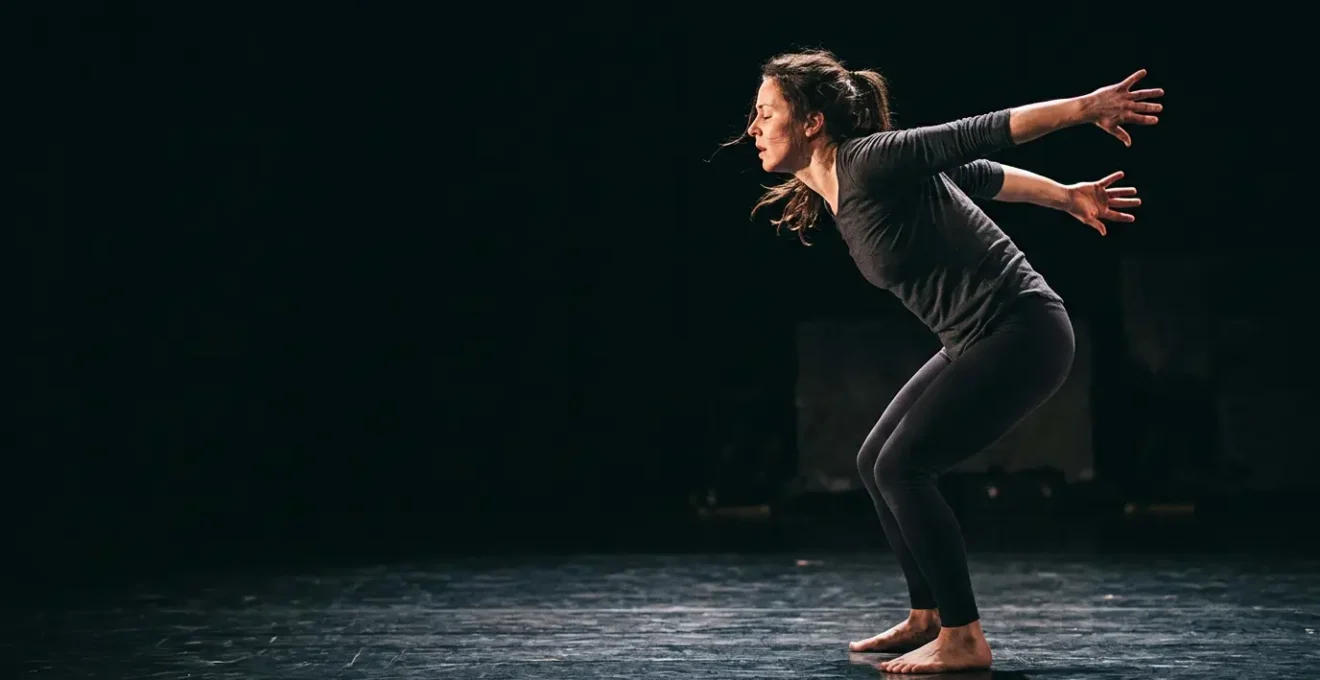
Physical theatre isn’t about miming actions; it’s about translating internal intent into a precise, physical grammar the audience can read.
- Core emotions originate in the torso and are often more telling than facial expressions.
- Authenticity comes from embodying a character’s motivation (‘the why’), not just indicating a gesture (‘the what’).
Recommendation: Focus on mastering the sequence of movement and the power of stillness to build a clear, unspoken narrative.
As a performer or director, you’ve felt it. That moment when an actor, rich with internal life, becomes physically mute, trapped in their own head. The common advice—”be more expressive,” “use your body”—is frustratingly vague. It often leads to broad, meaningless gestures that say nothing at all. We are told to tell stories, but we are rarely taught the specific, unspoken language required to do so when text is removed. The truth is, many performers simply mimic emotions, playing a high-stakes game of charades with the audience.
But what if the body had its own grammar? A set of rules as precise as any spoken language, where every choice, from the isolation of a muscle to the sequence of a glance, could build a clear, unspoken sentence. This isn’t about bigger movements; it’s about smarter, more anatomically honest ones. It’s about understanding that the torso can scream while the face remains calm, that the space between two actors can be more charged than any dialogue, and that stillness is often the most powerful action of all.
This guide moves beyond the platitudes. We will deconstruct this physical grammar, starting with the body’s emotional core, exploring the philosophies that shape movement, and identifying the common mistakes that undermine authenticity. By the end, you’ll have a clear framework for directing and performing stories that are not just seen, but felt, proving that the most profound narratives are often the ones left unspoken.
To navigate this exploration of non-verbal storytelling, this article is structured to build your understanding from foundational principles to advanced applications. The following summary outlines the key stages of our journey into the body’s expressive potential.
Summary: The Complete Guide to Non-Verbal Narration
- Why must you isolate the torso to convey specific emotions clearly?
- How to make an audience understand ‘I want that apple’ without saying a word?
- Lecoq vs Decroux: which physical method suits comic storytelling better?
- The ‘over-acting’ mistake that turns physical theatre into a game of charades
- In what order should eyes, head, and body move to signal a change in thought?
- When to break the fourth wall: pacing intimacy for maximum impact
- How to use proximity and stillness to create tension in large proscenium arches?
- Dramatic Theater Direction: Making Shakespeare Relevant for Gen Z Audiences?
Why must you isolate the torso to convey specific emotions clearly?
We are trained to look to the face for emotional cues, but this is a deeply misleading habit in performance. The face can lie; the body cannot. The true epicenter of our core emotional state—fear, joy, grief, rage—is the torso. It is the body’s resonant cavity, the source of breath, and the anchor of our posture. While the face might register a fleeting social smile, the torso could be clenched in anxiety or hollowed by loss. This is why research indicates that nonverbal communication makes up 65 to 95 percent of all communication; the body’s signals are simply more honest.
To convey a specific emotion with clarity, a performer must learn to create what I call an emotional topography. This means understanding that different emotions inhabit and radiate from different parts of the body. Isolating the torso allows you to articulate this core state without the noise of flailing limbs or an over-expressive face. A subtle curve in the spine can communicate profound defeat more effectively than a frown. A tightening of the solar plexus can signal rising panic long before the eyes widen. True physical storytelling begins here, in the ability to speak volumes with the core of your being.
As research from Princeton University confirms, the body is the ultimate arbiter of intense feeling. In the study, viewers were more accurate in judging an emotion when they saw only the subject’s body, not their face.
Body Cues, Not Facial Expressions, Discriminate Between Intense Positive and Negative Emotions.
– Alexander Todorov, Princeton University research published in Science
This principle of torso-centric emotion is not just an exercise; it is the foundation of believable physical performance. By mastering this isolation, you gain control over the most powerful and truthful instrument of expression you possess. The rest of the body then becomes an amplifier or a counterpoint to this core emotional truth, but it must never contradict it.
How to make an audience understand ‘I want that apple’ without saying a word?
To convey desire without words is to master the art of the charged space. It is not about the gesture of reaching; it is about the palpable tension that fills the air between the subject and the object of their want. The audience must feel the magnetic pull, the internal debate, and the sheer force of will that precedes any physical action. This is achieved not through mime, but through focus and stillness. The desire begins in the eyes. The gaze locks onto the object—the apple—and for a moment, the rest of the world ceases to exist. This intense focus is the first clause in your physical sentence.
The body then follows, but with immense control. It’s a lean, a subtle shift of weight, a preparation of the muscles that signals intent. The hand may lift, but it is the quality of the movement that tells the story. Is it a slow, deliberate reach of longing? A quick, hesitant motion of forbidden desire? Or the predatory stillness before a snatch? The space between the fingertips and the apple becomes the stage for the entire drama. It is in this charged negative space that the story of “want” is truly told.
As this image demonstrates, the story is in the micro-tensions. The visible tendons, the slight curve of the fingers, the fractional distance yet to be crossed—these details communicate a world of information. The audience doesn’t just see a person reaching for an apple; they experience the physical sensation of craving. This is anatomical honesty in action: the internal state of “want” manifesting as a tangible, physical reality that charges the empty space with meaning.
Lecoq vs Decroux: which physical method suits comic storytelling better?
The question of whether Lecoq or Decroux is “better” for comedy is like asking if a painter should use watercolour or oil. The answer depends entirely on the kind of picture you want to create. Both masters offer a profound physical vocabulary, but their philosophies lead to distinctly different comedic textures. Jacques Lecoq’s method, rooted in ‘le jeu’ (play), is about an actor’s dynamic response to the world around them. It excels at creating situational comedy, ensemble chaos, and the delightful absurdity that arises from characters buffeted by external forces. It is the language of improvisation, reaction, and joyful pandemonium.
Étienne Decroux’s Corporeal Mime, by contrast, is an internal, sculptural art. It focuses on the body as a precise, articulate instrument, “making the invisible visible.” This method is unparalleled for character-driven comedy. It gives a performer the control to reveal a character’s internal tics, contradictions, and neuroses through hyper-articulate physical grammar. It is the language of the perfectly executed pratfall, the meticulously timed double-take, and the comedy that comes from a character’s own flawed internal logic.
This comparative table, drawing from an analysis of Decroux’s corporeal mime, clarifies the distinction:
| Aspect | Jacques Lecoq Method | Étienne Decroux Method |
|---|---|---|
| Core Philosophy | Emphasis on ‘le jeu’ (play), improvisation, and reacting to external elements | Corporeal Mime: body as primary instrument, ‘making the invisible visible’ |
| Training Foundation | Neutral mask, seven levels of tension, movement analysis of natural elements | Precise articulation and chronology, systematic corporeal technique |
| Best for Comedy Type | Situational & ensemble comedy, absurd situations, chaotic group dynamics | Character-driven comedy, slapstick, internal tics and contradictions |
| Precision vs Spontaneity | Playfulness and spontaneous response to environment | Highly articulate, repeatable, controlled execution of gags |
| Modern Application | Building comedic escalation through tension levels (subtle to pandemonium) | Precise execution of complex physical comedy sequences |
Case Study: Frantic Assembly’s Hybrid Physical Comedy Approach
Leading UK physical theatre company Frantic Assembly demonstrates the modern hybrid approach to physical comedy by combining elements from both Lecoq and Decroux traditions. As highlighted in a guide to physical theatre, the company uses Decroux-inspired precision for choreographed physical sequences while incorporating Lecoq’s emphasis on play and ensemble improvisation to create dynamic, comedic performances accessible to contemporary audiences.
The ‘over-acting’ mistake that turns physical theatre into a game of charades
The single greatest mistake in physical performance is the impulse to *indicate* rather than to *embody*. This is the trap of “over-acting,” and it instantly transforms potentially profound physical theatre into a simplistic game of charades. Indicating is when a performer translates a word or an idea into a literal gesture: they point to their head for “think,” clutch their heart for “love,” or mime crying for “sad.” This is not storytelling; it is illustration. It’s a desperate attempt to show the audience the answer, born from a lack of trust in both the body’s intelligence and the audience’s perception.
True physical expression is not a translation of text; it is the organic result of an internal state. The performer must focus on the ‘why’—the character’s deep-seated need, fear, or desire—not the ‘what’ of the gesture. If a character is desperate for forgiveness, they don’t mime begging. Instead, the performer fills themselves with that desperate need, and the body will respond with anatomical honesty. Perhaps the shoulders collapse, the breath becomes shallow, or the hands open in a gesture of supplication. The resulting movement is authentic because it is a consequence, not a plan. It emerges from the character’s core rather than being pasted on top.
Avoiding this trap requires a radical shift in focus from external shapes to internal motivation. It demands embracing stillness and understanding that an action’s power is often in its preparation and its aftermath, not just the action itself. The most powerful moments are often found in the charged pause before a decision or the resonant stillness after an outburst.
Action Plan: From Charades to Authenticity
- Focus on the ‘why’ (character’s need) rather than the ‘what’ (literal gesture translation).
- Embrace active stillness and charged pauses before and after actions.
- Use breath as an authenticity gauge—held or unnatural breathing often signals an inorganic, indicated emotion.
- Let physical actions emerge organically from a fully realized internal emotional state.
- Avoid filling valuable empty spaces with unnecessary “movement noise” or fidgeting.
In what order should eyes, head, and body move to signal a change in thought?
A change in thought is not a singular event; it is a physical sequence. To make this internal shift legible to an audience, a performer must respect the body’s natural orienting response. This is a fundamental rule of our physical grammar, hard-wired into our neurology. When we are surprised or intrigued by a new stimulus, our bodies react in a specific, predictable order: first the eyes, then the head, then the torso and body. To violate this sequence is to create a movement that feels artificial, robotic, and unbelievable.
Imagine a character on stage who hears a sudden noise off-stage right. The first thing to move must be the eyes. They flick to the source of the sound, instantly and involuntarily. This is the fastest, most sensitive part of the response. The head follows a split-second later, turning to bring the sound into a clearer field of vision and hearing. Finally, if the stimulus is compelling or threatening enough, the torso and the rest of the body will pivot, re-orienting the character’s entire being toward the new point of focus. This sequence—Eyes, Head, Body—is the physical signature of a mind changing its focus.
This image perfectly captures a moment within that sequence. The performer’s eyes have already locked onto the off-stage stimulus, their head is in the process of turning, but their torso has not yet fully committed. This “in-between” state is rich with information, showing the audience the precise moment of a decision being made. Mastering this sequence allows a director to externalize a character’s thought process, making their internal world visible and creating a clear narrative of attention and decision-making on stage.
When to break the fourth wall: pacing intimacy for maximum impact
In physical theatre, breaking the fourth wall is so much more than an actor turning to the audience and speaking. It is a physical, energetic transaction. It’s a shared glance, a conspiratorial breath, or a moment where the performer’s presence extends beyond the proscenium arch to create a direct, unspoken pact with the spectators. The question is not *if* you should break it, but *when* and *how*. The impact of this moment is entirely dependent on its scarcity and its timing. If overused, it becomes a gimmick; if perfectly placed, it can be a moment of profound, shared intimacy.
The key is to earn it. The performance must first build a self-contained, believable world on stage. The audience must be invested in the relationships and tensions within that world. Only then, at a moment of peak tension, private revelation, or comedic frustration, can the wall be pierced. A character, utterly defeated by their circumstances, might let their gaze sweep across the audience, not to ask for help, but simply to say, “You see this, right?” In that moment, the audience is transformed from passive observers into silent confidants. The connection is electric because it is earned and unexpected.
As MasterClass notes in their exploration of the form, this is a hallmark of many pioneering companies who seek a more immediate connection with their audience.
Many physical theater companies tear down the separation between audience and performers by extending the boundaries of the stage past the traditional limits of the proscenium.
– MasterClass, Physical Theatre: 3 Types of Physical Theatre
Case Study: Complicité’s Audience Connection Philosophy
The physical theatre company Complicité, which even derived its name from this actor-audience collaboration, became world-renowned for this very technique. They pioneered what they called “secret pacts” with audiences. These were achieved through fleeting glances and shared physical moments that broke the fourth wall without a single word. As noted in a guide on physical theatre, this demonstrates how the technique transcends verbal address to become a profound connection built on movement and presence alone, solidifying the audience’s role as a silent partner in the creation of meaning.
How to use proximity and stillness to create tension in large proscenium arches?
A large stage is not a void to be filled, but a canvas to be sculpted with space and stillness. In a vast proscenium, the distance between bodies—the proximity—becomes a powerful storytelling tool. The greatest mistake is to fill this space with constant, noisy movement. Instead, a director must learn to charge the negative space, turning emptiness into an active emotional landscape. This is achieved by weaponizing stillness and distance to create focal points and unbearable tension.
Imagine two characters locked in a silent conflict. Placing them at opposite ends of a wide stage creates an immediate visual representation of their emotional chasm. The vast space between them is not empty; it is filled with everything they cannot say. If one character then takes a single, slow, deliberate step toward the other, the entire dynamic of the stage shifts. The space shrinks, the tension skyrockets. This is far more powerful than having them pace aimlessly. The key techniques for this include:
- Focused Stillness: A performer who is completely still but radiating intense internal focus becomes a gravitational center on stage, forcing the audience’s attention.
- Magnetic Poles: Positioning emotionally linked characters (lovers, rivals) at extreme distances creates a “rubber band” effect, where the space between them feels taut and ready to snap.
- Micro-Movements in Macro-Space: In a vast, still stage picture, a tiny, repeated movement—a tapping finger, a twitching foot—becomes enormous, drawing the eye and signaling immense internal turmoil.
By using these principles, the space itself becomes a character in the drama. It can represent isolation, desire, or threat. The director’s job is to compose these stage pictures with the precision of a painter, understanding that what is left empty is just as important as what is filled. The actor’s job is to master the active stillness required to hold that tension.
Key Takeaways
- The torso is the true core of emotional expression, often providing more honest cues than the face.
- Authentic physical performance stems from embodying the character’s internal motivation (‘the why’), not just illustrating an action (‘the what’).
- Stillness and the strategic use of space are active, powerful tools for building tension and focusing audience attention.
Dramatic Theater Direction: Making Shakespeare Relevant for Gen Z Audiences?
The debate over making Shakespeare “relevant” often circles around updating the language or setting. This misses the point entirely. The emotional core of Shakespeare’s work is timeless; it’s the linguistic barrier that can alienate a modern, visually-oriented audience like Gen Z. The most potent solution is not to change the words, but to translate their emotional and visceral power through a robust physical grammar. When the body tells the story with clarity and force, the audience understands the rage of Tybalt or the grief of Juliet on a gut level, regardless of iambic pentameter.
The enduring appeal and adaptability of these stories is clear, as Shakespeare’s timeless works have generated over 200 screen adaptations, each seeking to bridge this gap. Physical theatre offers the most direct bridge. By focusing on the techniques we’ve discussed—torso-driven emotion, charged space, and anatomical honesty—a director can stage a Shakespeare play that feels immediate and raw. The verbal poetry is complemented by an equally rich physical poetry. The conflict is not just heard in the text; it is seen in the tense proximity of rival families. Love is not just declared in a sonnet; it is felt in a shared, stolen breath across a crowded room.
Case Study: Sam Gold’s Broadway Romeo and Juliet for Gen Z
Sam Gold’s 2024 Broadway production of ‘Romeo and Juliet’ is a masterclass in this approach. As one review of the ‘Romeo and Juliet’ production noted, by starring young actors Kit Connor and Rachel Zegler and keeping the original language intact, the production leans heavily on physical theatre to connect with a Gen Z audience. The use of simplified sets, performers running through aisles, and pre-show physical improvisations creates an immersive, visceral experience. It successfully translates Shakespeare’s soaring emotional intensity into a body-driven narrative that feels urgent and contemporary, proving that the most effective way to make Shakespeare relevant is to make it physically resonant.
This approach doesn’t dumb down the material; it unlocks it. It honors the text by giving its subtext a powerful, physical life, ensuring these essential human stories continue to connect with every generation.
Begin embodying these principles today and transform your stagecraft from mere action into profound, unspoken poetry.