In summary:
- The primary challenge in heritage venues is not a lack of options, but the need for a non-invasive engineering mindset that treats the building as an unalterable system component.
- Successful event production requires designing technical solutions (power, rigging, acoustics) around the venue’s fixed constraints, not trying to force the venue to adapt.
- Meticulous planning, from power load calculations to acoustic modelling and legal compliance with Listed Building Consent, is non-negotiable and prevents costly failures.
- By adopting a conservation-led approach, events can generate significant revenue that directly funds the preservation of these iconic UK spaces.
Walking into a Grade I listed cathedral or a centuries-old castle to plan a major event is a uniquely challenging experience. The immediate beauty is often overshadowed by a production director’s internal monologue of constraints: “Where can I rig? What’s the power situation? How will sound behave in here?” For event producers in the UK, the tightrope walk between deploying cutting-edge technology and respecting the fabric of a protected heritage site is a constant reality. The standard advice—”be careful,” “talk to the venue”—is well-intentioned but fundamentally inadequate for the technical complexity involved.
Many guides focus on the obvious problems, but they often miss the underlying principle. The common mistake is to view the venue as a passive backdrop that must be forced to accommodate modern production needs. This approach leads to conflict, potential damage, and regulatory nightmares. The key to success is not a battle between tech and tradition, but a disciplined exercise in temporary, non-invasive integration. This means shifting your perspective: the historic building is not an obstacle; it is the primary, unalterable component of your technical system.
This guide abandons the platitudes and instead adopts the mindset of a conservation-led production director. We will not just list problems; we will dissect the engineering and legal reasons behind them. From calculating generator loads for a building with medieval wiring to installing immersive LED walls without leaving a single mark, we will explore the specialist techniques required. This is about treating the venue with the respect of a curator while applying the precision of an engineer, ensuring your event is memorable for the right reasons and that you are invited back.
To navigate these complexities, this article breaks down the most critical technical and logistical challenges faced by producers in heritage spaces. Each section addresses a specific, high-stakes question, providing a framework for planning, problem-solving, and executing flawless events that honour their historic settings.
Summary: A Production Director’s Guide to Tech in Heritage Venues
- Why can’t you drill into the stonework to hang your lighting rig?
- How to calculate generator needs when the venue’s 13-amp sockets are insufficient?
- Theatre vs Cathedral: which acoustic environment is harder to mix sound for?
- The decibel limit oversight that gets your event shut down by the council
- When to schedule load-in to avoid disrupting public opening hours?
- How to install immersive LED walls in Grade II listed buildings without damage?
- The planning error that leads to a criminal conviction for altering a Grade I building
- Preserving Artistic Heritage: Funding Restoration in Listed Buildings?
Why can’t you drill into the stonework to hang your lighting rig?
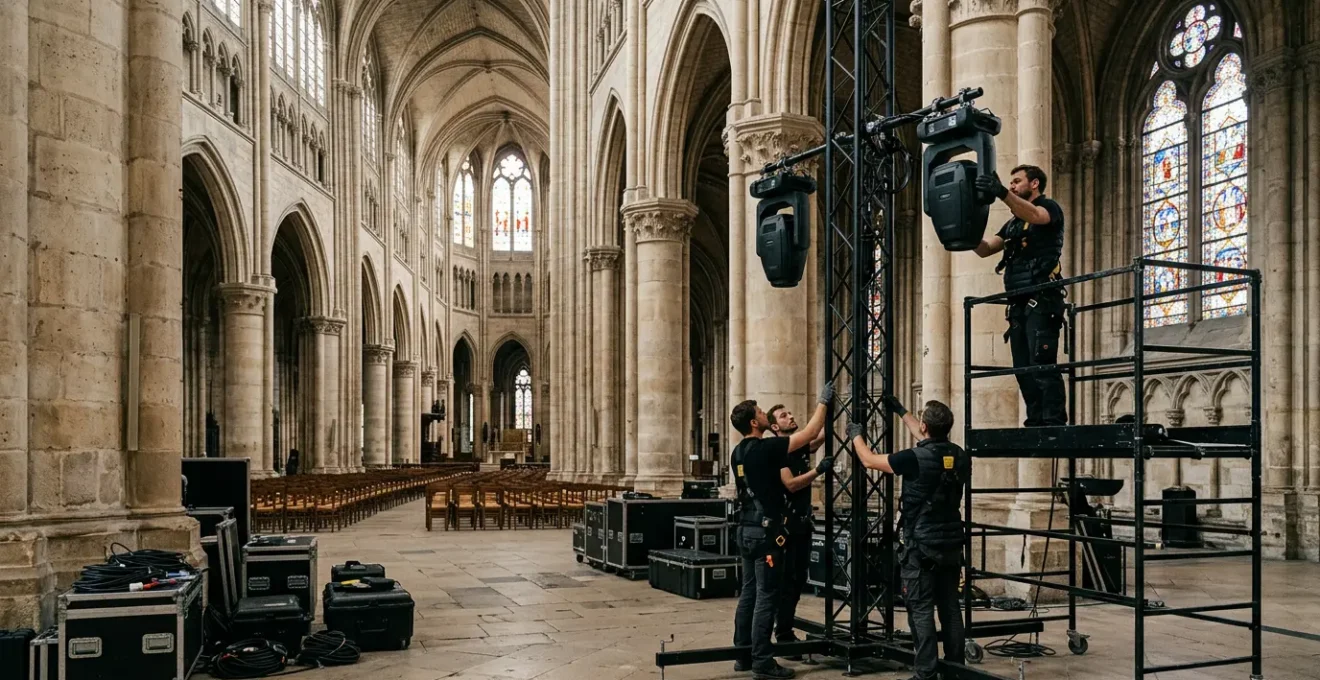
The question itself reveals a common misconception. In a listed building, the stonework is not merely a wall; it is the primary artifact. Drilling into it is equivalent to taking a chisel to a museum exhibit. Every stone, every joint, and every patina of age is part of the “fabric” of the building, which is legally protected. Unauthorized alteration, even for temporary structures, risks prosecution. The challenge, therefore, is not to find a way to attach to the walls, but to design a rigging system that is entirely self-sufficient and non-invasive, treating the floor as the only viable point of contact.
The solution lies in free-standing structures and engineered ballast. Instead of looking up at the walls for anchor points, the modern production director looks down at the floor plan to map out weight distribution. This involves designing systems that are held in place by their own mass, such as aluminium truss systems built on heavy-duty base plates with precisely calculated counterweights. For more complex needs, custom-weighted ballast systems using discreet steel plates, distributed across a wide floor area to respect load limits, can provide immense stability without a single screw. It’s an approach that requires more planning and structural assessment but is the only professionally acceptable method. This philosophy has been successfully employed by venues like National Museums Liverpool, who recreated ‘blank canvas’ spaces within their historic buildings, resulting in a 15 per cent increase in event bookings.
Non-invasive rigging solutions include:
- Custom-weighted ballast systems: Using steel plates distributed across the floor area.
- High-tension cable grids: Anchored between existing, non-heritage architectural features after a full structural assessment.
- Free-standing aluminium truss: Using goalposts or box structures with properly calculated counterweights.
- 3D laser scanning: To map the venue and identify non-heritage structural elements (like modern steel reinforcements) suitable for temporary attachments.
How to calculate generator needs when the venue’s 13-amp sockets are insufficient?
Relying on a heritage venue’s internal wiring is one of the most common and dangerous assumptions an event producer can make. A building with 15th-century foundations is highly unlikely to have a 21st-century ring main. The “13-amp sockets” are often part of an aged, under-specified system designed for cleaning equipment, not a full-scale production. Attempting to power a modern lighting rig, PA system, and catering from these can lead to tripped breakers, electrical faults, or even fire. The professional standard is to assume the venue provides zero usable power and to specify an external, super-silent generator.
Calculating your needs begins with a detailed equipment list, paying close attention to the power draw of each item. Modern LED technology has been a game-changer, dramatically reducing power consumption compared to older tungsten fixtures. However, high-power items like line array PA systems and large video walls remain significant drains. Once you have a total power draw in watts (or kVA), the critical next step is adding a safety margin. Overlooking this is a rookie mistake; a generator running at 100% capacity is unstable and unsafe. To ensure a stable power supply and accommodate inrush currents when equipment starts up, industry experts recommend maintaining a 30% safety headroom. Therefore, if your total draw is 70kW, you need a 100kW generator as a minimum.
The final part of the calculation involves logistics: generator placement, cable runs, and noise control. The generator must be sited where its exhaust and noise do not affect the event or local residents, often requiring long, safely-ramped cable runs and acoustic baffling. This all adds to the complexity and cost but is an essential part of a professional production.
The following table illustrates the vast difference in power requirements for common production equipment:
| Equipment Type | Power Draw (Watts) | Heat Output | Safety Headroom Required |
|---|---|---|---|
| LED Stage Wash (x10) | 1,500W | Minimal | 20% |
| Tungsten Par Cans (x10) | 5,000W | High | 30% |
| Line Array PA System | 8,000W peak | Moderate | 30% |
| Video Wall (20sqm) | 4,000W continuous | Moderate | 25% |
Theatre vs Cathedral: which acoustic environment is harder to mix sound for?
While both present challenges, the cathedral is unequivocally the more difficult environment for modern event audio. A purpose-built theatre is designed for acoustic control; its surfaces are treated with absorbent materials, its shape is calculated to minimise unwanted reflections, and its reverb time (RT60) is short and controlled, prioritising clarity. A cathedral is designed for the exact opposite. Its vast, hard, parallel surfaces of stone and glass are intended to create a long, enveloping reverberation that makes a choir or organ sound glorious and divine. This is an acoustic nightmare for amplified speech or music requiring rhythmic precision.
As one technical expert succinctly puts it in the Event Production Guide, a “cathedral’s long RT60 (great for a choir) is a nightmare for speech intelligibility.” An RT60 (the time it takes for sound to decay by 60 decibels) can be 5-10 seconds in a large cathedral, compared to 1-2 seconds in a theatre. This means every word spoken into a microphone is immediately followed by a wash of overlapping echoes, turning clear speech into an unintelligible muddy mess. The primary job of the sound engineer in a cathedral is not to make things louder, but to fight the room’s natural acoustics to achieve clarity.
This battle is won with two key strategies: speaker placement and Digital Signal Processing (DSP). Instead of one large PA system at the front, a distributed system of smaller, highly directional speakers is used. These are placed at intervals down the length of the space, each delayed electronically so that the sound from each speaker reaches the listener’s ear at the same time as the direct sound from the stage. This creates the illusion of a single sound source and keeps volume levels lower, exciting the room’s reverb less. On the processing side, engineers use advanced DSP techniques to tame the environment:
- Parametric EQ: Applying sharp cuts to specific frequencies, typically in the 250-500Hz range, which are prone to building up as “muddiness” from stone reflections.
- Digital Delays: Aligning the arrival time of sound from multiple speaker positions to improve clarity and localisation.
- Beam-steering Technology: Using advanced column speakers that can electronically direct the sound towards the audience and away from reflective walls and ceilings.
The decibel limit oversight that gets your event shut down by the council
For many event producers, noise management is an afterthought. In a heritage venue, it must be a primary planning consideration. Historic venues are often located in or near residential areas, and many are not built to contain the low-frequency energy of a modern sound system. A noise complaint to the local council can lead to a visit from an Environmental Health Officer, who has the power to shut down your event on the spot if you are in breach of your license conditions or causing a statutory nuisance. This is not a theoretical risk; it is a common and costly outcome of poor planning.
The most critical oversight is failing to understand the specifics of the venue’s license and the difference between measurement standards. As the team at Hampton Court Palace demonstrates, professional venues provide a set criterion to organisers, which includes specific decibel limits, monitoring locations, and time restrictions. Simply being told “keep the noise down” is not enough. You need to know the precise limit (e.g., 65 dBA over 15 minutes at the nearest residential facade) and, crucially, understand the weighting. Failing to distinguish between dBA (which mimics human hearing and filters out low bass) and dBC (which measures low-frequency content more accurately) can be disastrous. Your system might be compliant on a dBA meter while the thumping bass, measured in dBC, is shaking the neighbour’s windows and triggering complaints.
A robust noise management plan is essential. This should be a formal document agreed upon with the venue and, if necessary, the council. It typically involves pre-event noise propagation modelling, the use of directional subwoofer arrays (like cardioid setups) to steer bass away from sensitive areas, and real-time monitoring throughout the event by a competent person with a calibrated sound level meter. Below is a breakdown of the key measurement standards you must understand.
| Measurement Type | Frequency Range | Common Limits | Monitoring Location |
|---|---|---|---|
| dBA (A-weighted) | Mid-high frequencies | 65-75 dBA residential | Property boundary |
| dBC (C-weighted) | Low frequencies/bass | 80-85 dBC residential | Nearest dwelling |
| LAeq (Average) | Full spectrum average | 55-65 dBA over 15min | Sensitive receptors |
When to schedule load-in to avoid disrupting public opening hours?
In a heritage venue that is also a public attraction, the production schedule is not your own. Your load-in and load-out windows are dictated by the venue’s primary function: serving its daytime visitors. Attempting to run cables or move flight cases through public areas during opening hours is not only disruptive and unsafe but is almost universally prohibited by venue management. This compresses the available time for technical setup into the “dark hours”—overnight, early morning, and after the venue closes to the public.
This compressed timeframe has a significant knock-on effect on planning, staffing, and budget. As a rule of thumb, production experts confirm load-in typically requires 2x the standard venue time due to access restrictions, delicate surfaces, and the need for careful, often manual, handling of equipment. You cannot simply reverse a 40-foot articulated lorry to a loading bay. Instead, equipment may need to be cross-loaded onto smaller electric vehicles or even hand-carried through protected interiors. This necessitates a larger crew working anti-social hours, which must be factored into the budget from day one.
A successful load-in is choreographed like a military operation, often following a 24-hour clock. The heaviest and noisiest work is scheduled for the dead of night, while quieter, more detailed tasks are reserved for times when the venue is closed but staff may still be present. A typical schedule might look like this:
- Phase 1 (2am-6am): The ‘silent’ load-in. Heavy structural elements like truss and staging are brought in using electric forklifts and dollies with soft rubber wheels. This is the time for major construction.
- Phase 2 (6am-10am): Pre-opening setup. With major structures in place, crews focus on rigging and running primary cable looms before the first visitors arrive.
- Phase 3 (10am-6pm): Public hours. All heavy work ceases. The crew may be stood down or focus on quiet, isolated tasks like programming at front-of-house or prepping equipment in backstage areas.
- Phase 4 (6pm-10pm): Post-closing focus. Once the public has left, the venue comes alive with activity. This is the prime window for focusing lights, sound-checking the PA, and programming content.
- Phase 5 (10pm-2am): Final technical rehearsals and full system checks before the event day.
How to install immersive LED walls in Grade II listed buildings without damage?
The desire for large, immersive LED video walls presents one of the greatest modern challenges in a historic setting. The core problem is weight. A large LED wall, combined with its support structure and necessary ballast, can exert immense point loads on the floor. In a modern conference centre with a concrete floor, this is rarely an issue. On a suspended timber floor from the 18th century or ancient flagstones laid on earth, it’s a recipe for disaster. The risk of cracking a priceless stone or even causing a localised structural failure is very real.
The first step is a structural one: you must obtain the floor loading data (measured in kilonewtons per square metre, or kN/m²) from the venue’s conservation officer or a structural engineer. This is a non-negotiable figure. Your proposed installation’s total weight, distributed over its footprint, cannot exceed this limit. Often, the raw footprint of a standard LED wall support system is too small, concentrating the weight dangerously. The solution is to use load-spreading plates. These are typically large sheets of steel or thick timber placed under the support structure’s base plates, effectively increasing the footprint and distributing the total weight over a much larger area, thus reducing the pressure (kN/m²) at any given point.
Sometimes, even with load-spreading, the numbers don’t work. True expertise is knowing when to say no. A case study from Sight & Sound Productions highlights this perfectly: after analysis, they determined the structural risk of installing an LED wall was too high for a specific historic venue. Instead, they showed their problem-solving ability by “utilizing projection technology to display the intended messaging,” achieving the client’s goal without compromising the building’s integrity. This decision to pivot to a different technology demonstrates a mature, conservation-led approach.
Your action plan: Floor load distribution checklist
- Request floor loading data (kN/m²) from the venue’s structural engineer before any design work begins.
- Calculate the total weight of the complete LED wall system, including the screen, truss structure, and all ballast.
- Design steel or timber load spreaders (minimum 25mm thickness) that distribute the weight across at least four times the area of the system’s base plates.
- Ensure the final calculated pressure (total weight / total spreader area) is safely below the venue’s certified limit.
- Obtain written approval of your calculations and plans from the venue’s conservation officer before a single piece of equipment arrives on site.
The planning error that leads to a criminal conviction for altering a Grade I building
The single most catastrophic error a production manager can make in a heritage venue is to undertake any physical work, however minor or temporary, without the correct permissions. Under UK law (specifically the Planning (Listed Buildings and Conservation Areas) Act 1990), it is a criminal offence to carry out works for the demolition, alteration, or extension of a listed building in any manner which would affect its character without authorisation. The penalties can include unlimited fines and even imprisonment. The phrase “it’s easier to ask for forgiveness than permission” does not apply here; it can lead to a criminal record.
The critical misunderstanding is what constitutes an “alteration.” Many assume this only applies to permanent changes. This is dangerously incorrect. As a heritage legal expert from the Museums and Heritage Advisor notes, “unauthorized alteration, even if reversible, is the crime itself.” Attaching a cable to a wall with a screw, painting a temporary sign onto a historic surface, or even pressure-washing a facade without consent could all be deemed an offence if it affects the character of the building. The key is to obtain formal, written Listed Building Consent (LBC) from the local planning authority for any works that might be considered an alteration. While many minor, temporary installations may not require full LBC, this must be confirmed in writing by the venue’s conservation officer, who acts as the guardian of the building’s integrity.
To protect yourself, your company, and your client, a rigorous documentation process is essential. Your bible is the Method Statement and Risk Assessment (RAMS), but for a listed building, this needs to be expanded. Before any work begins, a comprehensive legal and procedural checklist must be completed and signed off by all parties:
- Written Listed Building Consent: For any works deemed to affect the building’s character, secured from the local council.
- Detailed Method Statement: A step-by-step guide for every single technical installation, from running a cable to building a stage.
- Conservation Officer Approval: Written sign-off on all method statements from the venue’s appointed heritage expert.
- Photographic Evidence: A comprehensive, time-stamped photographic survey of the venue before load-in, documenting the exact condition of all surfaces, to be compared with a post-event survey.
- Public Liability Insurance: Ensuring your policy has specific cover for work in listed buildings, as standard policies may have exclusions.
Key takeaways
- Conservation-Led Design: The building’s constraints are not limitations but the primary design parameters for all technical systems.
- Meticulous Planning is Paramount: From power calculations with 30% headroom to 2x load-in time allocation, success is determined long before arriving on site.
- Compliance is Non-Negotiable: Understanding and documenting adherence to noise limits, floor loading data, and Listed Building Consent is a core professional duty, not an optional extra.
Preserving Artistic Heritage: Funding Restoration in Listed Buildings?
It can be easy to view the relationship between event producers and heritage venues as purely transactional and fraught with restrictions. However, a more collaborative and sustainable model is emerging, one where the revenue generated from commercial events becomes a vital lifeline for the preservation of the venues themselves. When managed correctly, hosting events is not just a way to use a historic space; it’s a powerful mechanism for funding its future. This shifts the dynamic from a simple client-supplier relationship to a symbiotic partnership in cultural preservation.
Many of the UK’s most iconic institutions are registered charities or not-for-profit organisations. For them, every pound of commercial income is critical. The success of National Museums Liverpool’s events business, which generated over £1 million in annual revenue, is a testament to the potential. This income is not just profit; it’s ploughed directly back into the museum’s core mission: conserving collections, maintaining the buildings, and funding educational programmes. By choosing to host an event in such a venue, a company is making a direct contribution to preserving a piece of the nation’s heritage. This provides a powerful narrative for corporate social responsibility and adds a layer of meaning to the event itself.
This model is often formalized through a “heritage levy” or a clear policy of reinvestment. As Eventbrite highlights in its guide to unique venues, this is a common and successful approach. As they state, “Many of our venues are not-for-profit, and funds made from events are reinvested back into the maintenance and conservation of the spaces. This means hosts are helping with the preservation of iconic and much loved institutions while enjoying all it has to offer.” For the event producer, understanding and communicating this benefit to the end client can be a compelling part of the sales proposition. The event becomes more than just a party in a castle; it becomes an active investment in its continued existence for future generations.
Armed with this technical and regulatory framework, you are now equipped to approach your next heritage venue project not with apprehension, but with the confidence of a specialist. By demonstrating this level of professional diligence, you become a trusted partner, ensuring the creation of extraordinary events while actively participating in the preservation of our shared cultural legacy.