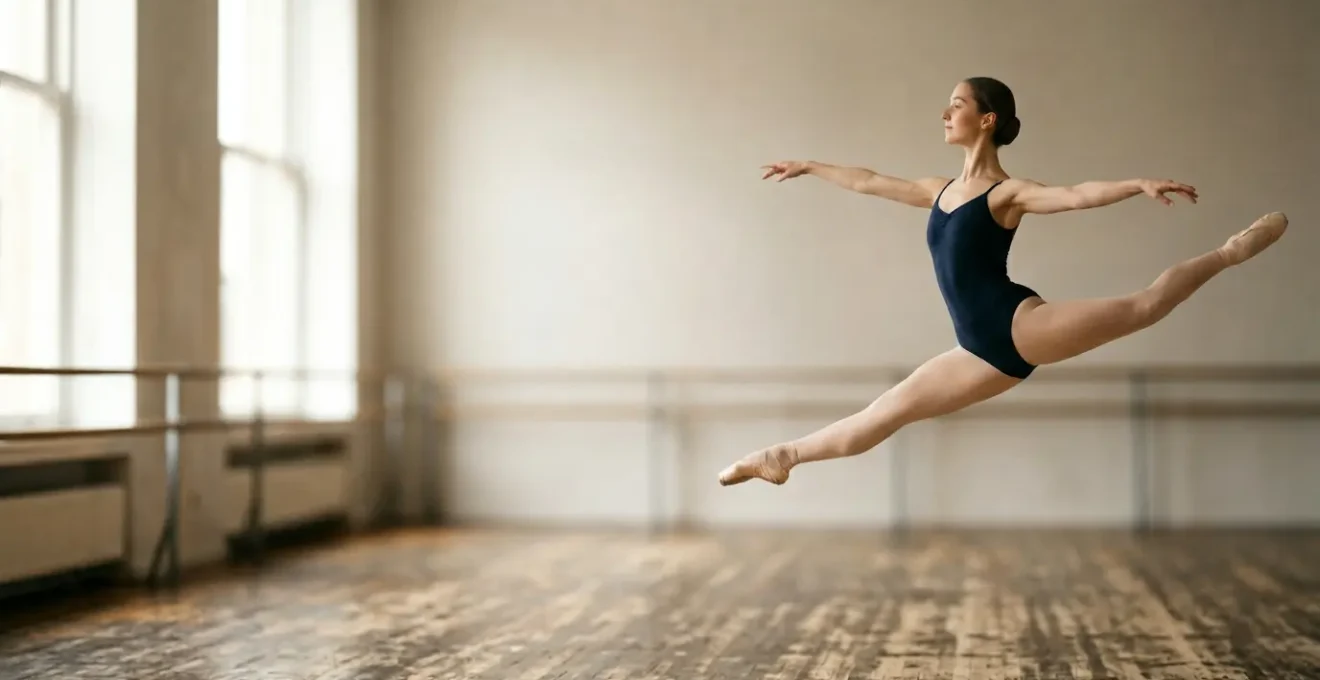
The long-term health of a dancer depends less on achieving extreme aesthetic lines and more on understanding and managing the body’s physiological load like a high-performance athlete.
- Jumping technique is paramount, as landing generates forces over seven times body weight, making force dissipation a primary skill for career longevity.
- Chronic nutritional errors, specifically low energy availability, directly compromise bone mineral density, a risk that cannot be mitigated by physical training alone.
Recommendation: Prioritize training neuromuscular control and strength through a full range of motion over passively increasing flexibility, and implement structured recovery and nutrition protocols based on scientific principles, not tradition.
The image of a dancer’s career cut short by injury is a familiar and painful narrative in the art form. For generations, the response to physical limitation or plateaus in performance has been a simple, almost punishing mantra: stretch more, try harder, push through the pain. This approach, rooted in a tradition that values aesthetic lines above all else, often overlooks a fundamental truth. The physical demands placed on a dancer are not merely artistic; they are profoundly athletic, comparable to those faced by elite sports professionals.
Conventional wisdom focuses on flexibility and repetition, but what if the true keys to unlocking a dancer’s potential and ensuring a long, healthy career are hidden in plain sight, within the principles of sports science? What if the conversation shifted from ‘how high can you kick?’ to ‘how strong are you at the end of that range?’ This is where the paradigm must shift. Instead of treating dancers as ethereal artists who happen to move, we must see them as the powerful athletes they are and equip them with the same data-driven tools used in elite sports.
This guide moves beyond the platitudes. It delves into the specific biomechanical and physiological principles that govern a dancer’s body. We will dissect the critical difference between passive flexibility and active strength, analyze the nutritional errors that silently sabotage careers, and provide structured frameworks for training and recovery. By adopting a scientific lens, we can build dancers who are not only more expressive but also more resilient, powerful, and durable.
To navigate this in-depth analysis, the following sections will break down the most critical areas where a sports science approach can revolutionize dance training and performance.
Summary: A Biomechanical Approach to Dance Training for Longevity and Performance
- Why does jumping technique affect longevity more than flexibility?
- How to structure high-intensity interval training (HIIT) alongside rehearsals?
- Turnout vs Knee Stability: which should you prioritize for long-term health?
- The nutritional error regarding bone density that plagues athletic dancers
- When to use active recovery vs complete rest after a heavy show week?
- The training error of over-training flexibility without strength
- Running vs Swimming: which cardio builds stamina without stiffening the hips?
- Performer’s Stamina: Cardio Training for Musical Theatre Actors?
Why Does Jumping Technique Affect Longevity More Than Flexibility?
The answer lies in a single, powerful concept: physiological load. While flexibility is visually celebrated in dance, it is the management of immense forces during dynamic movements that truly dictates a dancer’s career span. A grand jeté is not just a leap; it is a rapid cycle of explosive power generation followed by high-impact force absorption. The musculoskeletal system must effectively dissipate these forces upon landing to prevent chronic stress and acute injury. Poor landing mechanics concentrate these forces on vulnerable structures like the knees, ankles, and lumbar spine.
The magnitude of this load is often underestimated. Biomechanical studies have shown that dancers can experience ground reaction forces of up to 7.4 times their body weight during the landing phase of a jump. No amount of passive flexibility can protect a joint from this level of repeated impact. True protection comes from superior neuromuscular control, where muscles are trained to eccentrically contract (lengthen under tension) to act as brakes, distributing the load across a larger system.
As this image illustrates, proper landing technique involves precise alignment and coordinated muscle engagement from the foot all the way up the kinetic chain. Training should therefore prioritize plyometrics and eccentric strengthening exercises that mimic these demands. Teaching a dancer to land silently and with control is more valuable for their longevity than achieving a few extra degrees of passive range of motion in a split.
How to Structure High-Intensity Interval Training (HIIT) Alongside Rehearsals?
Integrating supplemental cardio into a dancer’s demanding schedule presents a significant challenge. The goal is to enhance cardiovascular endurance without inducing excessive fatigue or causing an “interference effect,” where one type of training negates the benefits of another. High-Intensity Interval Training (HIIT) is an efficient solution, but its structure is critical. Randomly adding intense workouts can lead to overtraining and a decline in technical skill due to neural fatigue.
A data-driven approach involves tailoring HIIT protocols to the specific demands of performance. A dancer performing a 90-second, explosive variation requires a different energy system than one performing a sustained, three-minute group piece. Therefore, the work-to-rest ratios of the HIIT session should reflect this. This trains the body’s energy pathways to be more efficient under performance-specific conditions. Furthermore, it’s crucial to schedule these sessions intelligently.
Placing a HIIT session at least 48 hours away from a heavy technical rehearsal or performance is essential. This allows the central nervous system to recover, ensuring that motor patterns and coordination are not compromised. Choosing cross-training modalities that use different muscle groups, such as swimming or cycling, can also prevent overuse injuries in the legs while still providing a potent cardiovascular stimulus. The key is strategic implementation, not just adding more work.
Action Plan: Implementing a Fartlek-Style HIIT Protocol for Dancers
- Match Ratios to Performance: For short, explosive variations (e.g., 90 seconds), use a work-to-rest ratio of 1:4 or higher. For longer, sustained group numbers (e.g., 3 minutes), a 1:2 ratio is more effective.
- Build Choreographic HIIT: Use actual dance phrases for intervals (e.g., performing 8 tour jetés followed by a 45-second rest) to train specific neuromuscular pathways and build performance-specific stamina.
- Schedule for Recovery: Position HIIT sessions a minimum of 48 hours away from heavy technical rehearsals to allow for full neural recovery and prevent the interference effect from degrading technique.
- Vary Muscle Groups: Incorporate activities like swimming (especially for male dancers to build upper body strength) or cycling to elevate heart rate without over-training the legs.
- Progress Gradually: Begin with 3-4 sprint intervals per session and build to 8-10 intervals over a period of three weeks. Aim for a maximum of 3 HIIT sessions per week to see significant endurance improvement without overtraining.
Turnout vs Knee Stability: Which Should You Prioritize for Long-Term Health?
Turnout is a foundational aesthetic of many dance forms, but the relentless pursuit of a flat 180-degree position is a primary driver of injury when it’s not supported by anatomy and strength. The answer to the question is unequivocal from a sports science perspective: knee stability must always be prioritized. A stable, healthy knee is a prerequisite for a long career; excessive turnout achieved through compensation is a liability.
Ideal turnout is a sum of contributions from the hip, tibia, and foot. In fact, biomechanical research shows that achieving optimal turnout requires a combination of approximately 70 degrees of external rotation from the hip, 5 degrees of tibial torsion, and 15 degrees of rotation from the foot and ankle. When a dancer lacks sufficient hip rotation, they often force the position by pronating the feet or torquing the knee joint. This “biomechanical compensation” places enormous stress on the medial (inner) structures of the knee, the ankle, and can even lead to pathologies in the lower back.
The danger of this forced position is well-documented. As leading researchers have pointed out, there is a direct link between this compensation and widespread injury patterns. This highlights that pain is often a symptom of faulty mechanics, not a lack of flexibility.
High occurrences of low back pain, along with injuries to the knees, lower legs, feet, and ankles, are frequently associated with compensatory movements and excessive forcing of turnout.
– Kaufmann et al., Physiopedia – Turnout in Ballet Dancers
Therefore, training must focus on strengthening the deep external rotators of the hip to maximize a dancer’s *active* and usable turnout. The goal is to work honestly within one’s anatomical limits, using strength to control the available range, rather than forcing a position that the skeletal structure cannot support. This protects the knee and ultimately leads to more powerful and sustainable movement.
The Nutritional Error Regarding Bone Density That Plagues Athletic Dancers
The most pervasive and dangerous nutritional error in the dance world is not about choosing the “wrong” foods, but about consuming too few calories overall. This leads to a state known as Low Energy Availability (LEA), where the body does not have enough energy to support both the demands of training and its basic physiological functions. One of the first systems to be downregulated in a state of LEA is the reproductive system, which in turn has a devastating impact on bone health.
This issue is alarmingly common. For instance, a 2019 study of vocational female ballet students found that a staggering 44% had reduced energy availability, with 22% in a state of clinical LEA and 40% experiencing menstrual dysfunction, a key red flag for hormonal disruption that impairs bone mineral density accrual. This directly increases the risk of stress fractures and osteoporosis later in life.
The consequences of LEA are not theoretical; they are measurable and significant, creating a direct disadvantage for dancers compared to other athletes who may have better nutritional support systems.
Case Study: The Bone Density Gap Between Dancers and Athletes
A 2024 study in Applied Physiology, Nutrition, and Metabolism provided stark evidence of this problem. When comparing 132 pre-professional dancers to 137 female athletes, researchers found that dancers had significantly lower total body bone mineral density (1.03 g/cm² vs 1.14 g/cm²). Critically, the study revealed that Body Mass Index (BMI) was a much stronger predictor of bone density in dancers than in the other athletes. This highlights that for dancers, maintaining a healthy body weight through adequate energy intake is a primary factor in building and preserving a strong skeleton, independent of calcium intake alone.
The focus for any dance teacher or scientist must be on education around energy availability. Dancers need to understand that food is fuel for performance and health. Under-fueling is not a pathway to an aesthetic ideal; it is a direct route to injury and a shortened career.
When to Use Active Recovery vs Complete Rest After a Heavy Show Week?
After a demanding performance week, the instinct might be to collapse on the couch for two days. While complete rest has its place, it’s not always the optimal strategy. The choice between active recovery and complete rest should be a data-informed decision, not an emotional one. The key is to differentiate between central nervous system (CNS) fatigue and peripheral (muscular) fatigue. This distinction is vital, especially in a population where overuse injuries are rampant.
The rates of such injuries in professional dance are significant. For example, a study of a professional ballet company found 4.4 injuries per 1000 exposure hours, with 64% of these being overuse injuries. This underscores the need for intelligent recovery protocols to mitigate cumulative strain. Active recovery—low-intensity movement like swimming, cycling, or specific floor barre sequences—promotes blood flow to tired muscles, helping to clear metabolic byproducts and reduce soreness without adding significant strain.
Conversely, complete rest is non-negotiable when the CNS is overtaxed. Signs of CNS fatigue include mental fog, a noticeable drop in coordination, emotional irritability, or an inability to execute technique with quality. Simple objective metrics can help guide this decision. An elevated morning resting heart rate (more than 10 bpm above baseline) or a significant drop in a simple performance test like grip strength or vertical jump height are strong indicators that the body needs a full shutdown to recover. Listening to the body must be supported by looking at the data.
The Training Error of Over-Training Flexibility Without Strength
One of the most ingrained—and dangerous—training errors in dance is the glorification of passive flexibility without a corresponding emphasis on strength and control. Hypermobility, or an unusually large range of joint motion, is often seen as an asset. However, without the muscular strength to stabilize and control that range, it becomes a significant liability. This creates “unusable” range of motion that the dancer cannot access or protect during dynamic movement, leading to joint instability and injury.
This disconnect between passive and active range is a common source of pain, and it is often misdiagnosed as a flexibility issue. Research has directly linked pain to this strength deficit, particularly in the hips, which are crucial for turnout and overall stability.
Case Study: The Proprioceptive Deficit in Hypermobility
Research highlighted by Physiopedia on turnout biomechanics reveals a critical danger for naturally hypermobile dancers. For this population, stretching without concurrent strengthening can create profound joint instability. Studies show that dancers who achieve extreme passive flexibility often exhibit reduced proprioception—the nervous system’s ability to sense the body’s position in space. Without this crucial feedback, the joints can easily be pushed into damaging positions during fast or complex movements. The extended range of motion becomes functionally useless and a high-risk factor for injury because the dancer lacks the neuromuscular control to manage it.
This is further supported by clinical findings that directly correlate weakness with pain, even when passive flexibility appears adequate. The problem isn’t the range of motion itself, but the lack of control over it.
Dancers with knee pain had significantly decreased active turnout despite similar passive turnout to pain-free dancers, indicating weakness in hip external rotators rather than flexibility limitations.
– Silveira & Piedade, Physical Therapy Research, Factors that influence turnout in ballet dancers with knee pain
The paradigm must shift from simply stretching to strengthening throughout the entire range of motion. Exercises that challenge stability at the end-range are far more valuable than static passive stretching. A dancer’s goal should be to own their flexibility with strength, making every degree of motion both safe and usable.
Running vs Swimming: Which Cardio Builds Stamina Without Stiffening the Hips?
The choice of cardiovascular cross-training can have a significant impact on a dancer’s primary discipline. While running is often a go-to for building endurance, its biomechanics can be problematic for dancers. The repetitive, sagittal-plane motion can reinforce tension in already overused hip flexors (like the psoas), leading to stiffness and a restricted range of motion in arabesques and other extensions. Swimming, by contrast, generally emerges as a superior option for dancers seeking to build an aerobic base without compromising hip mobility.
The low-impact, multi-planar nature of swimming promotes hip extension and rotation, effectively counteracting the flexion-dominant patterns of many dance forms. It builds cardiovascular capacity while simultaneously encouraging a more balanced muscular development. The following table breaks down the key biomechanical differences and their implications for dancers.
| Factor | Running | Swimming |
|---|---|---|
| Movement Plane | Sagittal plane-dominant | Multi-planar (rotation + extension) |
| Impact Level | High-impact | Low-impact |
| Hip Flexor Effect | Reinforces tension in overused psoas | Promotes hip extension and rotation |
| Risk for Dancers | Can cause strength/endurance loss in legs if volume is too high | Minimal interference with dance training |
| Optimal Use | Short high-intensity sprints for power (low volume) | Aerobic base building and active recovery |
| Recommended Technique | Pose Method or forefoot-striking to reduce hip flexor dominance | Freestyle/backstroke for hip extension emphasis |
This does not mean running is entirely off-limits. Short, low-volume sprints can be an excellent tool for developing power. However, for building a foundational aerobic base or for active recovery, swimming is the biomechanically safer and more complementary choice for most dancers. The decision should be based on the specific training goal and the individual dancer’s needs.
Key Takeaways
- Force Over Form: Managing the high physiological load of jumping through superior eccentric strength and neuromuscular control is more critical for career longevity than achieving extreme passive flexibility.
- Strength as the Prerequisite for Mobility: Flexibility without the strength to control it is a liability. Training must focus on building stability and active control throughout a joint’s full range of motion.
- Energy as the Foundation: Adequate energy availability is non-negotiable. It is the primary defense against bone density loss and overuse injuries, and no amount of training can compensate for under-fueling.
Performer’s Stamina: Cardio Training for Musical Theatre Actors?
The “triple-threat” demands of musical theatre—acting, singing, and dancing simultaneously—present a unique physiological challenge. Stamina for a performer is not just about lasting through an eight-show week; it’s about maintaining vocal quality and character intent while under significant cardiovascular duress. A sports science approach using periodization is essential to build this specific type of endurance without causing burnout.
First, it’s important to recognize that dance itself is a high-intensity activity. According to research on dance fitness workouts, participants exercised at an average of 73% of their maximum heart rate and 52% of their VO2 max. A performer’s training plan must account for this baseline load from rehearsals and build on it strategically, rather than just adding more intensity.
A periodized plan should be divided into three phases. In the off-season (before a show), the focus is on building a strong aerobic base with longer, moderate-intensity cardio. During the pre-season (rehearsal period), training should become more specific, using high-intensity intervals that mimic the show’s demands. A powerful technique here is “intermodal intervals”—alternating bursts of physical cardio with singing challenging vocal passages to train the body to manage breath under load. Finally, during the in-season (show run), cardio should be used for maintenance and recovery only, with low-intensity sessions to avoid overtraining and preserve vocal health.
This structured approach ensures that the performer peaks at the right time and has the specific stamina required to deliver a powerful performance night after night. It shifts the focus from simply “getting fit” to building resilience for the unique and multifaceted demands of the stage.
Integrate these biomechanical and physiological principles into your training, coaching, or teaching philosophy. By doing so, you can help foster the next generation of dancers and performers who are not only artistically brilliant but also physically robust, empowering them to build long, healthy, and impactful careers.