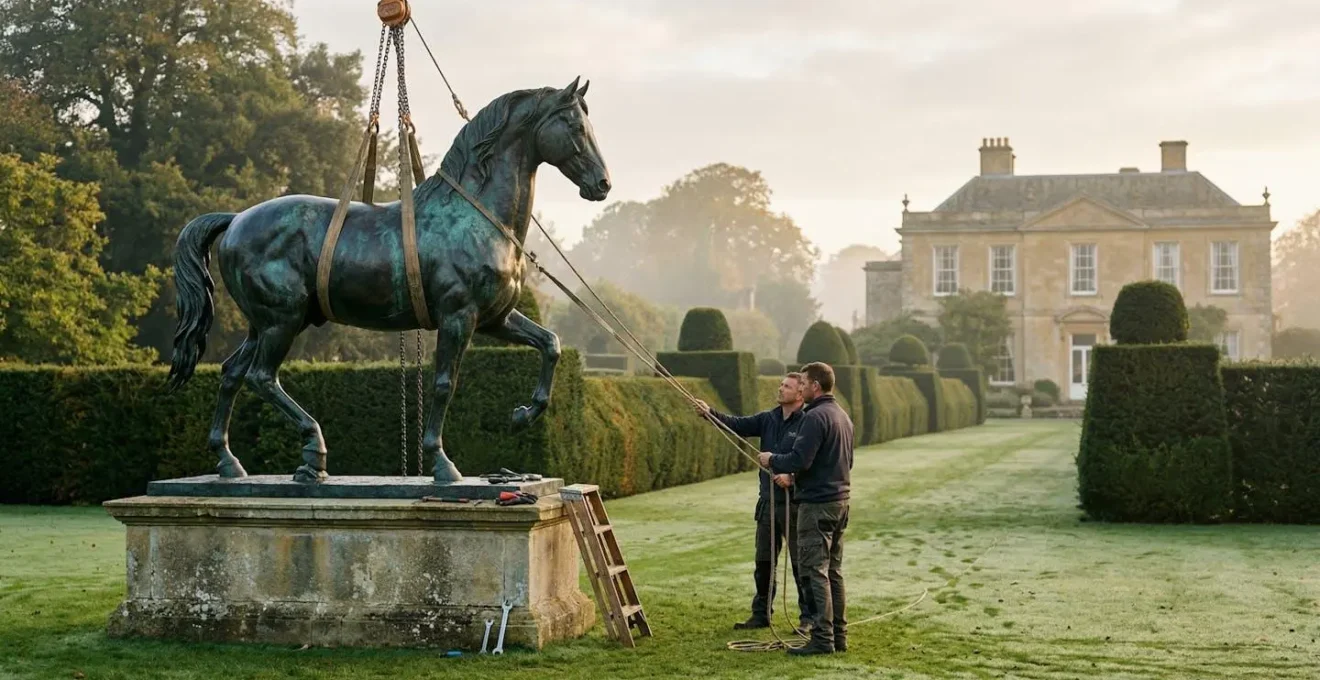
Installing a bronze sculpture is more than an aesthetic choice; it’s a significant investment vulnerable to UK-specific risks like accelerated corrosion and sophisticated theft.
- Environmental factors, particularly coastal salt-air, dramatically accelerate degradation if not managed proactively.
- Improper foundations in Britain’s often waterlogged soil lead to instability and irreversible damage to the artwork.
- Standard security measures are often insufficient against organised thieves who target bronzes for their scrap metal value.
Recommendation: A proactive strategy focusing on geotechnical stability, disciplined patina management, and layered, forensic security is essential to protect both the physical integrity and long-term value of your sculpture.
Placing a bronze sculpture in an English garden is a timeless act, merging enduring art with the evolving beauty of nature. For landowners and estate managers, it represents a significant cultural and financial investment. However, the idyllic vision can quickly be compromised by the realities of the British climate and modern security threats. Too often, advice focuses merely on placement and occasional cleaning, overlooking the critical technical decisions that safeguard the sculpture’s longevity and value.
The common approach of setting a piece on a simple stone slab or relying on a standard alarm system is a critical oversight. These methods fail to account for the challenges of waterlogged soil, the corrosive effects of salt-laden air in coastal regions, or the calculated methods of metal thieves. Protecting this asset requires a shift in mindset: from passive owner to proactive custodian. It demands an understanding of material science, geotechnical engineering, and modern security strategies.
This guide moves beyond the basics. We will explore the technical nuances that define the difference between a sculpture that endures for centuries and one that succumbs to neglect or theft. By adopting the perspective of a specialist, you will learn to make informed decisions that protect the physical integrity, aesthetic appeal, and financial worth of your investment, ensuring it remains a source of pride for generations to come.
This article provides a structured approach to installing and protecting your bronze sculpture. Below is a summary of the key areas we will cover, from environmental challenges to the specifics of commissioning and security.
Summary: A Practical Guide to Installing and Securing Bronze Sculpture
- Why does bronze turn green faster in coastal UK locations?
- How to create a concrete plinth that prevents sinking in waterlogged soil?
- Lost Wax vs Sand Casting: which method produces sharper detail for investment?
- The security oversight that makes garden bronzes an easy target for scrap thieves
- When to rewax outdoor bronze: recognizing the signs of active corrosion
- The alarm system oversight that voids coverage for theft in London townhouses
- Corten Steel vs Stone: which resists graffiti and weather better in a city centre?
- The Rise of the Modern Sculptor in Public Spaces: Commissioning for Councils?
Why Does Bronze Turn Green Faster in Coastal UK Locations?
The classic green patina on a bronze sculpture is a result of oxidation, a natural protective layer. However, in the UK’s coastal environments, this process can accelerate into aggressive corrosion. The primary culprit is the presence of airborne chlorides from sea spray. These salt particles settle on the bronze surface, attracting moisture and creating a highly corrosive electrolyte that attacks the copper alloy far more rapidly than simple rainwater.
This effect is quantifiable and significant. While inland areas see a steady, predictable rate of atmospheric corrosion, coastal areas experience corrosion rates of 80 to 200µm per year, which can be several times higher. This aggressive environment doesn’t just speed up the formation of a green patina; it can lead to pitting, streaking (from run-off), and a structural weakening of the metal over time. For an asset like a bronze sculpture, this represents a direct threat to its long-term value and integrity.
Managing this risk begins with site assessment. A sculpture placed within a few miles of the coast will require a much more rigorous maintenance schedule, particularly more frequent washing to remove salt deposits and more regular application of protective wax coatings. Ignoring the elevated chloride levels is a common but costly mistake that can lead to expensive conservation work down the line. The location dictates the maintenance regime; a one-size-fits-all approach is inadequate for protecting a valuable bronze asset in the diverse British landscape.
How to Create a Concrete Plinth That Prevents Sinking in Waterlogged Soil?
One of the most critical but often overlooked aspects of outdoor sculpture installation in the UK is the foundation. Simply placing a heavy bronze piece on a decorative stone slab is a recipe for disaster in Britain’s frequently waterlogged ground. The key to long-term stability is not just the plinth itself, but the subterranean foundation that supports it. This is a matter of geotechnical stability, not just aesthetics.
For a permanent, stable installation, a reinforced concrete foundation is essential. This must extend below the frost line (typically 450mm or more in the UK) to prevent movement from frost heave during winter. More importantly, it must incorporate a drainage system. A deep bed of compacted hardcore and gravel beneath the concrete pad, often combined with a French drain to channel water away, is non-negotiable. This prevents the ground from becoming saturated and losing its load-bearing capacity, which would otherwise cause the plinth and sculpture to tilt or sink over time.
This diagram illustrates the essential components of a properly engineered foundation for a bronze sculpture in challenging soil conditions.
As the cross-section shows, the visible plinth is only the tip of the iceberg. The integrity of the installation depends on the unseen elements: the depth of the foundation, the steel rebar reinforcing the concrete, and the aggregate drainage layer. While some methods involve setting the statue directly into wet concrete for a seamless look, this makes future removal for conservation or relocation extremely difficult. A more practical approach involves casting stainless steel mounting bolts into the concrete, allowing the sculpture to be securely bolted down but also removed if necessary. This foresight protects the long-term serviceability of your investment.
Lost Wax vs Sand Casting: Which Method Produces Sharper Detail for Investment?
When commissioning or purchasing a bronze sculpture, the casting method used is a defining factor in its quality, detail, and ultimately, its investment value. While several techniques exist, the two most common are sand casting and lost wax casting. For an investor or collector, the choice is clear: lost wax casting is the superior method for producing works of high fidelity and value.
Lost wax, or ‘cire perdue’, is an ancient and labour-intensive process prized for its ability to capture minute details from the artist’s original model. As the Big Bronze Technical Guide notes, it is a method that has remained unsurpassed for centuries. In their “Bronze Sculpture Installation Guide”, they state:
Made principally from copper and other non-ferrous metals, each piece of bronze sculpture is made entirely by hand by artisans skilled in the “Lost Wax” casting method, unsurpassed for rendering life-like detail to metal sculpture. Unchanged since Roman times, Lost Wax casting takes several steps over a four to six week period to complete. The result is a richly-finished, vibrant and lifelike piece of bronze sculpture.
– Big Bronze Technical Guide, Bronze Sculpture Installation Guide
The reason for this superior quality lies in the process itself. A wax replica of the sculpture is created and encased in a ceramic shell. When fired, the wax melts out, leaving a cavity into which molten bronze is poured. This allows for incredibly fine surface textures, thin walls, and complex forms that sand casting cannot replicate. Sand casting, which uses a mould made from compacted sand, is faster and cheaper, but the granularity of the sand limits the achievable level of detail. The resulting surface is rougher and more porous. This distinction is critical for investment-grade detail.
The table below, based on industry comparisons, clearly outlines the trade-offs. For a limited-edition or one-off piece where artistic detail is paramount, the higher cost and longer lead time of the lost wax method are justified by the superior result and higher market value.
| Aspect | Lost Wax Casting | Sand Casting |
|---|---|---|
| Detail Resolution | Extremely fine, captures fingerprints | Good, but limited by sand grain size |
| Surface Finish | Smooth, minimal porosity | Textured, higher porosity |
| Wall Thickness | Consistent, thinner possible | Variable, thicker required |
| Process Time | 4-6 weeks per piece | 2-3 weeks per piece |
| Market Value | Higher (limited editions) | Lower (mass production) |
| Repair Ease | Easier welding and conservation | More challenging to repair |
The Security Oversight That Makes Garden Bronzes an Easy Target for Scrap Thieves
The most common security oversight for garden sculptures is a misplaced reliance on conventional deterrents like CCTV and burglar alarms. While these have their place, they are often ineffective against professional metal thieves. These criminals are not deterred by the possibility of being seen; they operate quickly and are primarily concerned with being caught with identifiable, stolen goods. This is where a modern approach focused on forensic deterrence becomes vastly superior.
The fundamental error is failing to make the asset itself undesirable to a thief. A thief sees a large bronze sculpture not as art, but as hundreds of kilograms of copper alloy with a high scrap value. The single most effective way to protect it is to remove that value by making the metal traceable and impossible to sell legitimately. This is achieved through forensic marking solutions. Technologies like SmartWater contain a unique chemical code, registered to the owner, that is invisible to the naked eye but glows under UV light. A small dab of this liquid makes any piece of the metal traceable back to the scene of the crime, rendering it toxic to handle for any scrap dealer.
The deterrent effect is not theoretical. Independent criminological research has shown its profound impact. A study led by Professor Martin Gill at the University of Leicester found that 74% of criminals admitted they would be deterred from stealing an item if they knew it was marked with a forensic liquid. In the same study, SmartWater was rated as a more powerful deterrent than security guards, alarms, and even high-visibility police patrols. This highlights a crucial shift in security thinking: prevention through irrefutable identification is more effective than prevention through passive surveillance.
When to Rewax Outdoor Bronze: Recognizing the Signs of Active Corrosion
Proactive maintenance is the cornerstone of preserving a bronze sculpture’s value. The primary line of defence against the elements is a sacrificial layer of microcrystalline wax. This clear coating protects the bronze and its patina from moisture, pollutants, and salt. However, this wax layer degrades over time and requires regular replenishment. The question for any owner is not *if* to rewax, but *when*. Waiting for visible damage is a reactive and costly mistake.
A disciplined maintenance schedule is essential. For most UK gardens, a thorough wash and a new application of wax should be performed at least annually. However, as a best practice, many conservators recommend a bi-annual schedule. For sculptures in coastal locations or polluted urban environments, this should be considered the absolute minimum. The ideal time for application is on a warm, dry day when the sun has gently heated the bronze, allowing the wax to flow into microscopic pores before being buffed to a finish.
Beyond a fixed schedule, you must learn to recognise the subtle signs that the protective wax layer is failing. The most obvious indicator is how water behaves on the surface. On a well-waxed sculpture, water will bead up into distinct droplets, much like on a freshly polished car. If water instead ‘sheets’ or spreads out across the surface, it is a clear sign that the wax has broken down and the bronze is exposed.
This macro view demonstrates a healthy, protected surface where water forms perfect spheres. An unprotected surface would show water spreading unevenly. Other signs of active corrosion include a dull, chalky appearance instead of a rich, semi-gloss lustre, and the appearance of bright green spots, which are indicative of pitting corrosion. Catching these signs early allows for timely intervention before minor issues become major conservation projects.
Action Plan: Auditing Your Bronze for Active Corrosion
- Check for bright green spots indicating pitting corrosion, especially in areas not naturally washed by rain.
- Look for any rust-coloured stains on the statue or its plinth, which may signal corrosion of internal iron armatures.
- Inspect the stonework below the sculpture for green staining, a clear sign of bronze run-off from an unprotected surface.
- Assess the patina’s finish: a healthy, waxed surface should have a deep, semi-gloss sheen, not a dull or chalky appearance.
- Document and photograph any areas of localized active corrosion to provide to a professional conservator for urgent treatment.
The Alarm System Oversight That Voids Coverage for Theft in London Townhouses
For high-value items like bronze sculptures, particularly in accessible urban settings like London townhouse gardens, insurance is a critical component of asset protection. However, many policies contain specific clauses about security systems that owners often overlook, potentially voiding their coverage in the event of a theft. The most significant oversight is the assumption that any alarm system will suffice, or that a theft without signs of forced entry will be covered.
Insurers for high-value art often stipulate that security systems must be installed and maintained by certified professionals from accredited bodies like NSI or SSAIB. A DIY-installed alarm, no matter how sophisticated, may be grounds for a claim being rejected. Furthermore, the policy may require proof of a specific type of activation. If a sculpture is simply lifted off an unsecured plinth without triggering an alarm or showing evidence of a broken lock or cut chain, the insurer may argue that “due care” was not taken. This is the “no forced entry” loophole.
To ensure coverage, the security system must be integrated with the sculpture itself. This can involve tamper-proof fixings that are connected to the alarm circuit, or vibration sensors attached to the sculpture or plinth. These measures ensure that any attempt to move the artwork triggers the alarm and provides clear evidence of a criminal act. Simply having a perimeter alarm for the house is often not enough. It is imperative to read the fine print of your policy and have a direct conversation with your insurer about the specific requirements for covering outdoor art, and to get their approval for your security plan in writing.
Corten Steel vs Stone: Which Resists Graffiti and Weather Better in a City Centre?
When selecting a material for a plinth or a sculpture in a high-traffic urban environment, the choice extends beyond pure aesthetics. The material must be robust enough to withstand not only weather and pollution but also vandalism, particularly graffiti. The two common choices, natural stone and Corten steel, offer very different performance profiles in this regard.
Natural stone, such as limestone or sandstone, has a classic, monumental appeal. However, it is highly susceptible to the challenges of a city centre. Its porous surface readily absorbs pollutants, leading to permanent staining. More critically, it is extremely vulnerable to graffiti. Paint and ink penetrate deep into the stone, and their removal requires expensive, specialist techniques like chemical poulticing, which can sometimes cause further damage to the stone’s surface. Stone is also brittle and can be easily chipped or damaged by impact.
Corten steel, on the other hand, offers superior resilience. This steel alloy is designed to form a stable, rust-like patina over time, which acts as a protective layer. This self-healing surface is far more resistant to urban pollution. In terms of vandalism, graffiti removal is significantly easier and cheaper. The affected area can be physically abraded or sandblasted to remove the paint, and the Corten will simply re-patinate itself over a few months, effectively healing the scar. Its high tensile strength also makes it far more resistant to impact damage than stone.
This table summarises the key differences, making it clear why Corten is often the more practical, low-maintenance choice for public-facing art in a challenging urban setting.
| Property | Corten Steel | Stone (Limestone/Sandstone) |
|---|---|---|
| Graffiti Removal | Can be abraded and re-patinated | Requires expensive chemical poulticing |
| Weather Resistance | Self-healing rust patina | Susceptible to spalling from salts |
| Impact Resistance | High tensile strength | Brittle, easily chipped |
| Maintenance Cost | Low after patina forms | High due to specialist cleaning |
| Urban Pollution Effect | Patina continues to develop | Permanent staining possible |
Key Takeaways
- Foundation First: Geotechnical stability through a deep, well-drained concrete foundation is non-negotiable for the long-term physical safety of your sculpture.
- Proactive Patina Management: A disciplined schedule of washing and waxing, especially in coastal areas, is far more cost-effective than reactive conservation.
- Invisible Security Trumps Visible: Forensic marking solutions that make metal traceable and worthless to thieves are a more powerful deterrent than CCTV or standard alarms alone.
The Rise of the Modern Sculptor in Public Spaces: Commissioning for Councils?
Having navigated the technical demands of installation and security, we return to the fundamental purpose of the sculpture: to enhance its environment. The decisions made during commissioning—choosing an artist and a subject—are as vital as the engineering that supports the final piece. Modern sculptors are increasingly adept at creating work that not only stands alone as art but also engages in a dialogue with its surroundings, whether that’s a public park or a private garden.
Artists like Gillie and Marc, renowned for their public art, exemplify this approach. Their work often carries themes of love, conservation, and connection, designed to bring a sense of wonder into everyday spaces. While this guide has focused on the practicalities of asset protection, the ultimate goal of these measures is to allow the art to fulfill its purpose unhindered. A secure, well-maintained sculpture is free to do what it was intended to do: to inspire, to provoke thought, and to bring beauty to its space.
As the artists themselves express, the right sculpture can transform a space, making the investment in its protection all the more worthwhile. In the words of Gillie and Marc:
Gardens are beautiful places, bringing a feeling of peace and tranquility, a special place to escape from our busy lives. Garden sculptures present a wonderful addition, bringing a new dimension of beauty, vibrancy, fantasy and culture.
– Gillie and Marc Artists, Large Garden Bronze Sculptures Collection
By meticulously planning the foundation, understanding the material, securing the asset, and committing to its maintenance, you create the conditions for this “vibrancy, fantasy and culture” to flourish. The technical effort serves the artistic vision, ensuring the sculpture’s voice is not silenced by decay or theft, but continues to resonate within the garden for generations.
To apply these principles to your own estate, the next logical step is to consult with landscape architects or art installation specialists who can conduct a site-specific assessment and develop a comprehensive plan for your valuable artwork.
Frequently Asked Questions on Sculpture Security and Insurance
What proof is required for a successful theft claim?
Many policies require proof of forced entry. A sculpture simply lifted off a plinth may not be covered without tamper-proof fixings and alarms that provide evidence of a criminal attempt.
Can I install security systems myself?
No, many high-value policies require security systems to be installed by certified professionals. DIY installation can void coverage entirely, as insurers need proof of professional standards.