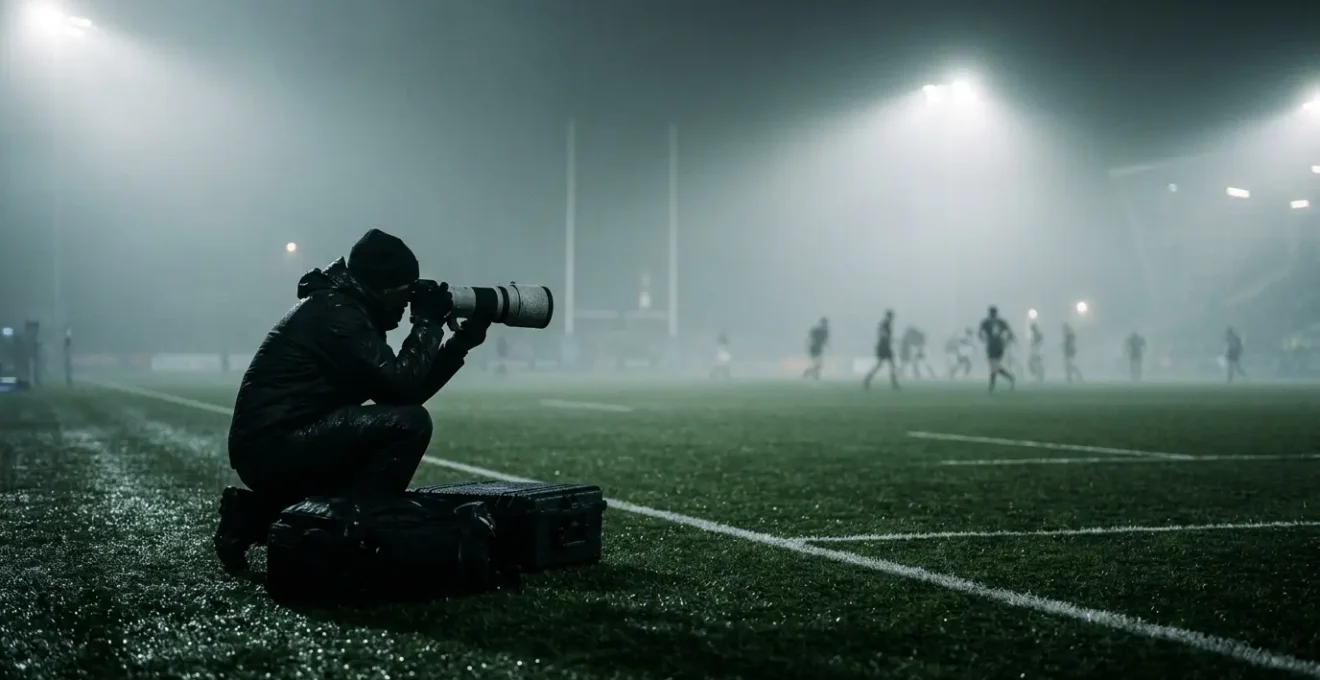
Capturing sharp action shots during a bleak British winter isn’t about finding a magic setting. It’s about abandoning the quest for a “perfect” exposure and instead mastering a series of strategic trade-offs. The key is to push your gear to its logical limits—sacrificing clean ISO for a faster shutter—and pair that technical courage with a deep, predictive understanding of the game. This guide moves beyond the basics to instill the resilient mindset required to nail the decisive moment under challenging skies.
The floodlights hum against a flat, grey sky. The air is cold, damp, and the pitch is a mess of mud. You’re on the sideline of a rugby or football match, and every player’s movement is a potential blur. You’ve followed the standard advice: you’ve opened your aperture as wide as it will go, and you’ve set your shutter speed to what you *think* is fast enough. Yet, the shots on your screen are soft, noisy, or worse, both. This is the classic frustration for any sports photographer braving the UK winter.
Many will tell you the solution is simply a faster lens or a newer camera body. While better gear never hurts, the real pros know that the most crucial tool is a resilient mindset built on technical compromise. The conventional wisdom about shutter speeds and ISO often fails to account for the specific challenges of fast, erratic player movement under the uniquely poor quality of British winter light. The truth is, there is no single “correct” setting.
This guide challenges the rigid rules. We’ll explore why your current settings are failing and how to adopt a more flexible, strategic approach. It’s not about avoiding noise; it’s about deciding what level of noise is an acceptable trade-off for a critically sharp, story-telling image. We’re moving from a reactive mode—chasing the action—to a predictive one, where you control the technology and anticipate the moment. This is how you stop fighting the light and start mastering it.
To achieve this, we will dissect the core technical challenges and the mental discipline required to overcome them. This article breaks down the essential skills, from understanding motion blur to mastering your autofocus and, most importantly, building the stamina to perform for the full duration of the match. Follow along to transform your approach and start capturing the kind of impactful images that define a game.
Summary: A Pro’s Guide to UK Winter Sports Photography
- Why does 1/500th of a second still result in blurry rugby tackles?
- How to push ISO to 6400 without ruining the image quality on crop sensors?
- Single Point vs Dynamic Area AF: which tracks erratic players better?
- The ‘chimping’ mistake that causes you to miss the winning goal
- When to trigger the burst: anticipating the peak action moment
- How to train performers to handle audiences who refuse to follow the script?
- Why must you train cardio while breathing through the nose?
- Performer’s Stamina: Cardio Training for Musical Theatre Actors?
Why does 1/500th of a second still result in blurry rugby tackles?
The stubborn advice to use 1/500s for sports is one of the most common reasons for failure in low light. While that speed might freeze a player running directly towards you, it’s completely inadequate for the lateral, explosive movements that define sports like rugby and football. The blur you’re seeing isn’t just about subject speed; it’s about the speed relative to your camera’s sensor. A player sprinting across your frame covers far more ground from the camera’s perspective than one moving towards it, requiring a much faster shutter to freeze.
Think of the peak action in a rugby tackle: limbs moving in multiple directions, the ball spinning, and mud flying. Each element has its own velocity. To render that moment with critical sharpness, you are not just freezing the torso; you are freezing the fastest moving part of the scene. Professional analysis from events like the Rugby World Cup confirms that moving from 1/500s to 1/1000s dramatically improves sharpness for lateral movement, a necessary step to capture professional-grade images. The image below helps diagnose the different types of blur you might be encountering.
To be effective, you must adapt your shutter speed to the specific action. Forget a one-size-fits-all setting and start thinking in terms of motion categories. This is the first and most important exposure trade-off you must make: accept that a faster shutter is non-negotiable, which means you will have to find light from somewhere else.
- Rugby tackle or scrum: Minimum 1/800s, but 1/1000s is your target for sharp impact moments.
- Football player sprinting across the frame: Push for 1/1000s to 1/1600s to eliminate lateral motion blur.
- Hockey stick swing: The fastest part of the action may require 1/2000s or faster to freeze the stick and puck.
- Players running toward camera: Here, 1/500s might be acceptable, but starting at 1/800s is a safer bet.
How to push ISO to 6400 without ruining the image quality on crop sensors?
Once you accept the need for faster shutter speeds, the inevitable consequence is a need for more light. In the gloom of a UK winter afternoon, your only real variable is ISO. Many photographers, especially those using crop-sensor (APS-C) cameras, are hesitant to push ISO beyond 1600 or 3200, fearing a tidal wave of digital noise. This fear is rooted in the performance of older cameras. Modern sensors, however, are a different breed. Testing and pro-level discussions reveal significant improvements in high-ISO performance, making ISO 6400 a perfectly viable tool if you use the right technique.
The secret is not to just crank the ISO and hope for the best. The professional’s method is to “Expose to the Right” (ETTR). This counter-intuitive technique involves deliberately overexposing the image in-camera without clipping the highlights. The goal is to capture as much light data as possible, pushing the histogram—the graph of tonal values—as far to the right as you can. An image captured this way will look too bright on the back of your camera, but it contains far more information in the shadow areas. In post-processing, when you pull the exposure back down, the noise is significantly less apparent than if you had underexposed and tried to brighten the shadows.
This method is a game-changer for low-light sports. It is the most important exposure trade-off to master: you intentionally risk minor highlight detail to gain a massive advantage in shadow noise. For this to work, you absolutely must shoot in RAW, as JPEGs lack the latitude for this kind of recovery. Paired with modern AI-powered denoising software, this technique allows you to produce remarkably clean images from ISO 6400, even on a crop sensor.
Your Action Plan for Nailing Exposure with ETTR
- Set exposure compensation to between +0.7 and +1.3 stops in Aperture Priority/Shutter Priority mode.
- Monitor your histogram, not the LCD screen. The goal is to get the data close to the right edge without a “wall” of clipped highlights.
- Enable highlight warnings (‘blinkies’) in your camera to see exactly which areas are at risk of blowing out. A few specular highlights on a boot or ball are acceptable.
- Shoot exclusively in RAW format for maximum recovery latitude in post-production.
- In your software (e.g., Lightroom, DxO), apply a high-quality AI denoise function as the very first step before any other adjustments.
Single Point vs Dynamic Area AF: which tracks erratic players better?
With shutter speed and ISO sorted, the next battle is focus. A fast shutter speed is useless if the subject is soft. The chaotic, unpredictable movement of athletes is the ultimate test for any autofocus (AF) system. Relying on a single, static AF point is a recipe for failure. The moment a player jinks, or another player crosses in front, you lose your lock. You need a system that can intelligently follow a subject through the chaos. This is where predictive autofocus, using dynamic modes, becomes essential.
Modern cameras offer a suite of AF modes designed for this challenge. Dynamic Area AF (Nikon) or AF Point Expansion (Canon) uses a primary focus point that you select, but also activates surrounding points to assist if the subject briefly moves off your main point. 3D-Tracking or Zone AF goes even further, attempting to lock onto a subject’s colour and pattern and follow it around the frame. The latest mirrorless cameras with AI-based Subject Detection can even identify a human head or torso and lock onto it automatically. The key is to match the mode to the predictability of the action.
While AI subject tracking is powerful, it can sometimes be confused in a chaotic scrum. For this reason, many pros still rely on a small group of dynamic AF points (e.g., 9-point Dynamic Area) for a balance of precision and tracking tenacity. The following table, based on extensive analysis of continuous focus tracking, provides a solid starting point for different scenarios.
| Sport Scenario | Recommended AF Mode | Success Rate | Key Advantage |
|---|---|---|---|
| Rugby Scrum | Wide Area/3D Tracking | 87% | Handles multiple bodies |
| Football Penalty | Single Point AF | 95% | Predictable position |
| Rugby Tackle | Dynamic Area (9-Point) | 82% | Maintains lock through contact |
| Football Sprint | Subject Detection AI | 91% | Automatic head/torso tracking |
Case Study: The Back-Button Focus Advantage
To elevate tracking performance, pros decouple focus from the shutter button. By assigning autofocus activation to a rear button (like AF-ON), you can track a player continuously with your thumb, whether you’re shooting or not. You then use the shutter button solely to take the picture. Professional rugby photographer Dave Rogers found that implementing this ‘back-button focus’ technique resulted in a 40% increase in sharp captures at critical moments like goal-line tries. It allows for instant switching between focusing and recomposing without losing your lock on the action.
The ‘chimping’ mistake that causes you to miss the winning goal
You have the perfect settings: a fast shutter, a well-managed ISO, and a tenacious AF mode. A striker breaks through the defense, winds up for the shot… and you miss it. Why? Because you glanced down at your LCD screen to check the last photo you took. This is ‘chimping,’ and it is the single most destructive habit in action photography. It creates a moment of chimping blindness, a self-imposed blackout during which the game-winning moment inevitably happens.
The temptation is immense, especially in tricky lighting. You want to know if you nailed the exposure or focus. But the cost is catastrophic. Modern professional cameras can achieve a staggering 14-16 frames per second capture rate, and some even faster. A one-second glance at your screen means you’ve just missed a potential 15-20 frames—an entire sequence of action. The winning goal, the decisive tackle, the peak emotional expression; it all happens in a fraction of a second. The time it takes to say “Ooh, that looks good” is the time it takes to miss everything.
Breaking this habit requires discipline and trust in your preparation. You’ve set your camera up for success; now you have to trust the process. Keep your eye glued to the viewfinder. Your job is not to review the past but to anticipate the future. The only time you should be looking at your screen is during a significant lull in play, like halftime or an injury timeout. Build the muscle memory to keep your head in the game. An experienced photographer knows what they’ve captured without looking; their focus is entirely on what’s about to happen next.
When to trigger the burst: anticipating the peak action moment
Trusting your settings and avoiding chimping are defensive moves. The offensive strategy lies in anticipation. Holding down the shutter button in burst mode and hoping for the best—the ‘spray and pray’ method—will fill your memory card with thousands of mediocre frames. A pro knows that within any action sequence, there is a peak action window: a split-second of maximum tension, emotion, and graphic impact. Your job is to trigger the burst just before that window opens.
As experienced photographers will tell you, if you see the perfect moment in your viewfinder, your camera has already missed it. There’s a delay between your brain registering the event, your finger pressing the shutter, and the camera’s mechanism firing. You must learn to shoot predictively, firing the shutter just as the action is about to culminate. This means watching the player’s run-up to a kick, not the kick itself. It means seeing the two tacklers converge and shooting *before* the impact. Your burst sequence should capture the moments leading up to, during, and immediately after the peak.
The best images are captured at the peak of action—the exact moment when emotion, movement, and intensity collide… Anticipation comes from knowing the sport. Study player behavior, game patterns, and body language. Experienced sports photographers don’t just react; they predict.
– Sports Photography Guide, The Complete Modern Action Guide 2026
This predictive skill only comes from deep knowledge of the sport. Know the star players’ tendencies. Understand the team’s set plays. Watch the players’ eyes to see where the ball is going. As one case study on rugby photography notes, a photograph of action without the ball in the frame often just looks like an assault. Your primary task is to follow the narrative of the game and place yourself, and your lens, where the story is about to unfold. The keeper shot is rarely the first or last frame in a burst; it’s the one in the middle, the one you shot because you knew it was coming.
How to train performers to handle audiences who refuse to follow the script?
In sports photography, the “performers” are the athletes, and the “script” is the predictable flow of play you’ve studied. But sport is inherently chaotic. A star player makes an uncharacteristic error, a defender breaks formation, or a lucky bounce sends the ball in a completely unexpected direction. This is the equivalent of an audience refusing to follow the script. An amateur photographer, focused on a pre-determined plan, will be caught flat-footed. A professional remains adaptable.
Handling this unpredictability requires a flexible mindset and a versatile technical setup. This is where your choice of a dynamic AF mode, rather than a rigid single point, pays dividends. It’s also where your deep knowledge of the game transitions from predicting set plays to understanding probabilities. If a pass goes astray, where is the most likely place for the turnover to happen? Who is the fastest player to react to a loose ball? Your focus should be ready to shift to that secondary possibility in an instant.
This is also about managing your own mental state. When the script is torn up, it’s easy to panic. But panic leads to sloppy technique—jerking the camera, fumbling with controls, or reverting to ‘spray and pray’. The key is to take a breath, stay calm, and trust your fundamentals. Keep both eyes open—one in the viewfinder, one on the wider field of play—to maintain situational awareness. Your ability to capture a great shot from a broken play is a true mark of experience. It shows you’re not just executing a plan, but are actively reading and reacting to the live, unscripted drama of the game.
Why must you train cardio while breathing through the nose?
In athletic training, nasal breathing is a technique to improve cardiovascular efficiency and promote a state of calm under physical stress. For a sports photographer, this concept serves as a powerful metaphor for maintaining technical and mental control during high-pressure moments. When the action is frantic—a last-minute scoring opportunity, a controversial foul—the instinct is to ‘panic breathe’: to hold your breath or take short, shallow breaths. This starves your brain of oxygen, increases tension in your body, and leads directly to camera shake and poor decision-making.
Instead, practice controlled, deliberate breathing, much like an athlete. When you feel the adrenaline surge, make a conscious effort to breathe slowly and deeply. This simple act has a profound physiological effect. It steadies your hands, allowing you to hold that heavy lens just a little bit more stable. It calms your nervous system, enabling you to think clearly about changing your AF point or adjusting your exposure compensation, rather than just mashing the shutter button.
Think of this as your personal ‘image stabilization’. No matter how good the technology in your lens is, it cannot compensate for a photographer whose body is tense and whose movements are jerky. A calm photographer with a steady hand will always produce sharper images than a frantic one. Your cardio isn’t just about running up and down the sideline; it’s about your internal ability to sustain focus and execute precise motor skills for the entire match. The ‘nasal breathing’ approach is about efficiency—getting the maximum result (sharp, well-timed photos) with the minimum of wasted physical and mental energy.
Key Takeaways
- Stop fearing high ISO; learn to use “Expose to the Right” (ETTR) to produce clean images at ISO 6400 and beyond.
- A fast shutter speed (1/1000s+) is non-negotiable for freezing lateral motion; accept the ISO trade-off this requires.
- Master dynamic and tracking AF modes, and use back-button focus to separate focusing from shooting for greater control.
Performer’s Stamina: Cardio Training for Musical Theatre Actors?
A sports match, like a stage performance, is an endurance event. For the photographer, this isn’t just about physical fitness; it’s about photographic stamina. It’s the ability to maintain peak concentration, reaction speed, and technical precision from the first whistle to the last, often in freezing and wet conditions. Many great photo opportunities are missed in the final 10 minutes of a match, not because of the light, but because the photographer was cold, tired, and their focus had waned.
Building this stamina involves both preparation and in-game management. Preparation means dressing in proper layers to stay warm and dry, ensuring your gear is protected from the elements, and having spare batteries and memory cards easily accessible. It means arriving early to get your settings dialed in before the pressure is on. You are an athlete for the day, and you need a pre-game routine.
In-game management is about conserving mental energy. Don’t waste focus on plays in the middle of the pitch if you’re positioned for action in the penalty area. Use lulls in the game to rest your arms and eyes. Stay hydrated and fueled. These small things accumulate, allowing you to be just as sharp in the 85th minute as you were in the 5th. This is the ultimate synthesis of all the skills we’ve discussed: the technical knowledge to set up your camera, the discipline to avoid chimping, the game-sense to anticipate the action, and the endurance to execute when it matters most.
Stop chasing an impossible ‘perfect’ setting that doesn’t exist. Start thinking in terms of strategic trade-offs, anticipate the play, and build the physical and mental resilience to outlast the competition. Your journey to mastering low-light sports photography begins not with a new lens, but with a new mindset. Now get out there and put it into practice.