The financial value of a British art movement is not random; it’s a predictable cycle driven by historical disruption, institutional validation, and scarcity.
- Authentic movements that break established norms (like Vorticism) create a “disruption premium” that underpins long-term value.
- An artist’s journey from graduate show to a Tate retrospective follows a discernible “validation funnel,” offering clear entry points for savvy investors.
Recommendation: Shift from passive collecting to active analysis. By decoding these patterns, you can anticipate market shifts and identify value before it becomes consensus.
For the discerning collector, the London art market presents a fascinating paradox. It is at once a bastion of cultural heritage and a high-stakes financial arena. Many investors approach it with a mix of passion and apprehension, guided by the common refrain to “buy what you love.” While sound personal advice, this maxim is insufficient for building a strategically valuable collection. The question is not merely what to buy, but *why* certain pockets of 20th-century British art—from the radical geometry of Vorticism to the calculated shock of the Young British Artists (YBAs)—consistently outperform others.
The conventional wisdom points to artist fame, aesthetics, or simple scarcity. These are factors, certainly, but they are merely symptoms of a deeper mechanism. The true valuation of an art movement is rarely about a single painting or artist; it is about the power of the collective narrative, the historical moment it captures, and its subsequent journey through a gauntlet of critical and institutional validation. Understanding this process is the key to differentiating a fleeting trend from a cornerstone of art history with a resilient market value.
This analysis moves beyond surface-level appreciation to dissect the financial DNA of modern British art. We will treat these movements not as spontaneous creative bursts, but as asset classes with identifiable risk profiles and performance indicators. The goal is to equip you, the investor, with an appraiser’s framework for evaluating a movement’s potential. By understanding the lifecycle from rebellious inception to blue-chip institutionalisation, you can learn to read the signals, anticipate market shifts, and make acquisitions grounded in historical precedent and financial acumen.
This guide provides an analytical framework for understanding the forces that drive value within the UK’s most significant modern art movements. We will explore the characteristics that create long-term financial stability, the key signals for emerging talent, and the practicalities of acquiring works effectively.
Summary: How Creative Movements Shape the Valuation of Modern British Art
- Why do specific 20th-century British movements command higher prices than others?
- How to identify authentic characteristics of the Vorticist movement in unsigned works?
- Post-War Modernism or Young British Artists: Which offers better long-term stability?
- The risk of buying into “Neo-Movements” before critical consensus is established
- When to buy works from a movement: anticipating the Tate Britain effect
- Why is a selection for ‘Bloomberg New Contemporaries’ a major buy signal?
- How to bid at provincial auction houses without paying hidden premiums?
- How to Spot Emerging Artists at Graduate Shows Before Prices Skyrocket?
Why do specific 20th-century British movements command higher prices than others?
The value of an art movement is not determined by aesthetics alone, but by a confluence of historical significance, scarcity, and narrative power. In a market as established as the UK’s—which, according to a recent Art Basel & UBS report, saw £10.4 billion in art sales in 2024—the price differential between movements can be vast. The key differentiator is often what I term the ‘historical disruption premium’: a value assigned to movements that didn’t just innovate, but aggressively broke from and redefined the artistic conventions of their time.
Vorticism, for example, founded in 1914, was not merely a new style; it was a polemical attack on the perceived passivity of Impressionism and the romanticism of Futurism. Its members sought to create ‘a new living abstraction’ that captured the brutal, mechanical dynamism of the modern world. This intellectual and artistic aggression gives the movement its historical weight. This significance is then amplified by extreme scarcity.
Case Study: Vorticism’s Scarcity-Driven Valuation
The Vorticist movement was short-lived, effectively curtailed by the First World War. This historical disruption led to the physical loss of many key works. As noted by the art historian Richard Cork, a staggering thirty-eight of the forty-nine works from the seminal 1915 Vorticist Exhibition are now considered missing. This acute lack of supply for a movement of such profound art-historical importance creates immense market tension. When a verified Vorticist piece appears at auction, it is not just a painting being sold; it is a rare artefact from a pivotal moment in British art history, commanding a price that reflects this unique status.
In contrast, less disruptive or more derivative movements, while producing aesthetically pleasing work, lack this foundational narrative of rebellion and redefinition. They become footnotes rather than chapters in art history, and their market value reflects this subordinate status. For an investor, the primary task is to identify those movements that successfully challenged and reshaped the artistic landscape.
How to identify authentic characteristics of the Vorticist movement in unsigned works?
Authenticating an unsigned work, particularly from a movement as defined as Vorticism, requires a forensic eye. It is less about a single “tell” and more about the confluence of several distinct characteristics that, together, build a compelling case for attribution. The Vorticist manifesto provided a clear, almost prescriptive, set of visual and philosophical rules, which serve as an invaluable checklist for the modern appraiser. The primary goal was to express the “energy of the mind” and the harsh reality of a machine-age metropolis through a non-representational language.
The visual evidence must be paramount. Look for a style that deliberately rejects the soft focus of Impressionism and the chaotic motion of Italian Futurism. A true Vorticist work is defined by its hard-edged, geometric abstraction. The composition should feel architectural, constructed from sharp angles, intersecting planes, and forms that evoke machinery and urban structures without literally depicting them. This is the ‘new living abstraction’ Wyndham Lewis championed.
As the image above illustrates, the very application of paint is a key indicator. The brushwork should be confident and angular, creating a textural surface that feels almost sculptural. These are not delicate strokes; they are assertive marks that build form. An authentic piece must also align with the movement’s brief but intense period of activity, primarily between 1912 and 1915. Any work claiming a Vorticist identity but created outside this window requires extraordinary provenance to be considered credible.
Your Vorticist Authentication Checklist: Key Markers to Verify
- Visual Language: Does the work exhibit cubist fragmentation combined with hard-edged, machine-like imagery? It must feel built, not painted.
- Artistic Opposition: Does the style clearly reject both the atmospheric softness of Impressionism and the frenetic lines of Futurism? It should feel distinctly British and self-contained.
- Chronological Plausibility: Was the work created during the movement’s peak (c. 1912-1915)? Verify against the artist’s known timeline if a potential name is associated.
- Philosophical Intent: Does the piece convey a sense of ‘essential movement and activity’, reflecting mental energy rather than depicting a literal scene of action?
- Exhibition History: Can the work, its style, or its subject be cross-referenced with known Vorticist exhibitions, particularly the landmark 1915 Doré Galleries show?
Post-War Modernism or Young British Artists: Which offers better long-term stability?
When considering long-term stability, an investor is essentially weighing proven historical significance against high-growth potential and its associated volatility. The choice between British Post-War Modernism (think Bacon, Freud, Auerbach) and the Young British Artists (Hirst, Emin, Lucas) is a classic portfolio dilemma: the blue-chip bond versus the high-yield tech stock. Both have a firm place in art history, but their investment profiles are fundamentally different.
Post-War Modernism represents a period of intense, existential introspection, rendered through traditional, durable media like oil on canvas. Its key figures are institutional heavyweights, their markets supported by decades of museum retrospectives, academic scholarship, and a global collector base. Appreciation is steady and predictable, driven by provenance and scarcity. The risk is low, but so is the likelihood of exponential returns. It is the bedrock of a stable, legacy-focused collection.
The YBAs, on the other hand, represent a market phenomenon. As their Wikipedia entry notes, they are defined by their use of “‘shock tactics’, use of throwaway materials, wild living, and an attitude ‘both oppositional and entrepreneurial'”. This introduces a critical investment variable: materiality risk. A Damien Hirst formaldehyde shark or a Tracey Emin unmade bed presents conservation challenges and a conceptual dependence that a Lucian Freud portrait does not. This risk, however, is balanced by a history of explosive returns and a powerful, globally recognized brand.
The following table, based on market data, breaks down the core investment characteristics of each movement:
| Factor | Post-War Modernism | Young British Artists |
|---|---|---|
| Market Performance | Stable, institutional support | Higher returns than S&P 500 over 10 years |
| Top Artist Performance | Consistent appreciation | Hirst most financially successful but struggling to rebound to pre-crash levels |
| Material Durability | Traditional oil on canvas | Non-traditional media including elephant dung and cigarette sculptures |
| Best Performer Returns | Steady 5-10% annually | Tracey Emin achieved over 200% returns since 2003 |
| Risk Assessment | Low volatility | Question of sustainability once British hype faded |
Ultimately, the choice is not about which is “better,” but which aligns with your investment horizon and risk appetite. Post-War Modernism offers stability and a defence against market downturns. The YBAs offer higher potential returns but demand a greater tolerance for volatility and the unique risks associated with conceptual and materially fragile works.
The risk of buying into “Neo-Movements” before critical consensus is established
The phenomenal commercial success of the YBAs created a dangerous precedent: the belief that a movement can be manufactured. In the years that followed, numerous “Neo-Movements” have emerged, attempting to replicate the YBA formula of media-savvy branding and artistic rebellion. For the unwary investor, these can be treacherous waters. Buying into a movement before it has achieved critical consensus is pure speculation, and the risk of a total loss of capital is high, especially in a correcting market where the latest Art Basel report indicates a 25% decline in public auction sales value in 2024.
The fundamental error is mistaking marketing for momentum. An authentic movement is born from genuine artistic innovation and is nurtured by a specific ecosystem of peer-to-peer support, academic engagement, and eventually, institutional validation. A manufactured movement often has the branding and the manifesto, but lacks the underlying substance and the crucial support of the art world’s gatekeepers.
Warning Sign: The Cautionary Tale of Stuckism
The Stuckists, co-founded by Billy Childish and Charles Thomson in 1999, are a prime example. They had a clear, anti-conceptual art manifesto and were adept at generating press through protests against the Turner Prize. They explicitly positioned themselves as an alternative to the YBAs. However, the movement failed to gain critical traction. While the YBA label became a “powerful brand recognised worldwide,” as noted by Tate, its success was rooted in more than marketing. The YBAs’ defining feature was a truly innovative, “can-do” entrepreneurial approach to exhibiting, combined with the rigorous critical environment of institutions like Goldsmiths College. The Stuckists, by contrast, were perceived as reactionary and failed to secure the essential backing from major curators and galleries. Their market value remains negligible, a stark reminder that a press release does not make a movement.
Before investing in any new, self-proclaimed movement, an investor must act as a diligent researcher. Look for evidence of the ‘institutional validation funnel’ in action. Are these artists being included in curated group shows at respected non-commercial spaces? Are their works being acquired by discerning, established collectors? Is their practice being discussed in serious academic journals, not just in the popular press? If the answer to these questions is no, the risk of it being a hollow brand, rather than a genuine artistic force, is exceptionally high.
When to buy works from a movement: anticipating the Tate Britain effect
Timing is a critical, and often overlooked, element of art investment. For established movements, the most significant value inflection point is frequently tied to major institutional recognition. A full-scale museum retrospective, particularly at a national institution like Tate Britain, acts as the ultimate stamp of approval. It solidifies an artist’s or movement’s place in the canon of art history, educates a new generation of collectors, and triggers a surge in market demand. This phenomenon, which I call the ‘Tate Britain Effect’, is a predictable event that a savvy investor can anticipate.
Buying into a movement *after* the retrospective has been announced is often too late; by then, prices will have already been bid up by insiders. The strategic approach is to engage in what can be termed ‘curatorial arbitrage’: identifying the movements and artists on the path to institutional validation 12 to 24 months before a major exhibition is confirmed. This requires monitoring a series of leading indicators that signal growing curatorial interest.
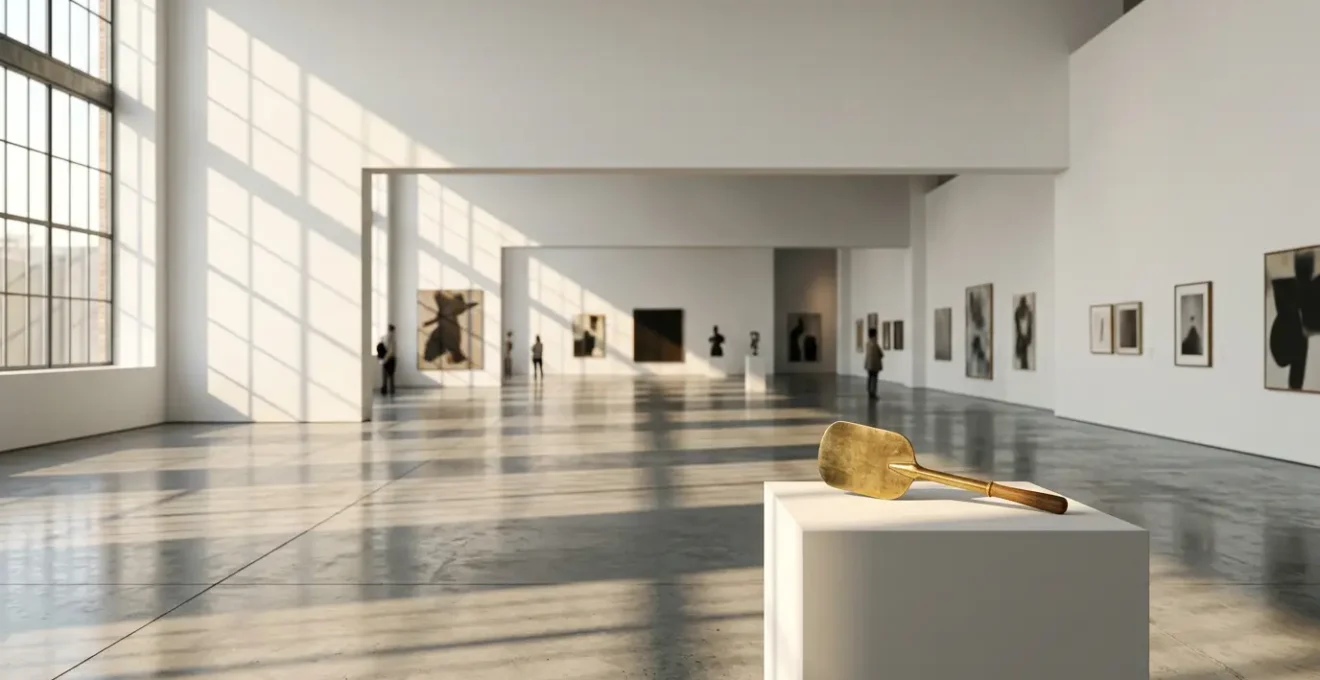
The empty gallery, poised for installation, is the perfect metaphor for this strategy. The value is not yet on the walls, but the entire structure is in place for its arrival. Academic interest, the signing of estates by major galleries, or the inclusion of overlooked artists in international biennials are all signals that the critical groundwork is being laid for a major reappraisal. It is during this “installation phase”—when the art world is preparing its narrative—that the greatest buying opportunities can be found.
Action Plan: Anticipating the Next Major Retrospective
- Monitor Anniversaries: Track the 50- and 100-year anniversaries of significant British movements. Museums often build their exhibition schedules around these historical milestones.
- Track Academic Research: Follow the dissertation topics at leading university art history departments. A surge in PhD research on an overlooked artist often precedes curatorial attention by several years.
- Watch Biennial Inclusions: Note when minor artists from a historically important but undervalued movement are included in prestigious international shows like the Venice Biennale. This is a sign of renewed global interest.
- Follow Gallery Signings: Pay close attention when a major commercial gallery (e.g., Gagosian, Hauser & Wirth) signs the estate of a deceased artist from a specific movement. This signals a long-term commercial and critical strategy.
- Identify Curatorial Trends: Look for a recurring focus on “forgotten” figures within well-known movements, especially female artists who were historically sidelined in male-dominated groups. Curators are actively looking to correct the historical record.
Why is a selection for ‘Bloomberg New Contemporaries’ a major buy signal?
In the complex ecosystem of the emerging art market, a few select platforms serve as reliable, third-party validators of talent. In the UK, a selection for the annual ‘Bloomberg New Contemporaries’ touring exhibition is arguably one of the most powerful early-career buy signals an investor can find. Its significance lies in its history, its rigorous selection process, and its function as the first rung on the ladder of the ‘institutional validation funnel’.
Historically, this exhibition has been a proven launchpad for artists who go on to achieve international acclaim. As noted in historical documentation on the YBAs, it was through exhibitions like New Contemporaries in the early 1990s that a “second wave” of what would become a global phenomenon first gained visibility. The exhibition provided a critical platform for artists who would later define the era.
A second wave of Young British Artists appeared in 1992-1993 through exhibitions such as New Contemporaries, New British Summertime and Minky Manky, including Douglas Gordon, Christine Borland, Fiona Banner, Tracey Emin, Tacita Dean
– Wikipedia, Young British Artists historical documentation
The power of a New Contemporaries selection stems from its independence. Unlike a commercial gallery show, where the motive is sales, the selection is made by a panel of respected artists and curators. This peer-review process provides an objective filter, identifying artists who are not only technically proficient but are also engaged in a relevant, contemporary dialogue. It effectively de-risks the investment by confirming the artist has passed a crucial test of critical, not just commercial, appeal.
Case Study: The New Contemporaries Alumni Track Record
The exhibition’s historical role as a talent incubator is its strongest endorsement. According to records on the YBA movement’s origins, artists like Tracey Emin, Tacita Dean, and Jane and Louise Wilson all emerged through New Contemporaries before building major international careers. For an investor, acquiring a work from a New Contemporaries artist is not a blind bet on an unknown student; it is a calculated investment in an artist who has been vetted by experts and is officially entering the professional art world on a path trodden by generations of successful predecessors.
How to bid at provincial auction houses without paying hidden premiums?
While London’s major auction houses dominate headlines, significant opportunities often lie in the UK’s provincial auction rooms. Here, one can find overlooked works with weaker provenance or from less-fashionable periods at attractive hammer prices. However, the allure of a low estimate can be deceptive. The final price paid by a bidder is often inflated by a series of fees and premiums that are not immediately obvious. Successfully navigating this environment requires calculating the ‘all-in’ cost before the first bid is even placed.
The primary addition is the Buyer’s Premium, a percentage of the hammer price that can range from 25% to 30%. On top of this, for works by living artists or those who died within the last 70 years, the Artist’s Resale Right (ARR) applies, adding up to 4%. If bidding online, which is increasingly common, a further 3-5% can be levied by the platform. These costs accumulate rapidly, turning a £10,000 hammer price into a final invoice closer to £14,000 before shipping is even considered.
The table below provides a typical breakdown of these often-underestimated costs:
| Cost Component | Typical Rate | Example on £10,000 hammer |
|---|---|---|
| Hammer Price | Base | £10,000 |
| Buyer’s Premium | 25-30% | £2,500-3,000 |
| Artist’s Resale Right (ARR) | Up to 4% | £400 |
| Online Bidding Fee | 3-5% | £300-500 |
| Shipping/Transport | Variable | £200-1,000 |
| Total All-in Cost | – | £13,400-14,900 |
Beyond the fees, due diligence is non-negotiable. Request a detailed condition report and ask specific questions: “Is the canvas relined?” or “Is there any retouching visible under UV light?” These factors dramatically affect value. Furthermore, pay close attention to attributional language. A work described as ‘Manner of’ or ‘Circle of’ an artist is not by the artist and is valued accordingly; this is where deep knowledge can uncover a misattributed bargain, but it also presents a significant risk for the novice. The key is to set a strict maximum ‘all-in’ price and adhere to it, resisting the emotional momentum of the auction room.
Key takeaways
- A movement’s financial value is directly linked to its ‘historical disruption premium’—its capacity to have radically broken with past artistic traditions.
- The journey from graduate show to museum retrospective follows a predictable ‘institutional validation funnel,’ offering clear, strategic entry points for investment.
- Assessing ‘materiality risk’ is crucial when comparing movements like the stable, traditionally-crafted Post-War Modernists against the conceptually and materially volatile YBAs.
How to Spot Emerging Artists at Graduate Shows Before Prices Skyrocket?
The graduate show is the genesis point of the art market, offering the highest risk but also the highest potential reward. It is here that one can acquire works for a few hundred pounds that might, in a decade, be worth tens of thousands. The challenge is discerning the one artist with genuine long-term potential from the hundreds of others. The success of the YBAs provides a powerful historical model for this; as historical data shows that over 90% of core YBA artists graduated from Goldsmiths BA Fine Art between 1987 and 1990, proving that certain institutions consistently produce market-leading talent.
The first step is therefore strategic scouting. Focus on the graduate shows of top-tier institutions like Goldsmiths, the Royal College of Art, the Slade School of Fine Art, and the Royal Academy Schools. History has proven these are the primary incubators of British artistic innovation. Within these shows, immediately seek out the prize-winners. Internal awards, selected by a panel of tutors and visiting artists, are the earliest form of expert vetting available and a strong indicator of who the institution itself is backing.
However, a good eye is not enough. The most successful artists are often those who can articulate the intellectual framework behind their practice. Engage with the students. An artist who can speak coherently and confidently about their work, its context, and its ambitions demonstrates a level of intellectual cohesion that is essential for a long-term career. They are not just making objects; they are building a practice. This is a quality that was central to the YBAs, who were famously entrepreneurial and articulate from the very beginning.
Finally, be practical. The large, ambitious degree show centerpiece is often not the best investment. It may be unwieldy or experimental. Ask to see the artist’s portfolio of smaller, more resolved, or more commercial works on paper or canvas. These are often more affordable and a better representation of the core practice you are investing in. Look for the same entrepreneurial spirit that defined the early YBAs—artists who are already thinking about how to document, present, and place their work in the world.
By shifting your perspective from that of a passive art lover to an active market analyst, the entire British art landscape transforms. The strategies outlined—from decoding the historical premium of Vorticism to scouting the next generation at Goldsmiths—provide a clear framework. The next logical step is to apply this analytical lens to your own collecting strategy, moving with the confidence that comes from understanding the fundamental mechanics of value.