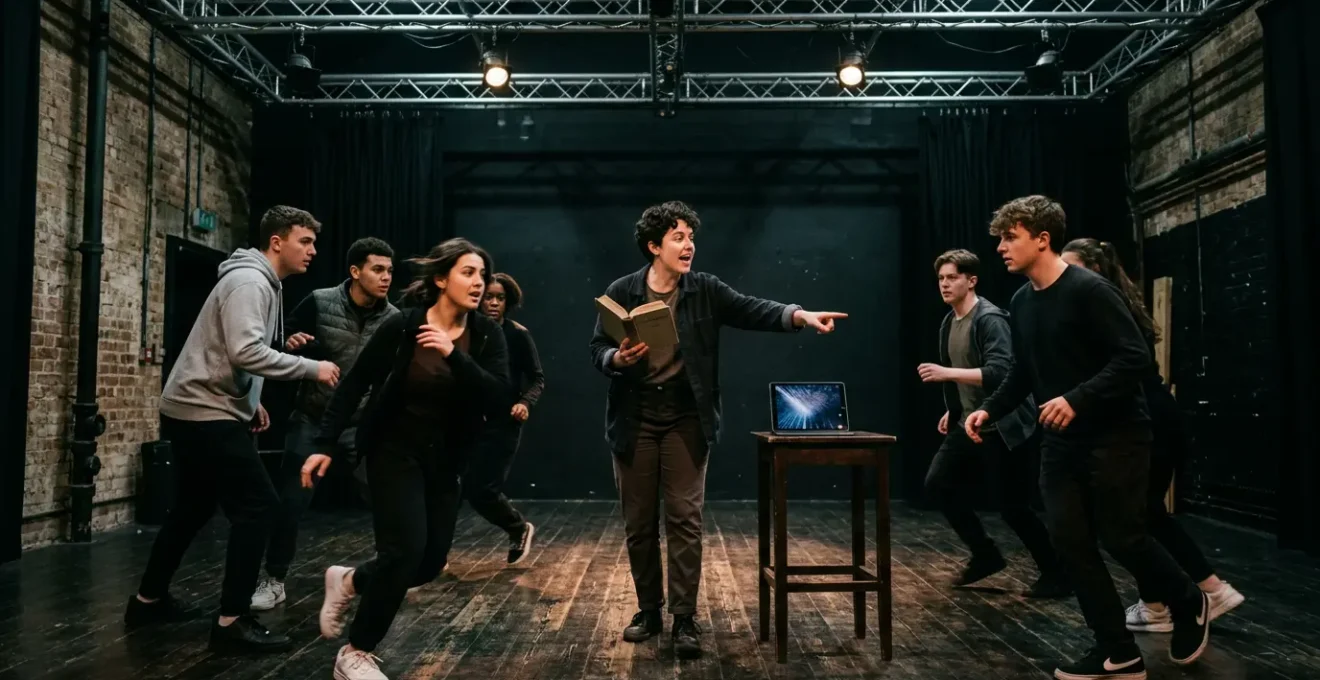
The key to making Shakespeare resonate with Gen Z isn’t ‘modernizing’ the text, but redesigning the audience’s relationship to it.
- Stop treating young audiences as passive spectators; grant them agency through interactive and immersive staging choices.
- Use pacing, spatial dynamics, and fourth-wall breaks with the strategic precision of a game designer to manage cognitive load and maximize emotional impact.
Recommendation: Ditch the surface-level gimmicks and instead build a directorial framework around consent, graduated intimacy, and audience agency to unlock the raw, authentic power of the original text.
Let’s be honest. The question of making Shakespeare “relevant” for young people often sends a collective shiver down the spine of the UK’s theatre community. We see visions of actors in hoodies, cringeworthy social media projections, and the ghosts of well-intentioned but misguided productions. The prevailing wisdom cycles through familiar tropes: slap on some contemporary costumes, cut the long speeches, and hope for the best. This approach is rooted in a fundamental misunderstanding of the Gen Z audience. Raised on the sophisticated narrative structures of video games and the direct, parasocial bonds of social media, they don’t crave dilution; they crave authenticity and engagement.
The problem isn’t the iambic pentameter. It’s the passive-spectator model we force upon them. They are experts at decoding complex systems and investing in worlds that grant them agency. Yet, in the theatre, we often ask them to simply sit down, be quiet, and receive a story from a distance. The perception, as a viral review of a recent Broadway hit put it, can be that “Shakespeare is brat”—a dense, performative puzzle rather than a visceral human experience. But what if we, as directors, stopped trying to be “cool” and started being smart? What if we leveraged the very language of the media Gen Z consumes—not as a gimmick, but as a structural blueprint for our direction?
This article is a call to arms for the creatively ambitious director. We will dismantle the idea that Shakespeare needs “fixing” and instead explore a series of powerful, practical techniques to change the audience’s relationship with the work. We’ll move from managing cognitive load and creating tension on a grand scale, right down to the ethics of audience connection in immersive settings. It’s time to stop talking down to our future audience and start inviting them into the game.
This guide breaks down a series of actionable strategies, moving from large-scale conceptual shifts to granular, in-the-moment techniques. Each section is designed to provide a specific tool for your directorial arsenal, helping you build productions that are both artistically rigorous and profoundly resonant.
Summary: A Director’s Playbook for Gen Z Engagement
- Why does keeping the original setting alienate 60% of young viewers?
- How to use proximity and stillness to create tension in large proscenium arches?
- Stanislavski vs Meisner: which method unlocks rawer emotion in British tragedy?
- The direction error that turns a 2-hour play into a 3-hour endurance test
- When to place the interval: maximizing suspense vs risking audience disengagement
- When to break the fourth wall: pacing intimacy for maximum impact
- How to make an audience understand ‘I want that apple’ without saying a word?
- Creating Immediate Audience Connection in Immersive Theatre: Boundaries and Consent?
Why does keeping the original setting alienate 60% of young viewers?
The doublets and hose are often the first thing to go in an attempt to “modernize,” but this is a superficial fix for a deeper problem: cognitive load. A historically accurate setting forces a young audience to do two things at once: decode the archaic language and decode the equally archaic visual language of the world. Every unfamiliar prop, costume piece, or social custom is a small mental hurdle that accumulates, creating a barrier between them and the emotional core of the story. The goal isn’t to simply replace old with new, but to create an aesthetic that feels intuitive, allowing the audience to focus their energy on the performances.
This isn’t about avoiding challenges; it’s about choosing the right ones. By stripping away unnecessary historical detail, we lower the barrier to entry without compromising the text’s integrity. The focus shifts from historical re-enactment to emotional authenticity. This allows modern fashion codes, for example, to do the heavy lifting of communicating character—Tybalt’s aggressive brand loyalty or Juliet’s understated rebellion become instantly legible.
Case Study: The ‘Romeo + Juliet’ Gen Z Success
Sam Gold’s 2024 Broadway production of Romeo + Juliet is a masterclass in this principle. By using contemporary costumes, a pre-show soundtrack of pop music, and a minimalist set, the production successfully bridges the authenticity gap for a young audience. The emotional connection to characters played by recognizable young actors is immediate, proving that when the cognitive load of the setting is removed, the power of Shakespeare’s original language can land with devastating, unobscured impact on a Gen Z audience.
Ultimately, the setting should serve the actor and the audience, not the museum. By creating a visually fluent world, we empower the language to be the star, proving that the emotions of Shakespeare are, and always have been, modern.
How to use proximity and stillness to create tension in large proscenium arches?
A vast stage is often seen as a space to be filled—with scenery, with bodies, with movement. But for a director crafting tension, its greatest power lies in its emptiness. The proscenium arch frames not just the action, but the void around it. In this space, stillness is not an absence of action; it is a deliberate, high-stakes choice. When an actor freezes in a vast, empty expanse, the audience’s focus sharpens to a razor’s edge. Every potential movement, every held breath, becomes charged with possibility and dread. This is the power of weaponizing negative space.
Proximity works as the explosive counterpoint to this stillness. After establishing a vast distance between characters, a sudden, rapid closing of that gap can be as shocking as a gunshot. The physical distance on stage becomes a direct metaphor for emotional distance. A director can map the entire arc of a relationship—from distant observation to suffocating intimacy—by choreographing the space between bodies. The key is to make distance and stillness active choices, not directorial afterthoughts.
The National Theatre’s 2013 production of Othello, staged in the cavernous Olivier Theatre, masterfully demonstrated these principles. As detailed in the National Theatre’s own learning resources, director Nicholas Hytner created moments of extreme tension through controlled formations and strategic breaks in those formations. By establishing a rigid military order and then shattering it with a single character’s stillness or a shocking breach of proximity, the production turned spatial dynamics into a core storytelling engine, making the vast stage feel both epic and claustrophobic.
Don’t fill the stage; sculpt it. Use stillness to pull focus and proximity to detonate tension. In the hands of a skilled director, the empty air on a proscenium stage becomes the most powerful tool of all.
Stanislavski vs Meisner: which method unlocks rawer emotion in British tragedy?
The quest for emotional authenticity in Shakespeare is fraught with peril. The heightened language can feel like a barrier to truthful feeling, leading to what Dame Helen Mirren calls the “very, very difficult” task of speaking poetry naturalistically. For decades, the dominant approaches in British theatre have drawn from Stanislavski’s system. His method, focused on emotional recall and deep analysis of given circumstances, can yield profound results. However, for Gen Z actors, the reliance on dredging up personal trauma for a role presents significant emotional safety concerns. Is there a better way to access the raw grief of Lear or the fury of Titus Andronicus without re-traumatizing the performer?
This is where the Meisner technique offers a compelling alternative. By prioritizing moment-to-moment response to a partner, Meisner pulls the actor out of their own head and into the present reality of the scene. The famous repetition exercise, when adapted to iambic pentameter, can be a revelatory tool. It forces the actor to stop ‘performing’ the verse and start using it as a vehicle for genuine, impulsive connection. The emotion is not sourced from a painful memory but generated live on stage, in the space between two performers. This creates a spontaneous, unpredictable energy that is electric for audiences and far more sustainable for the actors.
As Dame Helen Mirren suggests in her MasterClass on acting, young actors need the text to get them “by the throat.” This visceral connection often requires a hybrid approach. The intellectual rigour of Stanislavski’s text analysis provides the foundation, but the spontaneous, responsive truth of Meisner provides the spark.
This comparative table breaks down how these methods stack up when applied to the unique demands of Shakespearean tragedy, offering a guide for a safer, more effective rehearsal room.
| Method Aspect | Stanislavski Approach | Meisner Approach | Hybrid Recommendation |
|---|---|---|---|
| Emotional Access | Emotional recall from personal experience | Moment-to-moment partner response | Meisner for immediate truth, somatic techniques for physical expression |
| Text Work | Deep analysis of given circumstances | Repetition exercise adapted to verse | Use repetition with iambic pentameter to ground archaic language |
| Safety for Gen Z Actors | Risk of trauma retrieval | Partner-focused, less personal exposure | Combine with Alexander Technique for sustainable emotion |
| Suitability for Tragedy | Can access deep grief but exhausting | Creates authentic spontaneity | Michael Chekhov’s Psychological Gesture for epic scale |
Young actors don’t have to be interested in Shakespeare, unless it gets them by the throat… To try and find a way of speaking very heightened poetry in a naturalistic way is very, very difficult.
– Helen Mirren, MasterClass on Shakespeare Acting Techniques
The direction error that turns a 2-hour play into a 3-hour endurance test
The single biggest pacing error in directing Shakespeare is mistaking speed for energy. In a desperate attempt to keep the audience engaged, directors often push for relentless, high-stakes delivery from start to finish. The result is the exact opposite of what was intended: a monotonous wall of sound and fury that exhausts the actors and, more importantly, the audience. The human brain cannot sustain high alert for two hours. Without variation—without moments of quiet, reflection, or low-stakes connection—the big emotional peaks lose all their power. They become just another loud moment in a sea of loud moments.
The solution lies in shifting your thinking from pace to rhythm. A production’s rhythm is its heartbeat, a dynamic cycle of tension and release. This is where renowned UK director Trevor Nunn’s concept of the “dramatic energy graph” becomes an essential tool. Before even entering the rehearsal room, the director should map the play’s intended energy flow, intentionally plotting the peaks, valleys, and plateaus. This isn’t about telling actors to be “more energetic”; it’s about structuring the entire production around a carefully modulated energetic journey.
This approach, highlighted in Trevor Nunn’s Shakespeare masterclass series, emphasizes that low-energy scenes are not boring filler; they are crucial opportunities for the audience to breathe, process, and reset. These “sonic negative spaces”—moments of structured silence or quiet intimacy—are what give the climactic moments their devastating impact. A truly gripping production isn’t one that never lets up; it’s one that knows precisely when to hold back, making the eventual release all the more powerful.
Director’s Checklist: Crafting a Dynamic ‘Dramatic Energy Graph’
- Pre-Production Mapping: Before rehearsals begin, chart the play’s intended energy levels scene by scene, identifying the peaks, troughs, and moments of sustained tension.
- Incorporate ‘Sonic Negative Space’: Deliberately build in at least three moments of structured silence or significant sonic shifts to act as a reset for the audience’s palate.
- Vary Scene-to-Scene Energy: Use low-energy connective scenes as deliberate breathing room, allowing them to be quiet or even mundane to set up the next peak.
- Focus on Rhythm over Speed: Drill the tension/release cycles within scenes, using variations in movement, volume, and stillness rather than just pushing for faster line delivery.
- Stress-Test the Run-Time: During test runs, experiment with different energy levels. Run a scene at 50% intensity and see how it affects the following scene. This reveals more than a simple timed run-through.
Stop directing your actors to be faster. Start directing the audience’s heartbeat. That is where you’ll find true, sustainable dramatic energy.
When to place the interval: maximizing suspense vs risking audience disengagement
The interval is the most dangerous and powerful weapon in a director’s structural arsenal. Placed correctly, it’s a “cognitive cliffhanger” that sends an audience out into the foyer buzzing, desperate to know what happens next. Placed incorrectly, it’s a release valve that dissipates all dramatic tension, making the second half feel like an entirely new, and often unwelcome, play. The decision of where to break the narrative cannot be an afterthought based on run-time alone; it must be a strategic choice designed to maximize psychological investment.
The classic model is to place the interval after a major plot reversal or a moment of high action. However, a more effective strategy for a Gen Z audience—accustomed to the meticulously crafted suspense of binge-watch television—is to place it at the peak of a character’s emotional crisis. The question the audience should be left with is not “What will happen?” but “What will they *do*?”. This shifts the focus from external plot mechanics to internal psychological drama, creating a far deeper and more personal hook.
The National Theatre’s approach validates this. Internal analysis of their “Playing Shakespeare with Deutsche Bank” productions shows that using these cognitive cliffhangers is highly effective. In fact, productions using this strategy report 20% higher audience engagement scores in post-show surveys. This data confirms that the interval is not just a break; it is a crucial moment of narrative engineering that directly impacts an audience’s overall experience and emotional investment.
The interval should be placed immediately after the ‘point of no return’ or a major ‘mirror moment’ where the protagonist’s initial goal is fundamentally changed.
– Simon Godwin, Director of National Theatre’s Romeo & Juliet and Antony & Cleopatra
Don’t just stop the play. Weaponize the pause. Find your character’s point of no return, cut the lights, and let the audience’s speculation do your work for you during the break.
When to break the fourth wall: pacing intimacy for maximum impact
For an audience raised on the direct-address style of TikTok, YouTube, and video game tutorials, the fourth wall is not an invisible barrier; it’s a porous membrane. They are fluent in the language of parasocial connection. As directors, we can leverage this fluency to create moments of shocking intimacy. However, like any powerful tool, it must be used with precision. Breaking the fourth wall too early or too often turns it into a gimmick. The key is graduated intimacy, a carefully paced strategy that earns the audience’s trust before demanding their focus.
Think of it like a game’s narrative design. The first stage is the “cutscene,” where the audience observes the world and its rules from a safe, traditional distance. This establishes the narrative framework. The second stage introduces a minor break—a fleeting glance to the audience, a shared, knowing smile. This is a primer, a small invitation that signals to the audience that the rules might not be what they seem. The third stage is a retreat, a return to the safety of the fourth wall for a significant period. This makes the audience question if they imagined the earlier connection. The final stage is the deployment of the major break: a full-blown soliloquy delivered directly down the barrel, a desperate plea for help, or a conspiratorial aside. Because the moment has been earned, its impact is magnified tenfold.
Case Study: The Globe’s Graduated Intimacy
Productions at Shakespeare’s Globe, particularly their “Playing Shakespeare” series, are masters of this technique. As documented in their digital resources, their 2019 Romeo and Juliet used a three-stage approach. It began with minor breaks (fleeting eye contact during the prologue), built to a major direct address during Mercutio’s Queen Mab speech, and then retreated. This cultivated a graduated intimacy that felt familiar to a Gen Z audience, mimicking the shift from passive scrolling to direct engagement common in their digital lives. It transforms the soliloquy from a theatrical convention into a moment of genuine, one-to-one connection.
Don’t just break the fourth wall; build a relationship with it. Earn the audience’s trust, prime their expectations, and then choose your moment to look them right in the eye. They’ll be ready for it.
How to make an audience understand ‘I want that apple’ without saying a word?
Before a single line of iambic pentameter is spoken, the audience is already reading a story: the story told by the actor’s body. In the world of non-verbal communication, desire is a complex triangulation of focus, tension, and breath. To make an audience understand “I want that apple” without words, the actor must embody the internal conflict between impulse and restraint. The eyes may lock onto the object of desire, but the torso turns away, a physical manifestation of “I shouldn’t.” The hands might reach, then clench into a fist, pulling back—a tiny, lightning-fast drama of action and repression.
This isn’t about grand, sweeping gestures. The most powerful non-verbal storytelling is found in the micro-expressions and somatic shifts that the audience perceives almost unconsciously. It’s the slight widening of the eyes, the subtle shift of weight from one foot to the other, the almost imperceptible tensing of a jaw muscle. These are the details that build a believable internal world for the character, making their eventual actions—and their words—feel inevitable rather than simply scripted.
A crucial and often overlooked element in this is the breath. As Rodney Cottier, a master tutor from LAMDA, points out, the actor’s breath is a direct line to their emotional state. A sharp, hidden intake of breath upon first seeing the desired object immediately signals its importance to the audience. This somatic shift is visceral; the audience feels it along with the character. The controlled, slow exhale that follows, a physical attempt to regain composure, tells a story of internal struggle that is more potent than any line of dialogue. According to a summary of his masterclass at Harvard, this control of breath is a cornerstone of conveying complex, unspoken thoughts.
The actor’s breath is profoundly important – a slight sharp intake upon seeing the desired object, followed by controlled exhale as they repress desire. The audience perceives this somatic shift viscerally.
– Rodney Cottier, Head of Drama School at LAMDA
Train your actors to be poets with their bodies before they even approach the verse. Direct the breath, choreograph the tension between focus and posture, and the audience will understand the character’s deepest desires long before they dare to speak them aloud.
Key Takeaways
- Authenticity over Gimmicks: Gen Z audiences respond to emotional truth, not superficial ‘modernizing’. Focus on lowering cognitive load, not dumbing down the text.
- Rhythm, Not Pace: Avoid audience burnout by creating a ‘dramatic energy graph’ with deliberate peaks and valleys, using stillness and silence as powerful tools.
- Agency and Intimacy: Use techniques like graduated fourth-wall breaks and opt-in interaction to shift the audience from passive spectators to active participants.
Creating Immediate Audience Connection in Immersive Theatre: Boundaries and Consent?
The ultimate expression of our angle—shifting from passive spectator to active participant—is immersive theatre. Here, the “audience” as a monolithic entity dissolves, replaced by a collection of individuals, each with their own level of comfort and desire for engagement. For a director, this is both a thrilling opportunity and a profound responsibility. Granting audience agency is not about chaos; it’s about creating a structured system of choices. The most important choice you can give your audience is the choice to say no.
The key is to design a “consent-forward” experience. This moves beyond a simple pre-show announcement and embeds the principles of consent into the very fabric of the production’s design. This can be achieved through clear, intuitive systems that allow audience members to signal their boundaries non-verbally. These systems, often borrowing logic from festival or gaming culture, empower the audience by giving them control over their own experience, which paradoxically makes them more willing to engage deeply.
Case Study: Graduated Agency in ‘Romeo + Juliet’
The 2024 Broadway production of Romeo + Juliet at the in-the-round Circle in the Square Theatre provides a powerful model. By having actors run through aisles, use the entire auditorium as a playing space, and even ask audience members for props like chairs, the production creates a series of “opt-in” moments. An audience member can choose to simply observe, to lean out of the way, or to actively hand over their chair. This “graduated agency” allows each individual to find their own level of engagement, creating a shared experience that feels both communal and deeply personal, all while respecting implicit boundaries.
By implementing a clear consent model, you’re not limiting the performance; you’re creating a safer, more exciting container for it. When the audience knows their boundaries will be respected, they are more likely to take emotional risks alongside the performers.
This table outlines several effective models for managing consent and interaction in an immersive or semi-immersive setting, ensuring a positive experience for both performers and audience members.
| Consent Approach | Implementation Method | Audience Agency Level | Gen Z Reception |
|---|---|---|---|
| Color-coded Wristbands | Different colors signal interaction comfort levels | High – pre-selected boundaries | Positive – familiar from festival culture |
| Designated Zones | Physical spaces for different engagement levels | Medium – can move between zones | Very positive – gaming logic applied |
| Anchor Character System | Only specific actors initiate verbal interaction | Medium – clear entry points | Positive – reduces overwhelm |
| Proposition-based Touch | Actors offer, audience completes physical interaction | Very High – full control | Excellent – consent-forward approach |
Ultimately, making Shakespeare relevant for a new generation isn’t about tearing the text down. It’s about building a new kind of house for it to live in—a house with fewer walls, more doors, and an open invitation for everyone to come inside and play. To put these principles into practice, your next step is to audit your own directorial process and identify where you can begin to introduce these elements of audience agency.