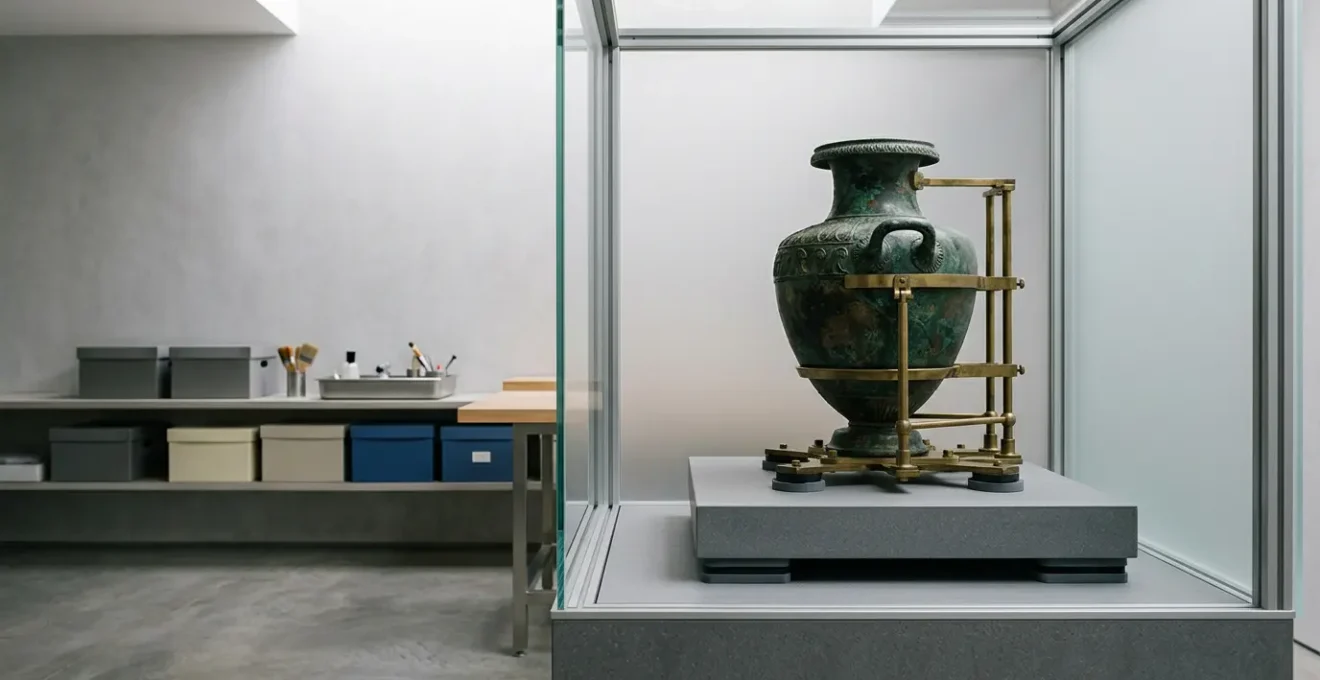
Effective artifact mounting is less about aesthetics and more about proactively engineering against unseen physical and chemical forces that cause irreversible damage.
- Material volatility, not just acidity, is the primary chemical threat to metal artifacts.
- Mismatched thermal expansion between a mount and an object is a leading cause of stress fractures.
- Security and seismic protection rely on a deep understanding of load paths and vibration decoupling.
Recommendation: Shift from a purely craft-based approach to an engineering mindset, where every material choice and mechanical joint is a deliberate defence against specific, quantifiable risks.
The responsibility of a mount maker is profound. When a fragile, irreplaceable artifact is placed in your hands, you become its primary guardian. The immediate task is to create a support that is both elegant and stable. However, the true challenge lies in defending that object against a host of invisible and often misunderstood adversaries: the slow, corrosive creep of chemical off-gassing, the sudden shock of a seismic event or careless bump, and the ever-present threat of theft. Many standard practices focus on the visible—making a mount disappear—but neglect the critical, unseen science behind long-term preservation.
This guide moves beyond the basics of archival materials and stable bases. It delves into the engineering principles that separate an adequate mount from a truly permanent, protective one. We will not simply list what to do, but explain *why* a specific foam can destroy bronze, how a simple clamping error can shatter ceramics, and what the physical difference is between an alarmed case and a weighted mount in a ‘snatch and grab’ scenario. The core premise is this: the most catastrophic failures in artifact display often stem from a misunderstanding of fundamental material science and physics. By mastering these principles, a technician can anticipate and neutralise threats before they manifest.
This article provides an in-depth exploration of the critical engineering decisions faced by conservation and mount-making professionals. The following sections break down the specific challenges, from material science to structural and security engineering, offering precise, actionable solutions.
Contents: A Guide to Advanced Mount-Making Principles
- Why does using the wrong foam degrade bronze artifacts over time?
- How to bend brass mounts that support the object without obscuring it?
- Alarmed Case vs Weighted Mount: which prevents ‘snatch and grab’ theft effectively?
- The clamping error that cracks ceramics when the temperature changes
- How to decouple display cases from the floor to protect against traffic rumble?
- How to create a concrete plinth that prevents sinking in waterlogged soil?
- Absorbers or Diffusers: which panel type fixes slap-back echo in small rooms?
- Installing Bronze Sculpture in English Gardens: Maintenance and Theft Prevention?
Why does using the wrong foam degrade bronze artifacts over time?
The degradation of bronze artifacts when in contact with incorrect foam is not a simple matter of acidity, but a complex chemical process driven by material volatility. Many common foams, especially those containing sulfur or chlorides, release corrosive gases over time—a phenomenon known as off-gassing. For bronze, the presence of chlorides is particularly catastrophic. These compounds act as a catalyst for “bronze disease,” a cyclical corrosion process that can rapidly pit and destroy the object’s surface, appearing as powdery green spots.
This process is significantly accelerated by humidity. In fact, conservation research shows the critical threshold for this destructive reaction lies between a 42-46% relative humidity, a common level in many environments. To combat this, the museum and conservation field relies on a rigorous quality control procedure. As the Gaylord Archival team explains, this preventative measure is key:
The Oddy test replicates 5-6 years of natural aging in 28 days, allowing conservators to predict possible long-term effects of materials on artifacts.
– Gaylord Archival, Well, That’s Odd-y: The Basics of the Oddy Test
Developed at the British Museum in 1973, the Oddy test is the industry standard for verifying material safety. It involves sealing a sample of the mount material (like foam) in an airtight container with coupons of silver, lead, and copper at 60°C for 28 days. The copper coupon is specifically used to detect the presence of chlorides and sulfur compounds—the primary enemies of bronze. If the copper shows any signs of corrosion, the foam is deemed unsafe for use near any copper-alloy artifact. Choosing a foam that has passed the Oddy test is the only reliable way to prevent this slow, insidious form of destruction.
How to bend brass mounts that support the object without obscuring it?
Fabricating a brass mount is a delicate balancing act between structural integrity and visual obscurity. The goal is an armature that provides robust, correctly-placed support while being as visually unobtrusive as possible. This requires precise metalworking skills, as brass becomes work-hardened and brittle when bent. Forcing a bend on cold, hardened brass will introduce micro-fractures, creating a weak point that could fail under load or during a seismic shock. The key is a process of annealing and careful shaping.
The correct procedure involves heating the brass rod or bar to a specific temperature (around 450-600°C, a dull red glow) and then allowing it to cool. This annealing process relieves internal stresses and makes the metal malleable again. Once annealed, the brass can be bent gently around a former or with nylon-jaw pliers to avoid marring the surface. For complex shapes, this process of anneal-bend-repeat may be necessary multiple times. Each bend must be planned to distribute the load of the artifact to its strongest points, avoiding delicate areas. The final mount should then be polished and, if required, coated with a stable lacquer like Incralac to prevent tarnishing, which could transfer to the artifact.
This meticulous work is more than just fabrication; it is a direct application of preventative conservation. As the experts at Conservation Wiki state:
A well considered, thoughtfully designed, safely constructed, appropriately supporting mount is a form of preventative conservation for a museum object while under the stresses of exhibition display.
– Conservation Wiki, Category: Mounts & Mountmaking
Ultimately, a successful brass mount is one that is forgotten by the viewer but performs its critical engineering function flawlessly, ensuring the artifact’s long-term safety by respecting the physical properties of the materials involved.
Alarmed Case vs Weighted Mount: which prevents ‘snatch and grab’ theft effectively?
When protecting smaller, high-value artifacts from ‘snatch and grab’ theft, the two primary physical deterrents are the alarmed vitrine and the weighted mount. Choosing between them requires an understanding of the threat. The ‘snatch and grab’ is a crime of opportunity and speed. The thief aims to bypass security in seconds. Therefore, the most effective deterrent is the one that introduces the most significant time delay and commotion. This is critical, as a Smithsonian Institution report revealed that nearly 90% of all artifact incidents are caused by visitor actions, whether accidental or malicious.
An alarmed vitrine is the first line of defence. Modern cases can incorporate a suite of sensors: vibration detectors on the glass, pressure sensors on the base, and door contacts. Any attempt to smash the (often laminated, security-grade) glass or force the case open triggers an immediate, loud local alarm and alerts a central control room. Its effectiveness lies in removing the element of surprise and drawing immediate attention from staff and other visitors. It turns a covert act into a very public and loud event.
A weighted mount works on a different principle: brute-force delay. Here, the artifact is securely fastened to a mount which is, in turn, bolted to an extremely heavy base (often concealed within the plinth), weighing hundreds of kilograms. The idea is not just to make the object heavy, but to make it take so much time and effort to move that it’s physically impractical for a thief to lift and carry. It can be paired with a ‘tether’ alarm, where breaking the connection to the object triggers an alert. The weighted mount is a silent, passive system that is highly effective against a lone actor without heavy-duty tools. It is an engineered solution to make the object’s mass its own best defence in a world where, according to INTERPOL, art theft is a billion-dollar criminal industry.
The optimal solution is often a layered one: an artifact secured with a tethered, weighted mount inside an alarmed vitrine. The weighted mount defeats the initial grab, and the alarmed case defeats any attempt at a more sustained attack, providing two distinct layers of protection against this common threat.
The clamping error that cracks ceramics when the temperature changes
One of the most insidious and preventable failures in mounting ceramics is cracking due to thermal stress. This often occurs when a rigid metal clamp is used to secure a ceramic or glass object too tightly. The root of the problem lies in a fundamental principle of material science: the Coefficient of Thermal Expansion (CTE). All materials expand when heated and contract when cooled, but they do so at different rates. Brass and steel have a significantly higher CTE than most ceramics. This means that for every degree of temperature change, the metal mount will expand or contract far more than the artifact it is holding.
If a metal clamp is fastened tightly around a ceramic vessel at a stable 20°C, a subsequent drop in temperature (e.g., overnight in a gallery with reduced heating) will cause the metal clamp to contract much more than the ceramic. This constriction creates immense pressure, concentrating stress on the point of contact. Because ceramic is brittle and has low tensile strength, this stress is often enough to initiate a crack that can propagate through the object. Conversely, a significant temperature rise will cause the clamp to expand away from the object, potentially making the mount loose and unstable. As technical documentation confirms:
A lower expansion coefficient reduces internal stress during rapid temperature fluctuations, minimizing the risk of thermal cracking.
– Great Ceramic Technical Documentation, Thermal Expansion Coefficients of Advanced Ceramics
The “clamping error” is therefore not about the clamp itself, but the failure to account for this differential movement. The solution is to never use a rigid, fully-constraining clamp on brittle materials. Instead, mounts should use padded, gravity-based supports. If a clamp is unavoidable, it must incorporate a buffering material with some give, such as a thick felt pad or a silicone sleeve. This buffer acts as a compressible interface, absorbing the dimensional changes of the metal clamp and protecting the fragile ceramic from concentrated stress. It is an engineering solution to a physics problem.
How to decouple display cases from the floor to protect against traffic rumble?
Protecting delicate artifacts from low-frequency vibrations, such as the ‘rumble’ from nearby traffic, subways, or heavy footfalls, requires more than just a stable plinth; it demands harmonic decoupling. The goal is to isolate the display case from the structure of the building, preventing floor vibrations from being transmitted to the object. This is achieved by installing a vibration-damping system between the case plinth and the floor. These systems typically use pads made from specialized elastomeric polymers, like Sorbothane, which are engineered to absorb vibrational energy and convert it into a negligible amount of heat.
The effectiveness of this system depends entirely on selecting the right material for the specific load and frequency. A pad that is too hard will transmit vibrations, while one that is too soft will compress completely and fail to isolate. The selection process is a precise engineering calculation, not a guess. It involves calculating the total weight of the case and its contents to determine the static load, and identifying the primary frequency of the vibration that needs to be mitigated. Different material densities and thicknesses (measured by durometer hardness) are effective against different frequencies. This precise selection is what achieves true decoupling, creating a ‘floating’ island for the artifact that is shielded from the building’s structural-borne noise.
Action Plan: Selecting Vibration Isolation Materials
- Calculate total weight of display case plus artifact to determine required load capacity of isolation system.
- Identify vibration frequency threats – high-frequency (footfalls, HVAC) vs. low-frequency (seismic, subway rumble).
- Select appropriate isolation material durometer (hardness) – softer materials (Shore A 30-50) for high-frequency damping, stiffer materials (Shore A 60-80) for heavy loads.
- Determine isolation pad thickness based on deflection requirements – typically 10-25mm for museum cases to achieve effective decoupling.
- Position isolation pads to evenly distribute weight and maintain center of gravity alignment, preventing stress concentration.
How to create a concrete plinth that prevents sinking in waterlogged soil?
Installing a heavy sculpture on a concrete plinth in an outdoor setting, particularly in areas with waterlogged soil common in the UK, presents a significant geotechnical challenge. A standard concrete pad foundation is likely to sink or tilt over time as the saturated soil beneath it compresses or shifts. The solution is to engineer a foundation that distributes the load over a wider area or transfers it to a deeper, more stable soil layer. This begins with understanding the core principle of stability.
Support objects completely. Check how the object is made and where it is stable/unstable and where a mount can be put safely. Place object at its center of gravity. If it is placed off center, you introduce stress.
– Northern States Conservation Center, Mounts – Basic Mount Making Rules
This principle applies as much to the plinth itself as to the mount on top of it. To prevent sinking, two primary engineering strategies are employed. The first is a raft foundation. Instead of a simple, thick block of concrete directly under the sculpture, the raft is a much wider and thinner slab of reinforced concrete that extends well beyond the sculpture’s footprint. This spreads the total weight (sculpture plus plinth) over a much larger surface area, reducing the pressure (force per unit area) on the weak soil below the threshold at which it will compress. The slab must be properly reinforced with a rebar grid to prevent it from cracking under the concentrated load of the plinth.
For extremely heavy sculptures or exceptionally poor soil, a piled foundation may be necessary. This involves driving or boring several concrete or steel piles deep into the ground until they reach a solid substrate, such as bedrock or a dense layer of gravel, well below the waterlogged topsoil. The concrete plinth is then cast on top of these piles, effectively transferring the sculpture’s entire weight directly to this stable, deep layer, bypassing the weak surface soil altogether. This is a more complex and expensive solution but guarantees long-term stability against sinking and tilting.
Absorbers or Diffusers: which panel type fixes slap-back echo in small rooms?
While the terms ‘absorbers’ and ‘diffusers’ are most commonly associated with acoustics for controlling sound waves like ‘slap-back echo’, the underlying physics—managing wave energy—is directly analogous to the challenge of mitigating mechanical vibrations that threaten artifacts. Understanding how these two strategies work provides a powerful mental model for advanced mount making. A direct impact or a persistent vibration is simply a form of energy that must be controlled before it reaches the object.
Absorption is a strategy of energy conversion. In acoustics, foam panels absorb sound waves and convert them into heat. In mount making, elastomeric materials like Sorbothane or silicone function as mechanical absorbers. When a vibration travels through the plinth, these materials compress and deform, converting the kinetic energy of the vibration into a minute amount of heat. This is the principle behind the decoupling pads discussed earlier. Absorption is most effective when you want to eliminate vibrational energy entirely. It is the preferred method for protecting an object from a continuous, known frequency, like HVAC hum or traffic rumble.
Diffusion, by contrast, is a strategy of energy dispersal. An acoustic diffuser has an irregular surface that scatters a sound wave into many smaller, less coherent waves, breaking up the strong reflection of an echo. In mechanical terms, diffusion can be thought of as a complex load path. Instead of a single, rigid support that transmits a shock directly, a well-designed mount can act as a mechanical diffuser. A complex lattice-work mount or a system with multiple contact points can break up a single, sharp impact force, distributing the energy through many different paths and reducing the peak force experienced at any single point on the artifact. This strategy is useful for protecting against unpredictable, sharp impacts, like a bump to the display case.
Therefore, the choice is not one-or-the-other, but a question of application. For persistent, ambient vibrations, absorption is key. For protection against sudden, sharp shocks, a mount designed with diffusive properties can be more resilient.
Key Takeaways
- Material science is non-negotiable: off-gassing and thermal expansion are silent threats that require an engineering-led response.
- Security is a function of time delay and commotion; layer passive (weight) and active (alarms) systems to defeat opportunists.
- Vibration is a wave energy problem. It must be either absorbed (converted to heat) or diffused (scattered) before it reaches the artifact.
Installing Bronze Sculpture in English Gardens: Maintenance and Theft Prevention?
Placing a bronze sculpture in an outdoor setting like an English garden exposes it to a far more aggressive environment than any gallery, presenting acute challenges for both long-term maintenance and security. The UK’s damp, often coastal climate is particularly hostile to bronze. The primary maintenance concern is, once again, bronze disease. As established, this corrosive process is activated by chlorides and water. Outdoor sculptures are perpetually exposed to rain, and locations near the coast are subject to salt carried in the atmosphere, creating a near-perfect storm for this chemical reaction. Regular inspection and a disciplined maintenance regime are therefore not optional, but essential for survival.
This regime typically involves an annual or biennial cycle of gentle washing with clean water and a non-ionic detergent to remove surface pollutants and chloride deposits. After thorough drying, a layer of microcrystalline wax is applied. This wax serves two purposes: it acts as a physical barrier, preventing water from reaching the surface of the bronze, and it saturates the colour of the patina, providing a rich, aesthetically pleasing finish. Any outbreak of active bronze disease must be mechanically removed by a trained conservator before the wax coating is applied, to prevent it from festering underneath.
Security in an open garden setting requires a different approach than indoor security. The ‘snatch and grab’ threat escalates to a planned, often overnight, attack. The first line of defence is a robust physical anchor. The sculpture must be immovably fixed to its concrete plinth using heavy-duty, concealed stainless steel dowels or anchor bolts. Simply resting the sculpture on the plinth is an invitation for theft. For very high-value pieces, more advanced security can be embedded. This can include seismic sensors within the plinth that trigger a remote alarm if cutting or heavy impact is detected, or the use of forensic marking systems like SmartWater or micro-dotting, which invisibly mark the sculpture with a unique code, making it traceable and much harder for thieves to sell on the black market.
Implementing these advanced engineering and conservation principles is the definitive step in elevating your practice. It moves the role of a mount maker from that of a craftsman to that of a technical guardian, ensuring the artifacts under your care are protected with scientific rigour for generations to come.