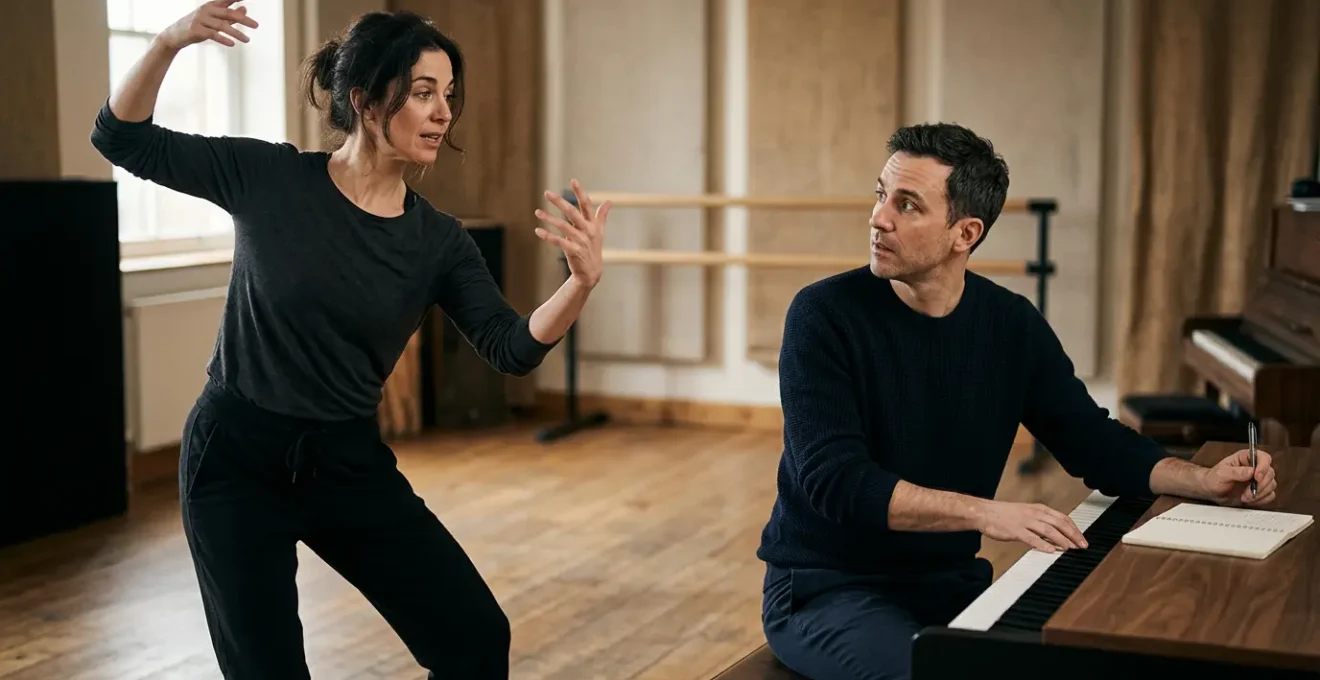
True artistic fusion between choreographers and composers is built on tangible frameworks, not vague communication.
- Adopt agile “creative sprints” for simultaneous, iterative development of music and movement.
- Secure the work’s future by mastering Grand Rights and defining copyright from the outset.
Recommendation: Structure your collaboration with clear contracts and a shared process timeline before the first creative session begins.
The vision is intoxicating: a seamless marriage of movement and sound, where music and dance are so intertwined they feel born of a single mind. For choreographers and composers, this is the ultimate goal of an original commission. Yet, the path to this artistic synthesis is often fraught with friction, misunderstandings, and creative dead-ends. Many collaborations stumble over the usual suspects: mismatched expectations, conflicting timelines, and the infamous refrain of “poor communication.”
Conventional wisdom tells us to “communicate more” or “find a shared vision.” While true, this advice is too abstract to be actionable. It fails to address the underlying structural disconnects in how musicians and dancers create. What if the secret to a successful collaboration wasn’t just about what you say, but about *how* your entire process is structured? The most fruitful partnerships move beyond good intentions and implement tangible frameworks that foster genuine, parallel evolution.
This guide, written from the perspective of a creative producer, will not rehash platitudes. Instead, it offers a blueprint for building a robust collaborative structure. We will dissect the process, from establishing a shared language beyond simple counts to navigating the complex legal frameworks of copyright and touring rights. By focusing on the architecture of your collaboration, you can create the conditions for artistic magic to not only happen but thrive sustainably.
To navigate this complex but rewarding journey, we’ve broken down the key structural and creative challenges you’ll face. This article provides a clear roadmap for transforming your collaborative process from a source of friction into a powerful creative engine.
Summary: A Framework for Creating Original Scores in Dance
- Why do ‘counts of 8’ confuse classical composers?
- How to build a timeline where music and dance evolve simultaneously?
- Commissioned Score or Existing Tracks: which offers more artistic freedom?
- The contract oversight regarding ‘Grand Rights’ that stops you touring the work
- How to balance live orchestra sound levels with dancer cues?
- How to integrate VST instruments into a traditional orchestral score?
- Exclusive Rights vs One-Time Performance: which contract creates better passive income?
- Protecting Ballet Choreography: Copyright Laws for Dance Creators?
Why do ‘counts of 8’ confuse classical composers?
The collaboration often hits its first snag at the most fundamental level: counting. A choreographer’s “five, six, seven, eight” is a rhythmic and kinesthetic launching pad, rooted in physical phrasing. For a classically trained composer, this can feel arbitrary. Their world is structured by time signatures, bar lines, and melodic arcs that don’t always align with an 8-count block. This isn’t a failure of musicality on either side; it’s a collision of two distinct professional languages. The ‘count of 8’ is a symptom of a deeper need for a shared structural vocabulary.
The solution isn’t for the composer to simply learn to count like a dancer, or vice versa. It’s to elevate the conversation from numbers to intention. As one composer experienced in dance collaborations notes, establishing a clear counting method is a crucial first step:
When composing for dance, there are two questions that I find important. The first is to make it clear early on how we’re counting. It sounds a bit banal – but it’s really important! Because everyone counts in different ways, contemporary dancers different from classical, musicians different from dancers. So it’s good to establish early on what counts we’re talking about.
– Composer collaborating with dancers, Four by four: composing for choreography – Sanjoy Roy
This early alignment opens the door to a richer dialogue about phrasing, dynamics, and emotional texture. Instead of saying “I need 3 counts of 8 here,” a choreographer can describe the desired energy: “This section needs a feeling of breathless acceleration, followed by a sudden, suspended silence.” This gives the composer a dramatic, rather than a purely mathematical, prompt to work from. The goal is to translate the physical arc of the movement into a parallel musical arc.
As this image suggests, the most successful collaborations map the flow of kinesthetic energy, not just the beats. By shifting the focus from arithmetic to artistry, both creators can find common ground in the shape and feel of the work, building a piece that is cohesive in its very DNA.
How to build a timeline where music and dance evolve simultaneously?
The traditional, linear model of collaboration—where a composer delivers a finished score to a choreographer—is a recipe for artistic compromise. It forces one art form to be subservient to the other. To achieve true synthesis, the music and dance must grow together. The most effective way to structure this is by borrowing a powerful concept from the world of software development: Agile methodology. This approach breaks the monolithic task of “creating a ballet” into small, manageable, iterative cycles known as “creative sprints.”
Instead of a single deadline months away, the team works in short bursts (e.g., 1-2 weeks) with a clear, shared goal for each cycle. For example, Sprint 1 might focus on establishing the opening theme and movement vocabulary. The composer develops a musical sketch, the choreographer creates a short phrase, and they present their work-in-progress to each other at the end of the sprint. This creates a low-stakes feedback loop, allowing for immediate adjustments. An insightful case study shows that dance production can naturally operate as an agile process, with composers and choreographers working as equal members of a cross-functional team without a rigid hierarchy.
Agile Methodology Applied to Dance Production
This framework shows how dance production can function as an agile process. It uses Research & Development sharings to test material with audiences during development. The approach emphasizes teams where composers, choreographers, and designers are equal contributors, working in parallel without direct management, fostering a truly collaborative journey.
This iterative model transforms the creative process. It replaces the anxiety of a “big reveal” with a continuous, dynamic dialogue. The music informs the movement, which in turn informs the music. This constant back-and-forth ensures that the final piece is a deeply integrated whole, not just a dance set to music.
Action Plan: Your Creative Sprint Framework
- Define Sprint Cycles: Establish a sprint length (typically 1-4 weeks) and set shared creative goals for each cycle.
- Identify Anchor Points: Break the work into short cycles with tangible deliverables by identifying 3-5 key emotional anchor points in the piece.
- Schedule Demos: Hold regular demo sessions where both artists present work-in-progress to each other for immediate feedback and iteration.
- Conduct Retrospectives: After each sprint, hold a brief meeting to reflect on the process, discuss what worked, and identify areas for improvement in the next cycle.
- Align Payment Milestones: Structure the commission contract so that payments align with sprint completion (e.g., 25% on signing, 25% after anchor point approval, etc.) to reinforce the iterative process.
Commissioned Score or Existing Tracks: which offers more artistic freedom?
The choice between commissioning an original score and using pre-existing music is a fundamental strategic decision that dictates the entire creative process. While licensing existing tracks can be faster and seemingly cheaper upfront, it inherently limits artistic freedom. The choreographer must adapt their vision to a fixed musical structure, tempo, and mood. The music becomes a container for the dance, rather than a co-creator with it. As choreographer Tommy Neblett states, the possibilities are vastly different: “With recorded music you’re limited to what already exists. But when you work with a composer, anything is possible.”
A commissioned score, by contrast, unlocks complete artistic flexibility. It is an invitation to a deep collaborative partnership where the music can be tailored precisely to the narrative and physical arc of the choreography. This path requires more lead time and a larger initial budget, but it offers unparalleled control and the potential for a truly unique, integrated work. The decision is not merely about art, but about process, budget, and long-term goals.
To make an informed choice, it’s helpful to use a structured decision matrix. A recent analysis of music programming for dance provides a clear framework for comparing these two paths across several critical factors.
| Factor | Commissioned Original Score | Existing Music Tracks |
|---|---|---|
| Creative Control | Full artistic flexibility; music tailored to choreography | Limited; must adapt movement to existing structure |
| Speed of Creation | Slower; requires lead time for composition and revision | Faster; can begin choreography immediately after selection |
| Long-Term Touring Rights | Negotiable grand rights for extended use | Complex; requires clearing rights for each tour/venue |
| Budget Requirements | Higher upfront commission fee; potential royalty structure | Lower initial cost; may face licensing fees per performance |
| Future Modification Potential | High; composer can adjust score for restaging | Minimal; fixed recorded arrangement |
| Collaborative Intimacy | Deep partnership; shared creative journey | Solo choreographic vision with musical inspiration |
Ultimately, choosing a commissioned score is a commitment to a deeper, more intimate collaborative structure. It’s an investment in a shared creative journey that can yield results unattainable with off-the-shelf music.
The contract oversight regarding ‘Grand Rights’ that stops you touring the work
You’ve created a stunning new work with an original score, the premiere is a success, and a presenter wants to book it for a national tour. But then, a critical contract oversight brings everything to a grinding halt: you failed to properly secure the “Grand Rights.” This is one of the most common and costly mistakes in dance commissioning. Unlike “Small Rights” (which cover non-dramatic performances of music, like a song on the radio), Grand Rights govern the use of music in a dramatic context, such as a ballet or musical theater production. They are the legal key that unlocks your ability to perform and tour the work.
Securing these rights is not an automatic part of a commission; it must be explicitly negotiated. As a leading publisher clarifies, this is a non-negotiable step in the process:
The use of copyright protected music for public performances of dance works and other types of staged works constitutes a ‘grand right’ for which a license directly from the publisher is required. It is important that your license be signed prior to any performances taking place.
– Wise Music Classical, Music for Dance – Copyright and Licensing FAQs
This isn’t a simple box-ticking exercise. The contract must clearly define the scope of the rights granted. Key clauses should address the exclusivity period (does the choreographer have exclusive rights for a set time?), the territory (is the license for domestic performances only, or international?), and the royalty structure for future performances. According to industry licensing standards, these grand rights must be negotiated directly with the publisher or the composer who holds the copyright. Ignoring this crucial legal framework from the outset can render a brilliant piece of choreography permanently stuck on its home stage.
The contract should be seen as a creative tool that protects the future life of the work. A well-structured agreement anticipates the work’s success and builds a clear, sustainable path for touring, revivals, and broadcasts, ensuring that both the choreographer and composer can benefit from their shared creation long after the premiere.
How to balance live orchestra sound levels with dancer cues?
The magic of a live orchestra is undeniable, but it introduces a significant practical challenge: sound balance. In a studio, dancers rehearse to a perfectly mixed recording. On stage, the acoustic reality is vastly different. The physical space between the orchestra pit and the stage, the acoustics of the venue, and the sheer volume of a live ensemble can easily overwhelm the subtle musical cues dancers rely on. A brass swell that sounds thrilling in the audience might completely obscure a delicate string passage that marks a critical choreographic transition for a dancer on stage.
The traditional solution involves a sound designer carefully placing microphones and monitors to try and replicate the studio sound. However, this one-way flow of information—from orchestra to dancer—is often insufficient for complex, tightly synchronized works. The most innovative productions are now flipping this dynamic on its head, creating a system of reciprocal cueing. This is a structural solution where technology enables a two-way conversation between the stage and the pit.
Bi-Directional Cueing: Dancers and Musicians Taking Cues from Each Other
In tightly-synced choreographic works, the traditional model of musicians cueing dancers is often reversed. Advanced productions now use dancer cameras and video monitors placed in the orchestra pit or directly for the conductor. This innovative setup, as detailed in collaborations for major ballet companies, enables musicians to take visual cues directly from choreographic landmarks. It creates a reciprocal relationship where both artists respond to each other in real time, ensuring a much tighter and more dynamic synthesis of music and movement.
This approach transforms musicians from accompanists into active participants in the live performance. The conductor might take a cue from a lead dancer’s leap, or the percussion section might sync to a rapid sequence of footwork they see on their monitor. This bi-directional flow of information creates a much more resilient and responsive performance environment. It’s a powerful example of how a structural and technological framework can solve an artistic problem, ensuring the intricate connection forged in the studio is not lost in the grand scale of a live theatrical performance.
How to integrate VST instruments into a traditional orchestral score?
Modern scores are rarely purely acoustic. Virtual Studio Technology (VST) instruments and electronic elements offer a vast sonic palette that a traditional orchestra cannot replicate. The challenge is to integrate these digital sounds with live players in a way that feels intentional and cohesive, not like a pre-recorded track layered clumsily over an orchestra. The key is a phased workflow that treats the VST mockup not as a demo, but as the foundational layer of the final score.
The process is one of strategic deconstruction. The composer first creates a complete, high-quality VST mockup of the entire score. This gives the choreographer a clear and consistent musical world to work with from the very first rehearsal. As the collaboration progresses, the composer and producer can then work through a specific “peeling away” process. This workflow ensures that the final hybrid score is a seamless blend of electronic and acoustic elements.
This integration is a multi-step framework that requires careful planning and technical precision:
- Create the Full VST Mockup: The composer provides the choreographer with the complete musical vision using virtual instruments, allowing for early and accurate choreographic development.
- Identify Permanent Electronic Stems: The composer strategically identifies which VST elements create sounds a live orchestra cannot produce (e.g., deep sub-basses, granular synths). These become permanent parts of the electronic score.
- Peel Away and Assign: Orchestral parts (strings, winds, brass) are methodically “peeled away” from the mockup and assigned to live players, while ensuring the remaining electronic layers complement them.
- Prepare the Conductor’s Score: The score for the conductor is prepared with clear visual cues, timecode markers, and specific instructions for synchronizing with the electronic elements.
- Implement a Click Track: A click track, audible only to the conductor and musicians (via in-ear monitors), is created to ensure precise synchronization between the live orchestra and the pre-recorded electronic stems during performance.
This methodical approach ensures that the integration of VSTs is not an afterthought but a core part of the compositional structure. It allows for the best of both worlds: the expansive, otherworldly textures of electronic music and the visceral, breathing energy of a live orchestra, all working in perfect harmony.
Key Takeaways
- Effective collaboration is built on tangible frameworks like agile sprints, not just abstract communication.
- Securing Grand Rights and defining copyright terms from the start is essential for the long-term life and touring potential of a work.
- Modern creation involves a hybrid workflow, strategically blending VST mockups with live orchestration for a richer sonic palette.
Exclusive Rights vs One-Time Performance: which contract creates better passive income?
For a composer, a commission is not just a one-time job; it’s an opportunity to create an asset that can generate passive income for years to come. The structure of the commission contract is what determines this long-term financial potential. A common model is a one-time flat fee, which offers the security of a guaranteed payment but cuts off all future revenue. A more forward-thinking approach involves structuring the contract to create ongoing royalty streams.
The choice is between a higher upfront payment versus a lower initial fee coupled with a share in the work’s future success. For a work that has strong touring potential, a royalty-based model is almost always more lucrative in the long run. Industry sources, for instance, recommend composers consider royalty structures of approximately 10% of box office receipts for Grand Rights performances. This “royalty stack” can include multiple streams: a per-performance fee, a percentage of the box office, and fees for broadcast or streaming.
An even more sophisticated model involves “unbundling” the rights. Here, the composer grants the choreographer a license for the dance performance but retains the rights to use the same music for other purposes, such as film scores, commercial licensing, or concert performances. This creates multiple, independent income streams from a single composition. The following table breaks down the risk and reward of these different financial frameworks.
| Contract Model | Upfront Payment | Ongoing Revenue | Long-Term Income Potential | Risk Level |
|---|---|---|---|---|
| One-Time Flat Fee | Higher single payment | None beyond initial fee | Low; income stops after commission | Low for composer; guaranteed payment |
| Exclusive Rights with Per-Performance Fee | Moderate initial fee | Fixed amount per performance | Moderate; depends on number of performances | Moderate; relies on work being performed |
| Royalty Stack Model | Lower upfront fee | Multiple streams: box office %, per-performance fee, broadcast/streaming royalty | High; potential for ongoing passive income if work tours extensively | Higher; income tied to commercial success |
| Unbundled Rights | Lower dance-specific fee | Composer retains rights for film, commercial, concert use of same music | Very high; creates independent income streams from single composition | Moderate; requires effective licensing management |
Thinking like an asset manager is crucial. By negotiating a contract that includes per-performance fees or a royalty stack, a composer transforms a single project into a long-term financial asset, creating a sustainable career that rewards the continued success of their creative work.
Protecting Ballet Choreography: Copyright Laws for Dance Creators?
While the score is protected by music copyright, the choreography itself exists in a more nebulous legal space. To be protected by copyright law, choreography must be “fixed in a tangible medium of expression.” You cannot copyright an idea or a style; you must document the specific sequence of movements. This act of “fixing” the work is the choreographer’s most important step in turning their art into a legally protected asset.
Fortunately, there are several accepted methods for documenting choreography. The most common is a high-quality video recording, but traditional notation systems are also powerful tools. The key is to create a record so detailed that another person could reasonably reconstruct the work from it. The primary methods include:
- Video Recording: Using multiple camera angles to capture the full spatial relationships and details of the movement.
- Labanotation: A detailed written notation system that documents movement, spatial patterns, and timing.
- Benesh Movement Notation: An alternative system that uses a musical staff-like structure to record the dancer’s movements.
- Textual Description: A detailed written narrative accompanied by photographs or drawings of key positions.
Once fixed, the work can be registered with the U.S. Copyright Office, though creators should be prepared for a wait, as processing times average between 6 and 13 months. This legal protection is what allows a choreographer to control who can perform their work, license it to other companies, and protect it from unauthorized use. However, in a collaborative commission, a critical question arises: who owns what?
Joint Copyright vs. Derivative Work: When music and dance are created inseparably, who owns what? It’s crucial to define in the initial contract whether the final piece is a ‘joint work’ or if the dance is a ‘derivative work’ of the music.
– Legal guidance for collaborative works, Harvard Law Review – Dancing on Their Own
This single contractual clause has massive implications. A “joint work” implies shared ownership and control, while a “derivative work” positions the dance as secondary to the music. Defining this relationship from day one is the final, and perhaps most critical, piece of the collaborative framework. It provides the legal clarity necessary for both artists to manage their careers and protect their creative legacies.
By implementing these structural, legal, and financial frameworks from the very beginning, you move your collaboration from a high-stakes gamble to a well-managed creative investment, building a foundation that allows true artistic innovation to flourish and endure.