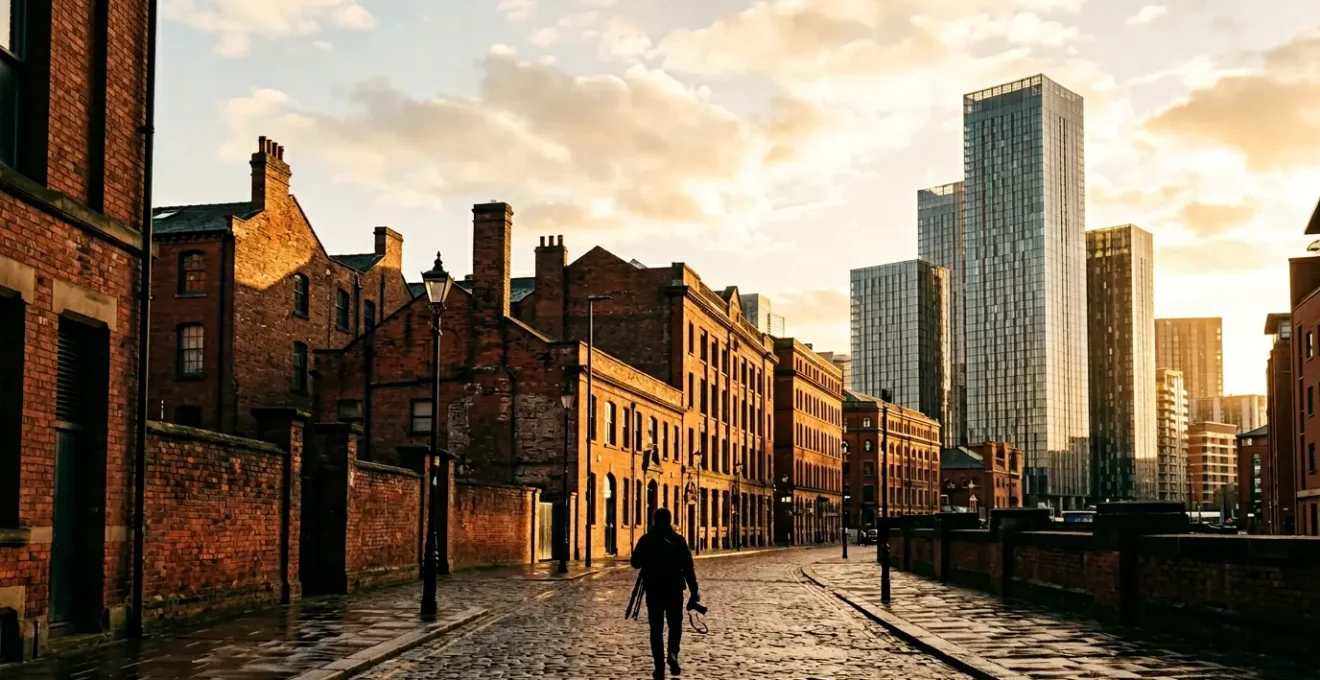
Documenting Manchester’s urban change effectively is less about lucky shots and more about adopting a rigorous, archival methodology.
- This involves precise ‘Then and Now’ alignment using architectural anchors and robust metadata for future reproducibility.
- A conscious narrative choice between a human-centric or architectural focus is critical to telling a compelling story of gentrification.
Recommendation: Adopt a systematic archival approach, from capture to metadata tagging, to ensure your work has lasting historical and social value.
The feeling is familiar to any city dweller: a favourite cafe vanishes, a familiar street corner is suddenly unrecognisable, replaced by glass and steel. For the urban photographer, the impulse is to capture this constant flux. Many will take a quick ‘then and now’ snapshot, a simple comparison of old and new. This approach, however, often lacks the precision and context to be truly valuable. Manchester, a city defined by its cycles of industrial reinvention and modern redevelopment, presents a perfect canvas for a more profound documentary practice.
The challenge goes beyond simply pointing a camera at a new building. How do we create images that future historians can actually use? How do we tell the complex story of gentrification, displacement, and growth with integrity? This requires moving past the mindset of a casual photographer to that of a visual archivist. But if the real key wasn’t just in *what* you photograph, but in the rigorous methodology *behind* the photograph?
This guide abandons generic advice and instead provides a systematic framework for documenting urban change. We will explore the technical discipline required for long-term projects, the legal nuances every street photographer must know, and the narrative strategies that turn a collection of images into a coherent socio-architectural story. By mastering this approach, your photography can become a vital part of Manchester’s historical record.
This article provides a comprehensive roadmap for photographers and urban historians. The following sections break down the essential techniques and considerations for creating a meaningful and lasting visual archive of Manchester’s evolution.
Summary: A Photographer’s Systematic Guide to Archiving Manchester’s Urban Change
- Why are photos of mundane high streets becoming valuable historical records?
- How to align shots perfectly for a ‘Then and Now’ series over 10 years?
- Human-Centric vs Architectural: which approach tells a better story of gentrification?
- The privacy law mistake that can get your street photography banned
- How to tag digital archives so future historians can find your location data?
- Why does a £50k sculpture generate more than that in local tourism value?
- Why does viewing fractal patterns reduce cortisol levels in stressed visitors?
- Art to Provoke Introspection: Can Gallery Design Improve Mental Health?
Why are photos of mundane high streets becoming valuable historical records?
The dramatic transformation of a city skyline is an obvious subject, but the true texture of urban history is often found in the mundane. Shopfronts, street furniture, advertisements, and the fleeting styles of passersby create a dense visual context that is invaluable to future researchers. These seemingly unremarkable details provide evidence of economic shifts, social trends, and the daily rhythm of a community. What appears boring today becomes a rich data point tomorrow, offering a granular view that grand architectural shots often miss.
This principle of documenting the everyday is the foundation of major archival projects. For instance, Manchester’s Documentary Photographic Archive contains over 100,000 images, many of which capture the city’s ordinary streets and people over decades. This collection demonstrates that the cumulative value of these “boring” photos is immense, allowing historians to trace the lineage of a neighbourhood with incredible specificity.
Case Study: The Northern Quarter Documentation Project
Photographer Steven Longbottom’s work documenting Manchester’s Northern Quarter exemplifies this principle. Commissioned for placemaking projects, he captured the interplay between independent businesses and the area’s distinct architectural character. His portfolio shows how what might be considered mundane street photography becomes a vital asset for marketing and historical documentation, chronicling the very identity that makes the neighbourhood unique before it inevitably changes again.
Therefore, the photographer acting as an archivist must resist the urge to only capture the spectacular. The methodical documentation of a typical high street, repeated over time, builds a socio-architectural narrative that is far more revealing than a single, dramatic image. It is in the subtle shifts—a shop closing, a new style of signage, a change in pedestrian flow—that the real story of urban evolution is told.
How to align shots perfectly for a ‘Then and Now’ series over 10 years?
Creating a compelling “Then and Now” series requires more than a good eye; it demands methodological rigour. The goal is to replicate a shot with near-perfect accuracy years or even decades later. This precision is not just for aesthetic consistency but also to create a scientifically useful comparison, allowing for clear analysis of architectural and social change. The key is to establish fixed, immovable reference points within the frame. These are your architectural anchors.
As the comparison above illustrates, elements like church spires, historic building rooflines, or permanent structural corners serve as a stable grid. By aligning these anchors in your viewfinder, you can ensure your camera position is identical across different time periods, even as the foreground and surrounding elements transform completely. However, physical alignment is only half the battle. To ensure someone else—or your future self—can replicate the shot, you must create a data-rich capture.
Action Plan: IPTC Metadata Workflow for Archival Photography
- Record Location Data: Log exact GPS coordinates, including latitude, longitude, and altitude data, directly into the EXIF fields of your image file.
- Document Technical Specs: Note the camera height from the ground, the focal length used, and the precise compass bearing in the IPTC “Instructions” field.
- Establish a Project ID: Create a unique, consistent project identifier (e.g., ‘Manchester_Ancoats_2024’) for easy versioning and searching within a larger archive.
- Use Controlled Keywords: Employ a controlled vocabulary, such as Getty’s Art & Architecture Thesaurus, for location and subject keywords to ensure standardised, searchable terms.
- State Your Intent: Write a brief “Statement of Intent” in the IPTC Description field, explaining the project’s purpose and context for future archivists, as advised by the official IPTC Photo Metadata standard.
This meticulous data entry transforms a photograph from a simple image into a reproducible scientific record. It is the invisible labour that guarantees the long-term value and usability of your documentary work, making your contribution to the visual archive robust and verifiable.
Human-Centric vs Architectural: which approach tells a better story of gentrification?
When documenting a changing neighbourhood like those in Manchester, photographers face a fundamental narrative choice: focus on the transforming architecture or on the people experiencing that transformation. Neither approach is inherently superior; they simply tell different, though often overlapping, stories of gentrification. The decision should be a conscious one, aligned with the specific story you intend to tell. A purely architectural approach can powerfully illustrate the scale and speed of physical change, creating an objective, almost clinical, record of development.
Conversely, a human-centric approach focuses on the social fabric of a place. It captures the local business owner, the long-term resident, or the new young professional. This method tells a more emotional, anecdotal story about who benefits from and who is displaced by urban renewal. It requires more time and trust-building but offers a powerful, personal narrative that architectural shots alone cannot convey. The most effective documentary projects often blend both, using architectural shots to establish context and portraits to provide the human soul.
Understanding the strengths and weaknesses of each is crucial for any photographer aiming to document urban change with nuance. The following comparison breaks down the key differences.
| Aspect | Human-Centric Approach | Architectural Approach |
|---|---|---|
| Primary Focus | Individual experiences, emotions | Physical transformation of space |
| Time Investment | Weeks to months for trust-building | Can be captured immediately |
| Legal Considerations | May require model releases | Generally public space documentation |
| Historical Value | Anecdotal, personal narratives | Systematic urban change evidence |
| Best For | Advocacy, community stories | Objective archival records |
This data, drawn from analysis of documentary photography methods, clarifies the trade-offs. The architectural method provides systematic evidence of change, while the human-centric approach provides the qualitative narrative. A truly comprehensive visual archive of a city’s gentrification needs both perspectives to be complete, showing not just how the buildings changed, but whose lives were changed with them.
The privacy law mistake that can get your street photography banned
Street photography in the UK operates under a relatively permissive legal framework, but a misunderstanding of the nuances can lead to serious issues, especially when your work moves from artistic practice to commercial use. The most common question is whether you can photograph people in public without their permission. Generally, in a public space like a Manchester street, there is no reasonable expectation of privacy, and photography for personal or artistic purposes is legal. However, the moment an image is used for commercial purposes—such as in advertising or sold as stock photography—the rules change. For this, you typically need a signed model release from any identifiable person in the shot.
Another frequent point of confusion is photographing into private property from a public street. While you are on public land, individuals inside a home or office still have a reasonable expectation of privacy. Photographing them through a window, especially for commercial use, can be a violation of privacy rights and may require a property release. The line between public and private is not always clear, and legal prudence is advised.
Finally, the introduction of GDPR has added another layer of complexity. How does this data protection regulation affect street photography? Under GDPR, a person can be “identifiable” not just by their face but through other unique features like distinctive tattoos, a work uniform in a specific context, or even their silhouette if it’s uniquely recognisable. While there are exemptions for journalistic, artistic, or literary purposes, the protection is stronger than many photographers assume. The critical distinction often comes down to the purpose of the photograph: documentary and art have more latitude than purely commercial applications. Ignoring this distinction is the mistake that can lead to legal challenges and damage a photographer’s reputation.
Navigating these rules requires a clear understanding of your project’s intent. If your goal is to build a historical archive for exhibition (artistic use), your legal standing is stronger than if you plan to sell the images to a real estate developer (commercial use). Always prioritise ethical considerations alongside the legal ones.
How to tag digital archives so future historians can find your location data?
A photograph without data is an artifact without provenance. For a future historian, a beautiful image of a forgotten Manchester street is useless if they cannot determine when and where it was taken. This is why meticulous metadata tagging is not an administrative chore but a core part of the archival process. Your responsibility as a documentary photographer extends beyond the shutter click; you are also the first archivist of your work. The goal is to embed as much context as possible directly into the digital file itself, ensuring the data never gets separated from the image.
The industry standard for this is the IPTC Photo Metadata Standard. This framework allows you to embed crucial information, including creator details, copyright information, a detailed description, and, most importantly, precise location data and keywords. Using a structured approach to keywording is essential. Instead of generic tags like “building,” use a hierarchical system: “United Kingdom,” “Manchester,” “Ancoats,” “Cutting Room Square,” “red brick warehouse.” This level of detail makes your work discoverable in large databases.
As the visualisation suggests, metadata acts as foundational layers of information embedded within the image file. The standards for this are constantly evolving. For example, the 2024.1 version of the IPTC standard expanded the definition of keywords to include not just subject matter but also aspects like lighting style, lens effects, mood, and dominant colours. Furthermore, with the rise of synthetic imagery, the 2025.1 version added new properties to identify AI-generated content, a critical distinction for future historians. Staying current with these standards ensures your archive remains compatible and relevant for decades to come.
Ultimately, your metadata is a message to the future. It provides the essential who, what, when, where, and why. By diligently and accurately tagging your digital archive, you ensure that your documentation of Manchester’s evolution is not just a collection of pictures but a searchable, verifiable, and invaluable historical resource.
Why does a £50k sculpture generate more than that in local tourism value?
Public art is a visible and often debated part of a city’s changing face. A common question from a purely financial perspective is how a significant investment in a non-functional object like a sculpture can possibly pay for itself. The return on investment for public art is rarely direct; instead, it functions as a powerful economic and cultural multiplier. A £50,000 sculpture doesn’t generate ticket sales, but it generates something far more valuable in the long run: identity, media attention, and foot traffic.
In a city with an economy as large as Manchester’s, where Greater Manchester’s gross domestic product reached £90.8 billion in 2022, such investments are strategic. The sculpture becomes a landmark, a meeting point, and an Instagrammable backdrop. This draws people to an area, who then spend money in local cafes, shops, and restaurants. It transforms a generic public space into a destination, enhancing the perceived value of the entire neighbourhood for residents, businesses, and tourists alike.
This multiplier effect is a cornerstone of cultural strategy in major cities. A prime example is the recent partnership between the English National Opera and Greater Manchester. This collaboration, featuring productions at venues like Factory International, demonstrates how cultural investments are leveraged to attract tourism and generate significant media coverage. The initial investment in the arts creates a ripple effect, boosting the hospitality sector and reinforcing the city’s brand as a leading cultural hub. The art itself is the catalyst, not the final product.
Therefore, when documenting the placement of a new sculpture or public art piece, the photographer is capturing more than just an object. They are recording a deliberate act of urban placemaking. The value isn’t in the raw materials of the art but in its power to reshape the public’s perception and use of a space, generating economic and social returns that far exceed its initial cost.
Key takeaways
- The historical value of urban photography lies in documenting mundane, everyday scenes, not just spectacular landmarks.
- Methodological rigour, using architectural anchors and comprehensive IPTC metadata, is essential for creating a useful, long-term archival record.
- The choice between a human-centric and architectural focus is a deliberate narrative strategy to tell different facets of the gentrification story.
Why does viewing fractal patterns reduce cortisol levels in stressed visitors?
An urban environment can be a source of immense stress, but it can also offer moments of unexpected tranquility. A growing field of environmental psychology suggests that this is partly due to our innate connection to nature, a concept known as biophilia. One of the most potent visual elements that triggers this positive response is the presence of fractal patterns—complex, self-repeating shapes found everywhere in the natural world, from snowflakes and coastlines to ferns and tree branches. Research indicates that viewing these mid-complexity fractals can reduce stress, lowering cortisol levels and inducing a state of relaxed alertness.
Cities, particularly one with a rich industrial and architectural heritage like Manchester, are filled with these patterns, both natural and man-made. The photographer’s eye can be trained to find them, capturing not just the form of the city but also the elements within it that subconsciously affect our well-being. As the editors of ArchDaily note in their celebration of photography’s role in architecture:
Through the lens of a skilled photographer, architecture showcases its interplay of lights and shadows, the tectonics of its structural elements, the careful detailing of joined materials, and the larger narratives of cultural heritage.
– ArchDaily Editorial, World Photography Day 2024
This “careful detailing” often contains the very fractal geometry that our brains find so pleasing. The act of photographing these patterns is an exploration of the city’s hidden therapeutic landscape. Here are some examples of where to find them in Manchester:
- The branching patterns in Victorian ironwork on the city’s historic bridges.
- The recursive geometry of red-brick bonds on industrial heritage buildings.
- Tree canopies and their complex silhouettes against geometric building facades in city parks.
- The self-similar patterns of the canal network when viewed from elevated viewpoints.
- Natural fractals created by weathering patterns and cracks in old stone facades.
By documenting these elements, the urban photographer does more than create an aesthetically pleasing image. They highlight the points of fractal resonance where the built environment echoes natural forms, contributing to a deeper understanding of how urban design can impact public mental health. It adds another layer to the visual archive: a record of the city’s psychological texture.
Art to Provoke Introspection: Can Gallery Design Improve Mental Health?
After the photographs of a changing city are taken, archived, and tagged, their final purpose is to be seen. The context in which they are viewed profoundly impacts their meaning and emotional resonance. A gallery or exhibition space is not a neutral container; its design can either amplify or mute the introspective potential of the work. In a rapidly growing city like Manchester, where the urban agglomeration population is projected to reach 2.85 million by 2026, creating spaces for reflection on urban change is increasingly vital for public mental health.
The design of an exhibition can guide a visitor’s emotional journey. The deliberate use of negative space on gallery walls, the pacing of an exhibition, and the journey a visitor takes through the space are all curatorial choices that can encourage contemplation. A crowded, chaotic display might mirror the overstimulation of the city itself, whereas a sparse, quiet arrangement allows each image to breathe, inviting viewers to engage deeply and personally with the scenes of transformation depicted.
The rise of digital exhibitions offers a new set of tools for shaping this experience, with both advantages and disadvantages compared to a physical space.
| Element | Physical Gallery | Digital Exhibition |
|---|---|---|
| Pacing Control | Visitor-controlled movement | Interactive sliders, timed transitions |
| Contextual Layers | Wall text, audio guides | Embedded oral histories, ambient soundscapes |
| Negative Space Use | Physical walls and spacing | Digital margins and transitions |
| Emotional Journey | Linear or clustered arrangement | Algorithm-guided or user-selected paths |
| Accessibility | Limited by location and hours | 24/7 global access |
Ultimately, whether physical or digital, a well-designed gallery experience does more than just display photos. It creates a therapeutic loop. The photographer documents the city’s change, and the gallery provides a sanctuary where citizens can process that change. It offers a space to reflect on what has been lost, what has been gained, and one’s own place within that ongoing evolution. Thoughtful exhibition design is, therefore, the final step in the documentary process, turning a visual archive into a tool for community introspection and well-being.
Begin your own documentary project today by applying this methodological rigour. By moving beyond the snapshot and embracing the role of a visual archivist, you can contribute a meaningful and lasting chapter to Manchester’s ongoing story.