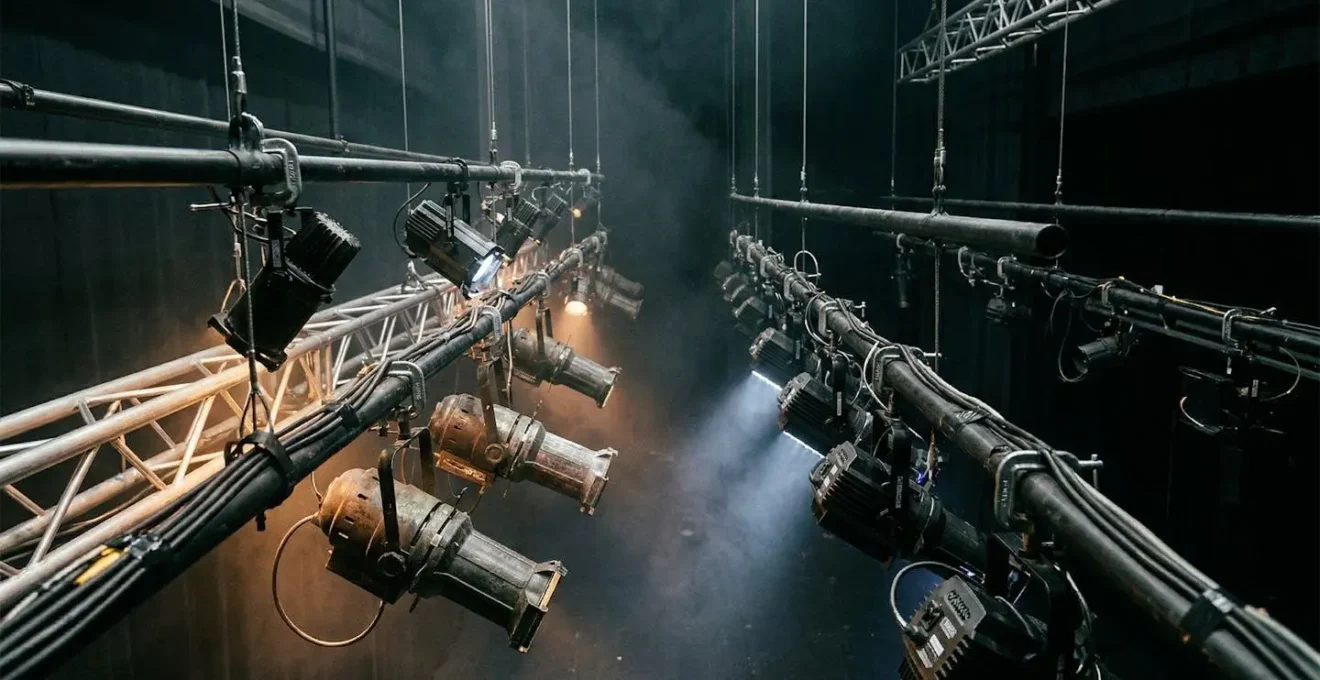
A full LED lighting rig upgrade can achieve a complete return on investment in under three years through drastically reduced operational costs.
- Energy and consumable savings alone can cut annual lighting expenses by over 70%.
- Success depends on avoiding cheap fixtures with poor colour rendering (low R9) and unreliable lifetime ratings.
Recommendation: Prioritise a phased upgrade, starting with high-usage fixtures, and build a business case based on Total Cost of Ownership (TCO), not just the initial purchase price.
For any Technical Director in a UK theatre, the pressure is mounting. Rising energy prices, tightening operational budgets, and increasing pressure from funding bodies like Arts Council England to demonstrate environmental responsibility have formed a perfect storm. The conversation inevitably turns to upgrading the lighting rig from legacy tungsten to modern LED fixtures. The conventional wisdom is clear: LEDs save energy, reduce consumables, and lower your carbon footprint. But this is where the simple narrative ends and the difficult questions begin.
A successful upgrade is not merely a shopping trip for new equipment. It’s a complex capital project that requires a robust business case to get signed off by the board. The generic advice to “invest because it’s worth it” doesn’t stand up to financial scrutiny. The real challenge lies in quantifying that worth. It requires a detailed calculation of the Total Cost of Ownership (TCO), a clear understanding of the technical pitfalls that can compromise show quality, and a pragmatic project plan that doesn’t require taking the theatre dark for a month.
This guide moves beyond the platitudes. It provides a financial and technical framework designed specifically for theatre professionals. We will deconstruct the return on investment, explore the critical differences in fixture quality that datasheets don’t tell you, and lay out a strategic approach for a phased, manageable, and successful transition to LED. This is your blueprint for building a compelling and realistic business case.
To navigate this complex topic, this article breaks down the essential financial, technical, and project management considerations. The following sections provide a clear roadmap for evaluating, planning, and executing a successful LED lighting upgrade in your venue.
Summary: Calculating the Real ROI of an LED Theatre Lighting Upgrade
- Why does an LED upgrade pay for itself in under 3 years despite high upfront costs?
- How to program LED fixtures to replicate the dimming curve of traditional halogen?
- Generic LED vs branded fixture: is the 50,000-hour promise reliable on cheap units?
- The CRI mistake that makes actors look green under cheap LED wash lights
- How to phase a lighting rig upgrade without closing the theatre for weeks?
- How to install track lighting on lath and plaster ceilings without cracking them?
- How to calculate a 10% contingency that actually covers emergency cast replacements?
- Managing live entertainment events in historic venues: Heritage restrictions vs tech needs?
Why does an LED upgrade pay for itself in under 3 years despite high upfront costs?
The initial capital expenditure (CapEx) for a full LED rig is significant, often causing finance committees to hesitate. However, the argument for the upgrade becomes compelling when the focus shifts from upfront cost to Total Cost of Ownership (TCO). The payback period is driven by massive reductions in operational expenditure (OpEx), including energy, consumables, and maintenance labour. In fact, industry case studies demonstrate that a full return on investment can be achieved in as little as 2.7 years.
Case Study: Small Theatre Energy Savings
A landmark 2012 study by ETC analyzed data from 5,000 small theatres. It found that for a typical 90-fixture system running for an average of 2 hours daily, the annual electricity costs were just $985.50 for an LED rig compared to $4,270 for a tungsten equivalent. This represents a staggering 74% reduction in energy consumption and an annual cut of 34,164 lbs in CO2 emissions, providing a powerful financial and environmental justification.
Beyond direct energy savings, the TCO calculation must include secondary benefits. Tungsten fixtures convert over 90% of their energy into heat, not light, placing a significant load on your building’s HVAC system. LED fixtures run dramatically cooler, reducing the need for air conditioning and generating further energy savings, especially during intense summer seasons. When you factor in the elimination of lamp replacement costs (both parts and labour) and the removal of consumables like colour gels, the financial case becomes undeniable.
As the image above illustrates, the thermal difference is not just a technical detail; it’s a financial one. That heat is wasted energy you are paying for. A comprehensive business case presents the board not with an expense, but with an investment that actively reduces operational deficits year after year.
How to program LED fixtures to replicate the dimming curve of traditional halogen?
One of the biggest artistic objections to early LED adoption was the quality of the dimming. Tungsten filaments have a natural thermal inertia, creating a beautifully smooth fade to black and a characteristic warm “red-shift” as they cool. In contrast, LEDs can switch on and off instantly, which can lead to visibly stepped or jerky dimming on cheaper units. Replicating the organic feel of halogen is a crucial task for ensuring lighting designers and directors embrace the new technology.
Modern professional fixtures and consoles offer sophisticated solutions to this challenge. It’s no longer about a simple 0-100% intensity channel. Success lies in a combination of fixture-side settings and console-side programming. Many high-quality fixtures now include built-in “Tungsten Mode” or “Halogen Emulation” DMX personalities that automatically handle the dimming curve and add a subtle amber shift at low intensities. Where this isn’t available, custom dimmer profiles can be created on the console to smooth out the response.
Cheaper LED fittings do not allow them to dim completely smoothly, resulting in a ‘stepped’ dim, rather than a smooth seamless dim.
– TheatreCrafts, Lighting with LEDs – Technical Guide
Achieving an imperceptible fade, especially at the low end (from 5% to 0%), often requires using 16-bit dimming channels. This increases the resolution of the DMX signal from 256 steps to 65,536 steps, eliminating any visible stepping. Combining this with carefully programmed timing palettes on the console gives the lighting programmer precise control to create fades that are indistinguishable from traditional tungsten for the audience.
Generic LED vs branded fixture: is the 50,000-hour promise reliable on cheap units?
The “50,000-hour lifespan” is one of the most frequently quoted, and most misleading, statistics in the LED market. While it suggests over five years of continuous 24/7 operation, the reality for cheap, unbranded fixtures is far from this promise. This headline figure often refers only to the LED emitter itself under ideal laboratory conditions, ignoring the components most likely to fail: the power supply, cooling fans, and driver electronics.
Professional manufacturers use a more rigorous and honest metric: the L70/B50 rating. This standard provides a much clearer picture of real-world performance. For example, understanding professional LED lifetime ratings reveals that a rating of L70/B50 at 50,000 hours means that after 50,000 hours of operation, 50% of a batch of fixtures (B50) will have a light output of less than 70% of their initial brightness (L70). Critically, this is a measure of lumen depreciation, not outright failure. A cheap fixture with no L/B rating offers no guarantee of performance, and its brightness could fall off a cliff after just a few thousand hours.
The reliability gap between generic and branded fixtures comes down to three key areas:
- Thermal Management: Reputable brands invest heavily in heatsink design and high-quality fans to keep the LED emitter at its optimal operating temperature. Poor heat dissipation is the number one cause of premature lumen decay and colour shift.
- Power Supply Units (PSUs): The PSU is a common point of failure. Branded fixtures use robust, high-tolerance components designed to withstand the voltage fluctuations and thermal stress of a theatre environment.
- Optical Quality: Investment in quality lenses and emitters ensures a consistent beam, even field, and superior colour mixing that will not degrade over time.
While the upfront cost of a branded fixture is higher, its reliable performance, consistent output, and meaningful warranty ensure a lower Total Cost of Ownership. An unbranded fixture that needs replacing in three years is no saving at all; it’s a false economy that puts productions at risk.
The CRI mistake that makes actors look green under cheap LED wash lights
Perhaps the most critical technical pitfall in an LED upgrade is colour rendering quality. Nothing will turn a director against a new rig faster than seeing their actors’ faces turn a sickly, greenish hue under the new wash lights. This common problem stems from a misunderstanding of how we measure the quality of white light. For years, the industry relied on the Colour Rendering Index (CRI), but this metric is outdated and easily manipulated.
CRI measures a light source’s ability to render a set of 8 pastel colours accurately compared to a reference source. However, it notably excludes saturated colours like deep red. This is why a fixture can have a “good” CRI of 90 but still make skin tones (which rely on red) look flat and unnatural. This is because it has a poor R9 value (the score for rendering saturated red), which is often omitted from budget fixture datasheets.
Modern, more rigorous metrics provide a better assessment of quality. The IES TM-30-18 standard is a far more comprehensive tool, using 99 colour samples instead of 8 to provide a fidelity score (Rf) and a gamut score (Rg). For any live performance or broadcast application, you must also consider the Television Lighting Consistency Index (TLCI). This metric specifically predicts how colours will appear on camera, which is vital for archival recordings, live streams, and IMAG. For professional results, television studios typically require a TLCI of 90 or higher.
When specifying fixtures, especially those that will be used for front light on actors, a high R9 value (ideally above 70) and a high TLCI score are non-negotiable. As the comparative table below shows, each metric tells a different part of the story, and a professional Technical Director must be able to interpret them all to avoid costly mistakes.
| Metric | Colour Samples | Application | Professional Minimum | Key Advantage |
|---|---|---|---|---|
| CRI (Ra) | 8 pastel colors | Human eye perception (live theatre) | ≥ 90 | Industry standard, widely understood |
| TM-30 (Rf + Rg) | 99 real-world colors | Comprehensive color fidelity + saturation | Rf ≥ 90 | Harder to game, statistical rigor |
| TLCI | ColorChecker chart | Camera sensors (broadcast, film, IMAG) | ≥ 90 | Predicts camera color rendering |
| R9 (Red) | Saturated red sample | Skin tones & costume accuracy | ≥ 50-70 | Critical for natural skin rendering |
How to phase a lighting rig upgrade without closing the theatre for weeks?
For most venues, the idea of a “rip and replace” upgrade, where the entire legacy system is removed at once, is a logistical and financial non-starter. A full rig installation can take weeks, requiring the theatre to go dark and lose significant revenue. The only realistic solution for an operational venue is a phased upgrade strategy. This approach replaces the rig incrementally over several seasons, spreading the cost and minimising disruption to the performance schedule.
A successful phased rollout requires careful planning. The key is to manage a “hybrid rig” where new LED fixtures work alongside the remaining tungsten units. This creates challenges in colour matching and system control, but these are manageable with the right strategy. The goal is to make strategic choices about which fixtures to replace first to maximise immediate impact on your budget and workflow.
This approach allows for continuous operation, spreads capital expenditure over multiple financial years, and allows the technical team to learn and adapt to the new technology gradually. A well-structured plan is essential for a smooth transition.
Your Action Plan for a Phased Upgrade
- Target High-Impact Fixtures First: Begin by replacing the highest-wattage and most-used fixtures, such as the FOH wash and cyc lights. This delivers the biggest and fastest reduction in your energy bills.
- Upgrade by System: To simplify installation and programming, upgrade one entire system at a time. For instance, replace all the cyc battens one year, then all the FOH profiles the next. This creates consistency within a given system.
- Manage the Hybrid Rig: Develop a strategy for colour matching. This may involve using gels on the remaining tungsten fixtures to match the colour temperature of the LEDs, or creating custom LED colour profiles to mimic the warmth of tungsten.
- Address Infrastructure Incrementally: As you add LEDs, replace the associated legacy dimmer modules with constant power relay modules or non-dim circuits. This allows you to update your power infrastructure gradually without a complete overhaul.
- Schedule Around the Calendar: Carry out installation work during dark days (typically Mondays), short breaks between shows, and the summer off-season. This minimises disruption to rehearsals and performances.
How to install track lighting on lath and plaster ceilings without cracking them?
This question, while about track lighting, highlights a critical issue for many UK venues: working within the constraints of historic or listed buildings. The traditional lath and plaster ceilings found in many Victorian and Edwardian theatres are beautiful, fragile, and often protected. The challenge is to install modern, heavy lighting equipment without causing irreparable damage.
Fortunately, the switch to LED technology provides an inherent advantage here. As GoKnight Lighting Consultants note, the reduced heat output is a major benefit for heritage preservation.
LED stage lighting fixtures produce much less heat than traditional tungsten fixtures. Since much less heat is generated, LED fixtures reduce the cost of cooling the facility space and also reduce the risk of burns to individuals operating the units.
– GoKnight Lighting Consultants, LED Stage Lighting Upgrade Considerations
This lower heat load minimises the long-term thermal stress that can cause historic plaster to dry out, become brittle, and crack. It also reduces the fire risk associated with hot fixtures near old, dry timbers. Furthermore, modern LED fixtures are often significantly lighter than their tungsten predecessors, which reduces the static load on the ceiling structure. However, safe mounting is still paramount. The primary rule is to never mount directly onto the lath and plaster itself. The load must always be transferred to the structural joists behind it.
Use a high-quality, deep-scan stud finder to locate the ceiling joists, which are typically spaced at 16 or 24 inches in older buildings. Once located, the best practice is to span multiple joists with a plywood backer board (at least 3/4 inch thick). This board distributes the fixture’s weight across a wider area, preventing stress concentration on a single point. Always use exploratory pilot holes to confirm joist locations before driving in heavy-duty fasteners. Where ceiling preservation is absolute, consider non-invasive solutions like floor-based boom stands or tension wire grids that avoid contact with the ceiling entirely.
How to calculate a 10% contingency that actually covers emergency cast replacements?
While the title is whimsical, the underlying principle is vital for any major capital project: a generic contingency fund is not a strategy. A robust contingency budget for an LED upgrade must be built on a detailed risk assessment of the project’s specific “known unknowns.” A flat 10% might cover a few extra cables, but it won’t touch the sides if you discover your legacy dimmer racks are incompatible or your console needs a complete replacement.
A proper contingency plan allocates funds to specific risk categories. The biggest financial surprises in an LED upgrade rarely come from the fixtures themselves, but from the supporting infrastructure needed to make them work. Your budget must account for potential overruns in areas that are only discovered during installation. For example, your existing circuits may not provide the clean, constant power that LED fixtures require, necessitating new wiring runs and the replacement of dimmer modules with relay modules.
The transition also impacts your data network. While traditional rigs use simple DMX, modern LED systems often leverage network-based protocols like sACN or Art-Net, which may require new Cat6 data cable runs and network switches. Another significant cost is labour. Programming a hybrid rig with fixtures from multiple manufacturers can be time-consuming, and these extra hours must be budgeted for. Finally, the secondary savings, such as reduced HVAC load, should be factored in. For example, replacing 30 traditional theatre fixtures with LED units can cut the associated heat output by 70-80%, a tangible saving that helps offset other costs.
A truly effective contingency budget includes line items for these potential needs:
- Infrastructure Gaps: Insufficient power circuits, new data cable runs (sACN/Art-Net), and network hardware.
- Dimmer Rack Modification: Costs for converting dimmers to constant power relays or installing bypass circuits.
- Scope Creep: A buffer for additional fixtures or accessories deemed essential once the creative team sees the new capabilities.
- Console and Software: Funds for firmware updates, new fixture profiles, or even a full console replacement if the existing desk cannot properly control the new rig.
- Labour Overrun: Reserved funds for extended programming and integration time, especially when managing a hybrid rig.
Key takeaways
- A sub-3-year ROI is achievable when calculating Total Cost of Ownership (TCO), not just purchase price.
- Prioritise colour quality (high R9 and TLCI) over marketing claims to protect artistic integrity.
- A phased, system-by-system upgrade is the most pragmatic and financially manageable strategy for operational venues.
Managing live entertainment events in historic venues: Heritage restrictions vs tech needs?
The challenge of integrating modern technology into historic venues is a constant balancing act. Heritage restrictions designed to preserve the architectural integrity of a building can often seem at odds with the technical demands of a modern production. However, an LED upgrade represents a rare win-win scenario, where the technological need aligns perfectly with conservation goals.
The benefits extend far beyond the stage. As a large-scale public building, a theatre’s overall energy consumption is a major operational cost. The efficiency gains from LED technology are substantial and well-documented. For instance, government analysis shows that even compared to efficient fluorescent lights, conversions to LED lighting typically save 50% on electricity, with savings rising to 80% when combined with smart controls. This has a direct and significant impact on a venue’s bottom line and its carbon footprint.
The reduced heat load, lower power draw, and lighter weight of LED fixtures all contribute to the long-term preservation of a historic building’s fabric. This synergy between technology and heritage strengthens the business case, making it more appealing to trustees and heritage funding bodies who are concerned with both artistic excellence and building stewardship.
Large-Scale Project Proof: Salt Lake City School District
While not a theatre, the Salt Lake City School District’s retrofit project demonstrates the transformative impact of a large-scale LED upgrade. By upgrading 37 buildings with LED lighting and wireless controls (including occupancy sensors and scheduling), the district achieved annual savings of $600,000, reduced energy usage by 6 million kWh, and cut carbon emissions by 4,400 metric tons. This resulted in a 24% overall reduction in utility costs, proving the model at scale.
Ultimately, the move to LED is not about compromising heritage for technology. It is about leveraging modern technology to make the operation of a historic venue more sustainable, both financially and environmentally. It allows the venue to reduce its operating costs, lower its carbon footprint, and preserve its unique character for future generations.
The evidence is clear: an LED upgrade is one of the single most impactful investments a theatre can make. The next step is to move from understanding the benefits to acting on them. Begin by auditing your current energy consumption and inventorying your highest-wattage fixtures to start building a specific, data-driven business case for your venue.