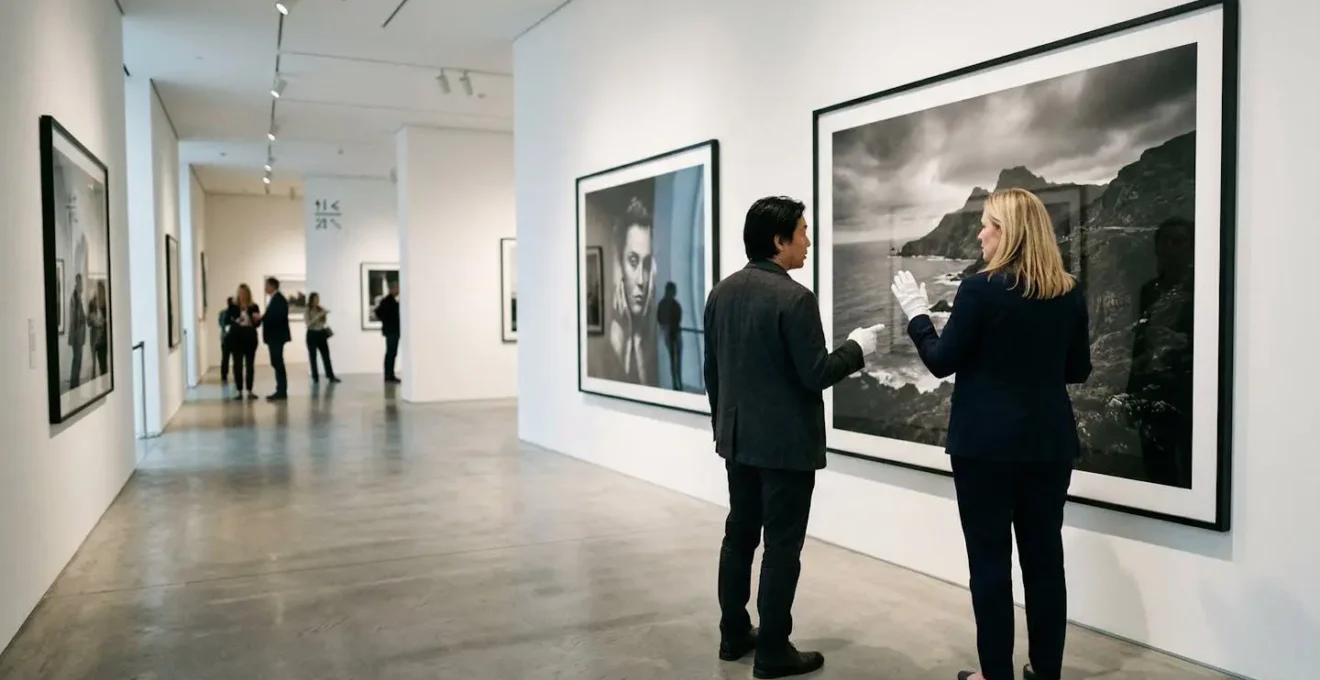
Fine art photography’s investment value is not a lesser version of painting’s; it is a distinct asset class built on verifiable scarcity and material science.
- The value of a photograph is dictated by its controlled edition, with limited runs commanding premium prices while open editions hold negligible resale value.
- The physical integrity of the print—from the chosen process (C-Type vs. Giclée) to the mounting method—is a non-negotiable component of its long-term worth.
Recommendation: Master the curatorial ‘due diligence’ of the photographic print—from verifying the signature on the verso to understanding its archival needs—to invest with confidence and unlock significant opportunities.
For the seasoned investor, the world of fine art has long been synonymous with the singular, inimitable object: the painting on canvas. The unique brushstroke, the artist’s direct touch—these are the traditional hallmarks of value. In this context, the photograph, an image born of a reproducible process, is often met with a healthy dose of skepticism. How can an object that exists in multiple be considered a serious, tangible asset? This is the fundamental question that has, for decades, placed photography in a separate, often misunderstood, category.
The conventional wisdom suggests that photography is merely a more accessible entry point to the art market, a “stepping stone” to “real” assets. But this perspective fundamentally misinterprets the medium. It overlooks the rigorous, deliberate structures that artists and gallerists have built to imbue the photographic print with its own powerful forms of rarity and authenticity. The discourse is not about whether a photograph can be as unique as a painting, but about understanding the specific, verifiable attributes that grant a photograph its status as a collectible object-hood.
This guide will dismantle the outdated comparison to canvas. Instead, we will adopt a curator’s lens to evaluate fine art photography on its own terms. We will demonstrate that the key to its investment viability lies not in a misguided quest for singularity, but in a deep understanding of its three governing principles: verifiable scarcity, material integrity, and artist-endorsed finality. By mastering these concepts, the traditional investor can move beyond skepticism and begin to see the photographic print for what it truly is: a sophisticated and potent asset class for the modern portfolio.
This article will guide you through the critical checkpoints of photographic investment, from deciphering the value of an edition to navigating the global market trends that define its future. We will explore the technical nuances that can make or break a print’s value and the market forces currently shaping demand.
Summary: Beyond the Canvas: Why Fine Art Photography Is a Viable Investment Compared to Traditional Canvas
- Why does a signed limited edition print cost 10x more than a poster?
- Why do open editions hold almost zero resale value compared to limited runs?
- How to verify a photographer’s signature and edition number on the verso?
- C-Type vs Giclée: which print process offers better archival stability?
- The dry-mounting error that devalues a collector’s print by 50%
- How to store unmounted photographic prints to prevent emulsion cracking?
- Western Pop Art vs Eastern Traditional: which genre is driving the current boom?
- Global Art Market Trends: How Asian Collectors are Influencing UK Auction Prices?
Why does a signed limited edition print cost 10x more than a poster?
The vast chasm in value between a fine art print and a mass-produced poster lies not in the paper or ink, but in a concept central to all art investment: artist-endorsed finality. A poster is a mere reproduction of an image, its connection to the artist’s intent purely informational. A signed, limited-edition print, however, is a deliberate art object. The market reflects this distinction starkly; the material difference might be $200 for a fine print versus $2 for a poster, but the price difference can be $20,000 versus $20. This demonstrates that we are not paying for the image, but for the artist’s validation of that specific object.
This validation is communicated through two key acts: the signature and the edition number. As one analysis poignantly notes, “The signature and edition number represent the artist’s final approval of that object as a definitive expression of their vision. It transforms a reproduction into a unique work.” It is this act that imbues the print with its aura and elevates it from a copy to a constituent part of the artist’s authentic corpus. The artist is, in effect, declaring that this object, in this specific state, is the final, correct manifestation of their creative will.
For the investor, this means the signature is not an autograph; it is a seal of approval. The limited number is not an arbitrary marketing tactic; it is a binding contract with the market, establishing the verifiable scarcity of the work. A poster has no such contract. It can be reprinted infinitely, diluting any potential for value accrual. The signed print, by contrast, exists within a closed, finite system defined by the artist themselves, making it a tradable and appreciable asset.
Why do open editions hold almost zero resale value compared to limited runs?
If artist-endorsed finality is the philosophical basis for a print’s value, the edition size is its primary economic driver. An “open edition” is anathema to the investment market because it completely lacks verifiable scarcity. With no upper limit on production, supply can always meet demand, preventing the price pressure that leads to appreciation. In contrast, a strictly limited edition functions like a precious metal; its rarity is a known, fixed quantity. Market analysis confirms this, showing that prints from editions larger than 200 lose significant value, while editions under 50 command premium prices. The market rewards discipline and constraint.
The impact of editioning is not subtle. A standout Pablo Picasso print from a small, sought-after edition can achieve a price of $5 million at auction. Yet, a lesser-known work from an open edition by the very same artist might struggle to fetch $500. This dramatic variance has nothing to do with the image itself and everything to do with the controlled supply. For a serious collector, the term “open edition” should be an immediate red flag, signaling an object produced for decorative, not investment, purposes.
The most sophisticated part of the market operates on a detailed hierarchy of rarity, even within a limited edition. Special proofs pulled outside the main numbered run, such as Artist’s Proofs (AP) or Printer’s Proofs (PP), are considered even rarer and carry a significant premium. Understanding this hierarchy is essential for advanced collectors.
This comparative table, based on data from industry guides for collectors, clearly outlines the investment hierarchy based on edition type.
| Edition Type | Typical Size | Investment Value | Premium Over Standard |
|---|---|---|---|
| Artist’s Proof (AP) | 10% of edition | Highest | +20-30% |
| Printer’s Proof (PP) | 1-5 prints | Very High | +15-25% |
| Hors Commerce (HC) | 5-10 prints | High | +10-20% |
| Limited Edition | 10-50 optimal | Standard High | Baseline |
| Open Edition | Unlimited | Minimal | -90% or more |
How to verify a photographer’s signature and edition number on the verso?
For a traditional art investor, provenance is paramount. With photography, the primary document of provenance is often the object itself—specifically, its verso (the back). This is where the crucial data of its identity resides. Verifying the authenticity of the signature and edition number is a core act of due diligence. It requires a forensic eye and a methodical approach, as forgeries or misattributions are a constant risk. The signature’s style, placement, and medium (pencil is preferred as it indents the paper and doesn’t fade like ink) are all critical data points.
An artist’s signature is not a static mark; it evolves over their career. Therefore, a key step is to cross-reference the signature in question with documented, authenticated examples from the same period of the artist’s life. Auction house catalogues and catalogue raisonnés are indispensable tools for this task. Likewise, the format of the edition number (e.g., ’34/100′ versus ’34 of 100′) should be consistent with the artist’s known practices. Small inconsistencies can be tell-tale signs of a fake.
Beyond the artist’s hand, one must look for other corroborating marks. Did a famous printer or publisher collaborate on this edition? If so, their chop mark or blind stamp should be present. These marks act as a second layer of authentication. Finally, one must always request and scrutinize the paper trail: the provenance. A complete history of ownership, tracing back to the original gallery or the artist’s studio, provides the ultimate validation for the information found on the print’s verso.
Your 5-Step Authentication Plan: Verifying the Verso
- Examine the Signature: Check for pencil (not ink) and typical placement (margin or verso). Scrutinize the handwriting for signs of authenticity versus careful copying.
- Cross-Reference: Compare the signature with documented examples from the same period in the artist’s career, noting any evolution in their style.
- Verify Edition Format: Ensure the numbering style (e.g., ’12/50′) and any proof designations (e.g., ‘AP’) match the standards documented for that specific artist and print series.
- Look for Printer’s Marks: Identify any publisher’s or printer’s blind stamps or chop marks that correspond with known collaborations for that edition.
- Demand Provenance: Request and review all available documentation tracing the ownership history back to the original point of sale to build an unbroken chain of custody.
C-Type vs Giclée: which print process offers better archival stability?
Once authenticity is established, the investor’s focus must shift to material integrity. A photograph is a chemical object, and its long-term stability—its very survival—depends on the process used to create it. For contemporary works, the two dominant processes are the traditional Chromogenic Print (C-Type) and the modern Pigment Print (Giclée). Each has profound implications for the artwork’s investment potential.
The C-Type is the classic colour photography process, involving light-sensitive paper and chemical development. It is the medium of 20th-century masters, and its connection to the history of photography gives it a certain gravitas. As noted in the Fine Art Photography Investment Guide:
A C-Type print from a traditionalist like Andreas Gursky has value because of its connection to classic photographic processes. The process is part of the asset’s story.
– Art Market Analysis, Fine Art Photography Investment Guide
However, from a purely scientific standpoint of longevity, modern Giclée prints made with archival pigment inks on acid-free paper often have the edge. These prints are created with highly stable, inert pigments rather than the more volatile dyes found in C-Prints. Rigorous testing confirms their durability; museum-quality giclée prints are rated for 150+ years under controlled conditions according to Wilhelm Imaging Research standards, often outlasting their traditional counterparts.
So, which is better? The answer is nuanced. A Giclée offers superior archival stability, a critical factor for long-term value preservation. A C-Type, however, may possess greater historical or conceptual value if the artist specifically chose that process as part of their artistic statement. The savvy investor must weigh both factors: the scientific data on longevity and the art-historical significance of the chosen medium. For a contemporary artist, a Giclée is often the mark of quality; for a historical work, the C-Type process may be an inextricable part of its identity.
The dry-mounting error that devalues a collector’s print by 50%
Perhaps no other factor so dramatically and irreversibly impacts the value of a photographic print as improper mounting. While seemingly a finishing touch, the choice of how a print is affixed to its backing is a critical decision with permanent financial consequences. The most common and devastating error is dry-mounting, a process that uses heat and a permanent adhesive to bond the print to a substrate. While it creates a perfectly flat appearance, it is almost always irreversible without catastrophic damage to the print.
This is not a minor concern. The art market is ruthless in penalizing works that have been compromised in this way, as the process fundamentally alters the original object and introduces materials that may not be archivally sound. The loss of value can be staggering.
Case Study: The Devaluation of a Richard Avedon Portrait
A classic Richard Avedon portrait, originally valued at $50,000, was brought to market. Upon inspection, conservators discovered it had been dry-mounted by a previous owner. Despite the use of so-called ‘archival’ materials, the process was irreversible. As a result, the work’s appraisal was slashed to just $20,000. This staggering 60% destruction of value illustrates how a single framing decision can catastrophically undermine an otherwise blue-chip investment. For this reason, the gold standard in conservation remains hinge-mounting with Japanese paper and reversible wheat starch paste.
For an investor, this means any mounted work must be approached with extreme caution. The mount should be inspected for any signs of adhesive stress, such as subtle rippling, or discoloration. The ideal is a “floated” mount, where the print is held by archival hinges and does not touch the mat, allowing it to expand and contract naturally with environmental changes. When in doubt, especially for a high-value acquisition, a professional conservation assessment is a wise and necessary investment.
How to store unmounted photographic prints to prevent emulsion cracking?
For the serious collector, not all works will be on display. A significant portion of a portfolio, especially unmounted prints, will reside in storage. Protecting these assets requires a scientific approach to environment control. A photograph is a delicate object; its emulsion layer, paper base, and image-forming materials are all susceptible to degradation from improper temperature and humidity. Fluctuations are the enemy, causing the print to expand and contract, which can lead to cracking, curling, and delamination—all forms of irreversible damage.
The ideal storage environment is not one-size-fits-all. Different photographic processes have different needs due to their unique material compositions. Gelatin silver prints, the bedrock of 20th-century black-and-white photography, are particularly vulnerable to high humidity, which can accelerate deterioration of the gelatin. C-Type prints, by contrast, benefit significantly from cold storage, which slows the inevitable fading of their organic dyes. Modern pigment prints are generally more robust but are still sensitive to extreme conditions.
Maintaining these precise conditions is often beyond the capability of a home environment. For this reason, many serious investors turn to professional, climate-controlled art storage facilities. While this represents an ongoing cost, often ranging from $50 to $200 per month, it should be viewed as an essential form of insurance. This investment in professional storage actively preserves the asset’s value by protecting its pristine physical condition, ensuring it remains a top-tier example of the work when it eventually comes to market.
The following table, based on conservation guidelines, outlines the specific environmental requirements for key print types.
| Print Type | Optimal Temperature | Relative Humidity | Special Considerations |
|---|---|---|---|
| Gelatin Silver | 18-20°C (64-68°F) | 30-40% RH | Most sensitive to humidity fluctuations |
| C-Type/Chromogenic | 2-5°C (35-41°F) | 30-35% RH | Benefits from cold storage |
| Giclée/Inkjet | 18-21°C (64-70°F) | 35-45% RH | Avoid direct air circulation |
| Platinum/Palladium | 18-21°C (64-70°F) | 40-50% RH | Most stable, least demanding |
Key Takeaways
- Scarcity is Deliberate: A print’s value is directly tied to its edition size. Limited editions create verifiable scarcity, while open editions are for decorative purposes only.
- Materiality is Value: The physical object matters. The printing process (C-Type vs. Giclée), the paper, and especially the mounting method are all critical components of a photograph’s investment-grade status.
- The Verso is Law: The back of the print, with the artist’s signature, edition number, and any printer’s marks, is the primary source of its identity and authenticity. Its verification is non-negotiable.
Western Pop Art vs Eastern Traditional: which genre is driving the current boom?
Understanding the physical asset is only half the equation. An investor must also understand the market in which it trades. The print market is not monolithic; it is a dynamic ecosystem of genres and collector bases, and right now, it is booming. According to ArtPrice’s 2024 Global Market Report, print sales have doubled in a decade, reaching 193,000 transactions and $473 million in auction turnover in 2024 alone. The question is, where is this growth concentrated?
A major driving force is unequivocally Western Pop Art. Artists like Andy Warhol, Keith Haring, and Roy Lichtenstein, whose graphic and accessible imagery translates perfectly to the print medium, continue to dominate. Their work attracts a broad base of buyers, including younger Millennial and Gen Z collectors who often discover art via social media. In a testament to this genre’s resilience, Keith Haring’s sales saw a 22% increase in 2024, defying a broader market slowdown that affected other top contemporary artists. This indicates a deep, sustained demand for Pop Art’s vibrant aesthetic and cultural commentary.
Simultaneously, a powerful and distinct trend is emerging in Contemporary Asian Photography. While Western Pop Art sees growth in transaction volume, contemporary photography from China, Japan, and Korea is experiencing a significant rise in value, driven by strong regional demand. Collectors in Asia are increasingly investing in their own cultural producers, creating a robust and sometimes volatile market. While blue-chip Western masters offer stable, steady appreciation, the high-growth sectors are clearly defined by the high liquidity of Pop Art and the passionate regional support for contemporary Asian works.
Global Art Market Trends: How Asian Collectors are Influencing UK Auction Prices?
The single most significant macro trend shaping the entire global art market—from paintings to photography—is the formidable buying power of Asian collectors. For years, the art world’s centers of gravity were London and New York. Today, the tastes and immense capital of collectors from mainland China, Hong Kong, and across Southeast Asia are setting new benchmarks and fundamentally influencing prices in Western auctions.
This influence is most visible at the highest end of the market. When a Claude Monet water lilies painting sold for $65.5 million at Sotheby’s in 2024, it was an Asian collector who won the bidding war against three other contenders. This is not an isolated incident. This trend demonstrates a deep appetite for iconic, best-in-class works, and that same buying power is now being directed towards master photographers. The same collectors setting records for Impressionist paintings are now competing for seminal works by artists like Andreas Gursky and Hiroshi Sugimoto.
The data from UK auction houses is unequivocal. According to Lyon & Turnbull’s 2024 auction data, a staggering 85% of Asian art works at UK auctions are now sold to international buyers, with the majority hailing from mainland China and Hong Kong. This influx of capital creates a highly competitive environment, pushing prices upward for specific genres and artists. For a UK-based investor, it is no longer sufficient to understand the local market. One must now think globally and recognize that the final price for a work at a London auction may well be determined by a bidder in Shanghai.
This global shift represents a massive opportunity. As Asian collectors continue to diversify their portfolios and deepen their engagement with photography, they are injecting new liquidity and demand into the market, reinforcing the status of fine art photography as a truly global asset class.
By shifting perspective from the singular canvas to the validated photographic object, the path to investment becomes clear. It is a path defined not by tradition, but by a modern, rigorous due diligence. Mastering the principles of verifiable scarcity, material integrity, and artist-endorsed finality allows an investor to navigate this exciting asset class with the precision and confidence of a curator. The skepticism towards the multiple gives way to an appreciation for the meticulous system that creates its value. Now that you are equipped with this framework, the next step is to apply it.