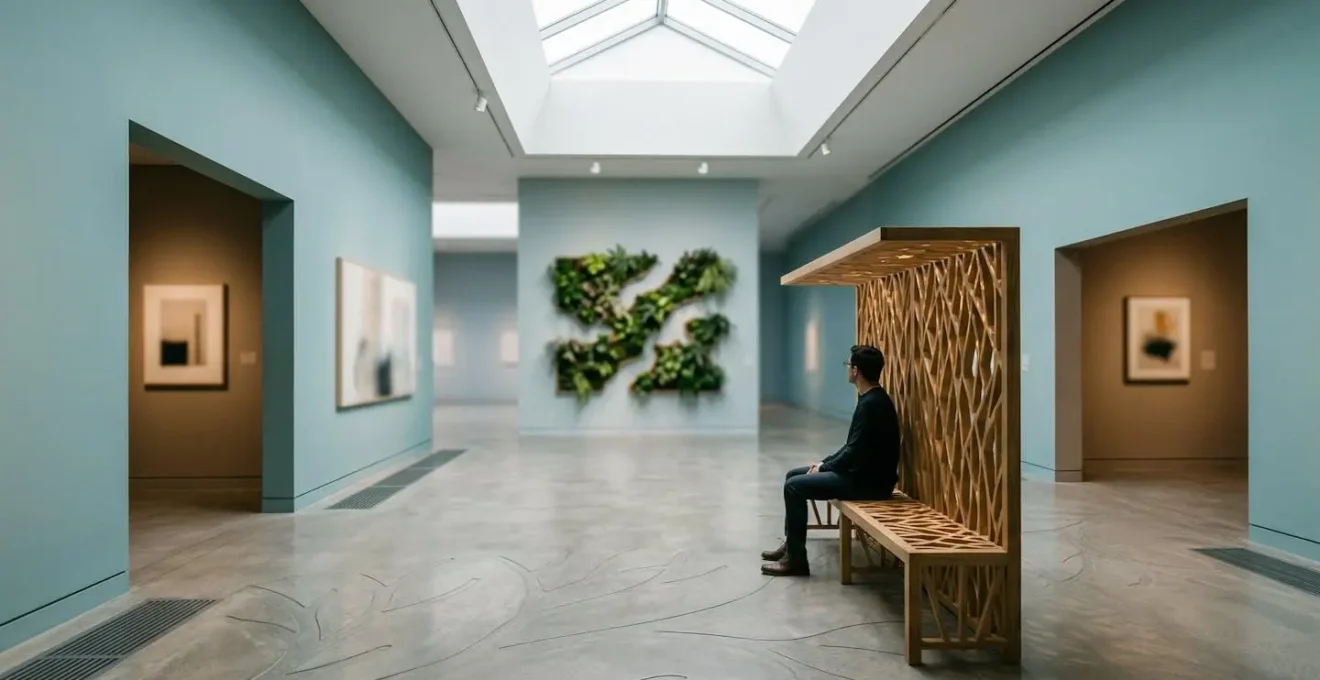
Exhibition design is no longer just about aesthetics; it is a powerful, evidence-based tool for actively regulating visitor mental and emotional states.
- Specific design choices, from colour palettes to spatial flow, directly impact physiological responses like heart rate and stress levels.
- True accessibility for neurodivergent audiences requires a deep focus on sensory regulation and informational autonomy, not just physical access.
Recommendation: Curators and public health liaisons must adopt a ‘psycho-architectural’ approach, intentionally shaping the gallery environment as a therapeutic space to foster psychological safety and profound self-reflection.
As curators and public health advocates, we often operate on the intuitive belief that art is inherently good for the soul. We meticulously arrange objects of beauty and meaning, hoping they will inspire, challenge, and comfort our visitors. The conventional wisdom is to create welcoming spaces, perhaps with comfortable seating and good lighting. But what if this approach only scratches the surface? What if the true potential lies not in the art alone, but in the meticulously crafted environment that holds it?
The prevailing discourse often stops at making museums generally “pleasant.” It fails to address the deeper, more complex psychological needs of a diverse audience. We are now at a critical turning point where art, neuroscience, and architecture converge. The central premise of this shift is profound: the gallery space itself can be an active therapeutic instrument. This is not about simply hanging calming pictures; it is about understanding the neurological and physiological mechanisms that underpin our experience of space, colour, and interaction.
This article moves beyond aesthetics to explore exhibition design as a form of intentional emotional and sensory regulation. Instead of asking “Is this beautiful?”, we will ask “How does this make a visitor feel, physiologically and psychologically?” My angle is that every curatorial choice—from the fractal patterns in a tapestry to the placement of a content warning—is a precise intervention. It is an opportunity to reduce stress, facilitate introspection, and create genuinely inclusive sanctuaries for mental wellbeing. We will explore how to transform galleries from passive containers of art into active agents of mental health.
This guide delves into the specific, evidence-based strategies that allow for this transformation. By examining the science behind visual perception, emotional pacing, and sensory accessibility, you will gain the tools to design exhibitions that not only showcase art but also nurture the inner world of every visitor.
Summary: Art to Provoke Introspection: Can Gallery Design Improve Mental Health?
- Why does viewing fractal patterns reduce cortisol levels in stressed visitors?
- How to design ‘slow looking’ spaces in busy city museums?
- Passive Viewing vs Participatory Art: which triggers deeper self-reflection?
- The curation error of displaying trauma-based art without adequate warning
- When to introduce the ‘reflection point’: pacing emotional content in an exhibition
- Why do greens and blues consistently lower heart rates in gallery settings?
- Why do visitors with autism need to know where the hand dryers are?
- Visiting Museums: Making Exhibitions Accessible for Neurodivergent Audiences?
Why does viewing fractal patterns reduce cortisol levels in stressed visitors?
The calming effect of nature is not just a poetic notion; it is a measurable neurological phenomenon rooted in the patterns we see. Our brains are hardwired to find comfort in fractals—the complex, self-repeating patterns found in everything from snowflakes and ferns to coastlines and clouds. This innate fluency with nature’s geometry is a powerful tool for curators. When visitors are stressed, their visual system is in a state of high alert. Introducing fractal patterns, whether in artworks or architectural details, provides the brain with information it can process with minimal effort. This ease of processing has a direct physiological consequence.
This phenomenon, a core concept in neuro-aesthetics, is not accidental. As Professor Richard Taylor explains, our visual systems have evolved to process these patterns efficiently. He states, “Through exposure to nature’s fractal scenery, people’s visual systems have adapted to efficiently process fractals with ease. We found that this adaptation occurs at many stages of the visual system, from the way our eyes move to which regions of the brain get activated.” This biological resonance is the key. Viewing these patterns can trigger a significant physiological stress-reduction response, with some research demonstrating that it can lower a viewer’s stress levels by as much as 60%.
For curators, this means actively seeking and highlighting art that incorporates these patterns or integrating them into the gallery’s design through screens, projections, or even flooring. It’s a deliberate shift from seeing art as a purely cultural object to recognizing it as a piece of biophilic design that can directly lower cortisol and promote a state of relaxed awareness in visitors. This is psycho-architecture in action, using visual input to regulate the nervous system.
How to design ‘slow looking’ spaces in busy city museums?
In the fast-paced environment of a major urban museum, visitors are often in a state of cognitive rush, moving quickly from one piece to the next. To foster genuine introspection, curators must intentionally design “slow looking” spaces—islands of calm that invite pause and deep engagement. This goes beyond simply placing a bench in a room. It involves creating a sensory bubble that shields the visitor from the surrounding hustle and offers a distinct shift in atmosphere. The goal is to create a ‘prospect-refuge’ nook, an architectural concept where a person can see out (prospect) without being easily seen (refuge), fostering a sense of safety and privacy.
The design of these spaces should be multi-sensory. This includes using acoustical panels or directional speakers to create a focused soundscape, employing a distinct lighting strategy like a warm, focused spotlight to visually separate the area, and choosing seating made from tactile, natural materials like wood or textured fabric. These elements work together to signal a change in pace and purpose, inviting the visitor to switch from a mode of passive consumption to one of active, contemplative engagement. The space should feel like an intentional gift of time and quiet, not an afterthought.
As the image above illustrates, a successful slow-looking space is an intimate enclosure within a larger, busier context. The strategic use of seating, lighting, and separation from the main flow of traffic creates a haven for personal reflection. By curating not just the art but also the conditions for viewing it, we can guide visitors toward a more meditative and meaningful connection with the work. This is a fundamental aspect of using the museum environment as a tool for mental wellbeing, providing a necessary counterpoint to the overstimulation of modern life.
Passive Viewing vs Participatory Art: which triggers deeper self-reflection?
The push for interactive and participatory art is often based on the assumption that active engagement is inherently superior to quiet observation. However, neuroscience reveals a more nuanced picture. The choice between passive viewing and active participation is not about which is “better,” but about which cognitive and emotional state a curator wishes to facilitate. The two modes activate fundamentally different neural networks, each valuable for introspection in its own way.
As contemporary neuroscience research on art engagement shows, “Passive viewing activates the Default Mode Network (associated with mind-wandering and self-reflection), while participation engages the Executive Function Network.” The Default Mode Network (DMN) is our brain’s “inward-facing” system, crucial for autobiographical memory, thinking about the future, and understanding ourselves. In contrast, the Executive Function Network (EFN) is our “outward-facing” system, responsible for problem-solving, planning, and executing tasks. Therefore, looking passively at a painting may trigger profound personal memories and self-assessment, while co-creating an artwork engages our sense of agency and problem-solving skills.
A truly effective exhibition understands this dichotomy and offers a spectrum of engagement. It doesn’t force participation but invites it, recognizing that some visitors will achieve their deepest reflection through quiet contemplation, while others need to act and create.
Case Study: Spectrum of Engagement Model in Contemporary Museums
To address this, design firm Interior Architects developed a model with three levels of participation: passive observation for internal reflection, light interaction (like leaving notes), and deep creation for enthusiastic co-creation. Their 2024 “Fleurish” installation proved that participatory art is most effective when it accommodates these multiple engagement styles, acknowledging that there is no single path to meaningful self-reflection. This approach respects visitor autonomy and provides different pathways to introspection.
The curator’s role is to be a sophisticated facilitator, providing opportunities for both DMN and EFN activation. This could mean placing a quiet, contemplative piece in one room and a collaborative installation in the next, allowing visitors to naturally gravitate toward the mode of engagement that best suits their internal state.
The curation error of displaying trauma-based art without adequate warning
Art that explores trauma can be profoundly healing and insightful, but displaying it without the proper framework is not just a curatorial misstep—it’s an ethical failure. Exposing an unprepared visitor to potentially re-traumatizing content can cause genuine psychological harm, undermining the museum’s role as a safe space for reflection. The common, single-line “content warning” at the entrance is often insufficient. It lacks specificity and fails to grant visitors the agency to manage their own emotional and psychological safety throughout the exhibition.
A responsible approach requires a multi-layered system that provides informational autonomy at every stage of the visitor’s journey. This is about giving visitors the tools to make informed choices about what they see and when they see it, thereby preserving their sense of control and psychological wellbeing. It’s an act of care that builds trust and allows for safer engagement with difficult subjects. The goal is not to sanitize the art, but to frame it with respect for the viewer’s potential vulnerabilities.
Implementing such a system involves thinking about the visitor’s path before, during, and after encountering challenging material. It’s a proactive strategy of emotional pacing and support. By providing clear notices, optional in-depth information, and dedicated spaces for emotional processing, we empower visitors to engage with challenging art on their own terms, transforming a potentially harmful encounter into an opportunity for contained, meaningful reflection.
Action Plan: A Multi-Layered Content Warning System for Trauma-Based Art
- General Advisory: Place clear content notices at the exhibition entrance explaining the overarching themes and the potential presence of triggering content.
- Section-Specific Notice: Before visitors enter a room or section with intense material, provide a more detailed warning about the specific nature of the content within.
- Visitor Autonomy Tools: Use QR codes or discreet panels next to specific artworks to offer optional, in-depth descriptions of potentially distressing content, allowing visitors to choose whether to engage.
- Decompression Zone: Intentionally design a calming, quiet space immediately following a section with traumatic art, featuring soft seating and non-challenging visuals to serve as an emotional “palate cleanser.”
- Post-Exit Resources: Conclude the exhibition with resource panels that provide links to mental health organizations and offer gentle prompts for processing the experience after leaving the museum.
When to introduce the ‘reflection point’: pacing emotional content in an exhibition
An exhibition is a narrative, and like any good story, it requires careful pacing. Bombarding visitors with emotionally intense content without a break leads to “empathy fatigue” or psychological overwhelm, shutting down the very introspection we aim to foster. A key element of therapeutic curation is the intentional design of “reflection points” or transition zones. These are not empty hallways between galleries; they are purposefully designed spaces that act as an emotional palate cleanser, allowing visitors to process what they have just seen before moving on to the next section.
The design of these transitions is a critical part of the exhibition’s emotional architecture. This can be achieved through a deliberate shift in sensory input. For example, moving from a gallery with dark, challenging art into a corridor with higher ceilings, warmer lighting, softer acoustics, and even a different floor texture can signal a psychological reset. These cues are processed by the brain as a change of scene, providing a moment of cognitive and emotional respite. It’s the curatorial equivalent of a deep breath.
As depicted in the image, a transition space can guide a visitor from one emotional state to another through purely architectural means. The shift in light from cool to warm, and in texture from hard to soft, creates a symbolic journey. Placing a single bench within this space suggests the option of a pause without demanding it, respecting the visitor’s autonomy. By orchestrating this emotional pacing, curators can maintain visitor engagement and prevent burnout, ensuring that the impact of the art is absorbed and integrated rather than simply endured.
Why do greens and blues consistently lower heart rates in gallery settings?
The calming effect of certain colors is not a matter of cultural association alone; it’s a hardwired physiological response. When we use specific hues in a gallery, we are not just making a decorative choice—we are engaging in a form of non-verbal communication with the visitor’s autonomic nervous system. Cool colors, particularly shades of blue and green, have a consistent and measurable impact on our physiology, making them a powerful tool for creating restorative environments.
The mechanism is linked to how our brains interpret information from the natural world. Greens and blues are the dominant colors of nature’s landscapes—open skies and lush vegetation—which our evolutionary history has taught us to associate with safety and resource availability. This association is so deep that exposure to these colors can trigger a direct physiological calming response. According to neuroscience research on color and the autonomic nervous system, “Exposure to blue-green light has been found to increase activity in the dorsal vagal complex, which sends signals via the vagus nerve to slow heart rate, lower blood pressure, and promote feelings of calm, safety and social engagement.”
In contrast, colors like red have been shown to have the opposite effect, slightly increasing heart rate and alertness. This makes color choice a critical element of therapeutic curation. Using a palette of soft greens and blues in a ‘slow looking’ space or a decompression zone actively helps to down-regulate a visitor’s nervous system. It’s a deliberate design strategy to reduce anxiety and create a state of mind conducive to contemplation and introspection. This is not about avoiding stimulating colors altogether, but about using them with intention, understanding their power to modulate the visitor’s physical and emotional state as they move through the exhibition.
Why do visitors with autism need to know where the hand dryers are?
For many neurotypical visitors, a trip to the museum is a primarily visual experience. For a neurodivergent visitor, particularly someone with autism, it is an all-encompassing sensory event where unpredictable stimuli can quickly lead to overload and distress. A sudden, loud noise like a hand dryer is not a minor annoyance; it can be a painful and dysregulating experience that derails the entire visit. This highlights a critical principle of neuro-inclusive design: predictability is a form of access.
The core issue is one of sensory processing. As made clear by co-design research with autistic participants, “Sensory stimulation, particularly via bright fluorescent lighting and loud noise, was identified as a common barrier in public buildings.” The anxiety for an autistic visitor often comes not just from the stimuli themselves, but from the hypervigilance required to anticipate them. Knowing in advance where potential sensory threats are located—be it hand dryers, automatic air fresheners, or a gallery with loud audiovisual elements—is a game-changer.
Providing sensory maps that identify locations of hand dryers, automatic air fresheners, and other sudden loud sounds allows visitors to plan routes that avoid or prepare for these triggers. This information frees up cognitive resources that would otherwise be spent on anxiety and hypervigilance, enabling deeper engagement with the museum’s content.
– Museum accessibility advocate, MuseumNext
This act of providing information—what we can call informational autonomy—is a profound act of care. It returns a sense of control to the visitor, allowing them to conserve their cognitive energy for engaging with the art rather than navigating a hostile sensory environment. It shifts the burden of adaptation from the individual to the institution, which is the heart of true accessibility.
Key Takeaways
- Design as Therapy: Curatorial choices in lighting, color, and spatial layout are not merely aesthetic; they are active interventions that can regulate a visitor’s nervous system.
- Sensory Regulation is Key: True accessibility, especially for neurodivergent audiences, hinges on managing the sensory environment and providing predictable information to prevent cognitive and emotional overload.
- Pacing is Paramount: A well-designed exhibition manages the visitor’s emotional journey with intentionally placed “reflection points” and decompression zones to prevent empathy fatigue and foster deeper processing.
Visiting Museums: Making Exhibitions Accessible for Neurodivergent Audiences?
Creating truly accessible exhibitions for neurodivergent audiences requires a fundamental paradigm shift—from a one-size-fits-all model to one of flexible, person-centered design. It’s about recognizing that “accessible” means something different for everyone and building in choice and control. This approach moves beyond physical access to embrace sensory and cognitive accessibility, focusing on creating an environment where a wider range of visitors can feel safe, comfortable, and ready to engage.
A holistic strategy involves collaboration with the community it aims to serve. Nothing about us, without us. Engaging special education teachers, occupational therapists, and, most importantly, self-advocates with autism in the design process is crucial. This co-design approach ensures that interventions are based on lived experience, not assumptions. Key adaptations often include a mix of environmental modifications and informational tools, designed to reduce anxiety and prevent sensory overload.
Case Study: The Smithsonian’s “Morning at the Museum” Program
A benchmark for neuro-inclusive design, the Smithsonian’s program offers a comprehensive model. Developed with a community advisory committee, the initiative provides early entry to limit crowds and makes targeted sensory modifications. These include dimmed lights and lowered sound volumes in certain areas. Crucially, they provide detailed pre-visit materials—including sensory maps like the one imagined below—that explain the layout, facilities, and sensory expectations. As documented by the Smithsonian Magazine, this allows families to plan their experience in advance, dramatically reducing anxiety and empowering visitors to navigate the museum with confidence.
Ultimately, making exhibitions accessible for neurodivergent audiences is not about creating separate, “special” experiences. It is about applying the principles of universal design to make the primary experience more welcoming for everyone. Providing quiet spaces, clear signage, and predictable sensory information benefits all visitors, including those with anxiety, PTSD, or simply a desire for a more contemplative visit. It is an investment in psychological safety that pays dividends for the entire community.
The role of the curator is evolving. We are no longer just guardians of objects, but stewards of human experience. By embracing the principles of psycho-architecture, neuro-aesthetics, and sensory regulation, we can craft exhibitions that do more than just display art—they can actively contribute to the mental and emotional wellbeing of our communities. To begin this journey, the first step is to analyze your own space not just for its aesthetic appeal, but for its psychological impact.