Post-Brexit, the success of a European orchestra tour hinges not on whether you have an ATA Carnet, but on the granular precision of its General List and your grasp of non-obvious rules like cabotage.
- Critical failure points include incomplete equipment lists leading to border delays, which can cause a cascading failure of cancellations and contract breaches.
- Misunderstanding Schengen 90/180 day rules for personnel or EU cabotage limits for vehicles are common administrative tripwires that can halt a tour.
Recommendation: Treat every border crossing as a high-risk event requiring dedicated contingency planning and partnership with a freight forwarder specializing in musical ensembles.
The new reality of touring a UK-based orchestra through Europe is one of heightened administrative friction. The days of loading a truck and crossing the Channel with minimal paperwork are gone. For orchestra tour managers and logistics coordinators, the post-Brexit landscape is not just about more forms; it’s about a series of high-stakes administrative tripwires, any one of which can trigger a catastrophic cascading failure, jeopardizing performances, budgets, and reputations. While many are aware of the need for an ATA Carnet, this is merely the entry ticket.
The common advice to “be organised” and “get a Carnet” is dangerously simplistic. It overlooks the procedural rigour required for every single item and the jurisdictional friction at every border. The true challenge lies in mastering the nuances that most overlook: the exact wording on a CITES certificate, the precise calculation of cabotage stops, the verification of ‘Grand Rights’ for each specific territory, and the strict tracking of every individual’s Schengen days. A single error in these areas can lead to impounded equipment, denied entry for key personnel, and cancelled concerts.
But if the fundamental risk has shifted from logistics to legal compliance, then the solution must also evolve. The key is no longer just efficient transport, but crisis-proof documentation and scheduling. This guide moves beyond the basics to deconstruct these specific, non-obvious failure points. It is a manual for transforming abstract regulations into a concrete crisis-prevention strategy, arming you with the detailed knowledge required to navigate the complexities of Carnets, CITES, and cabotage without incident.
We will examine the critical details of customs documentation, the specific challenges of transporting high-value instruments, the scheduling errors that can derail a tour, and the legal and financial ramifications that now define the business of international orchestra performance. This is your blueprint for procedural rigour.
Summary: A Crisis-Proof Guide to Post-Brexit Orchestra Touring
- Why must every single cable and bow be listed on your customs document?
- How to obtain CITES certificates for bows containing ivory or tortoiseshell?
- Air Freight vs Road Haulage: which is safer for double basses crossing Europe?
- The trucking scheduling error that gets your equipment impounded in France
- When to apply for Schengen visas for non-UK/EU orchestra members?
- How to choose a shipper who handles customs clearance documentation correctly?
- The contract oversight regarding ‘Grand Rights’ that stops you touring the work
- Importing Art from International Talent: Navigating Brexit Customs and VAT?
Why must every single cable and bow be listed on your customs document?
The ATA Carnet is often called a ‘passport for goods’, but this metaphor belies its rigidity. Unlike a personal passport, a Carnet’s General List is not a summary; it is an exact, itemised manifest. Every single piece of equipment temporarily exported, from a multi-million-pound cello to a 2-metre audio cable, must be listed with a corresponding description, weight, and value. The reason for this uncompromising level of detail is simple: customs officials operate on a principle of zero ambiguity. Any discrepancy between the physical goods and the manifest, no matter how minor, is grounds for suspicion, delay, and potential seizure.
An incomplete list is considered a false declaration. A customs agent cannot and will not make assumptions. If a flight case contains 50 cables but the Carnet lists only “box of cables,” the entire shipment can be held for a full manual inspection. This process can take hours, or even days, completely derailing a tight touring schedule. The consequences are not merely inconvenient; they are financially catastrophic. As British band White Lies discovered in 2022, Brexit-related customs legislation resulted in their equipment being delayed for two days, forcing the cancellation of their sold-out Paris show. This is the cascading failure in action: a documentation error becomes a logistical crisis, which becomes a contractual breach and a public relations disaster.
This need for precision has forced a change in operational planning. As one UK musician reported to the Independent Society of Musicians, “We can never book a gig on a carnet day, we have to keep it purely a travel day just in case we encounter any problems at any of the customs offices.” This introduces the concept of the contingency buffer, where extra, unfunded days for crew wages and hotels must be built into the schedule purely to mitigate the risk of administrative delays at the border. This is the new, hidden cost of touring.
How to obtain CITES certificates for bows containing ivory or tortoiseshell?
For philharmonic orchestras, the CITES (Convention on International Trade in Endangered Species of Wild Fauna and Flora) challenge is acute. Many older, high-value string instruments, particularly bows, contain small amounts of materials like elephant ivory or hawksbill turtle shell, now subject to strict international trade regulations. Moving these items across borders without the correct documentation is not just a customs violation; it is treated as wildlife trafficking, with severe penalties including permanent confiscation of the instrument.
Obtaining the necessary CITES Musical Instrument Certificate (MIC) is a non-negotiable prerequisite for any tour. This is a separate and distinct process from the ATA Carnet. The application requires irrefutable proof of the instrument’s provenance, specifically that the CITES-listed materials were acquired before the species was protected. This involves a deep dive into an instrument’s history, often requiring an expert appraisal and authenticated documentation. The certificate itself, which has a validity of three years according to CITES regulations, must be physically present with the instrument at every single border crossing.
The procedural rigour is absolute. Authorities require that the instrument is securely marked or uniquely identified so they can verify, without a doubt, that the certificate corresponds to that specific instrument. Furthermore, the certificate is granted on the condition that the instrument will not be sold or transferred while outside its country of origin. A simple administrative oversight, like a mismatched serial number or a failure to present the original certificate, can lead to the instrument being impounded indefinitely. For an orchestra, this could mean a principal player is unable to perform, compromising the artistic integrity of the entire concert series.
Action Plan: Pre-Convention Instrument Provenance Verification
- Verify Provenance: Confirm and document that any African elephant ivory was legally acquired and removed from the wild prior to February 26, 1976.
- Obtain Certificate: Apply for and secure a valid CITES Musical Instrument Certificate (MIC) or equivalent CITES document for the specific instrument.
- Mark and Identify: Ensure the instrument is securely marked or uniquely identified in a way that allows authorities to match it perfectly to its CITES certificate.
- Confirm Non-Transfer: Formalise the declaration that the instrument is for performance use only and will not be sold or otherwise transferred while outside its country of origin.
- Digital and Physical Copies: Keep high-resolution digital scans of all CITES documents accessible to the tour manager, but always travel with the original physical certificates.
Air Freight vs Road Haulage: which is safer for double basses crossing Europe?
The choice between air and road for transporting an orchestra’s arsenal of instruments, especially behemoths like double basses and harps, is a complex calculation of risk, cost, and time. Post-Brexit, this decision has become even more fraught. While air freight offers speed, it introduces significant risks related to handling, pressure changes, and temperature fluctuations in cargo holds. Road haulage, traditionally the preferred method for European tours, provides greater control but is now ensnared in new layers of cost and regulation.
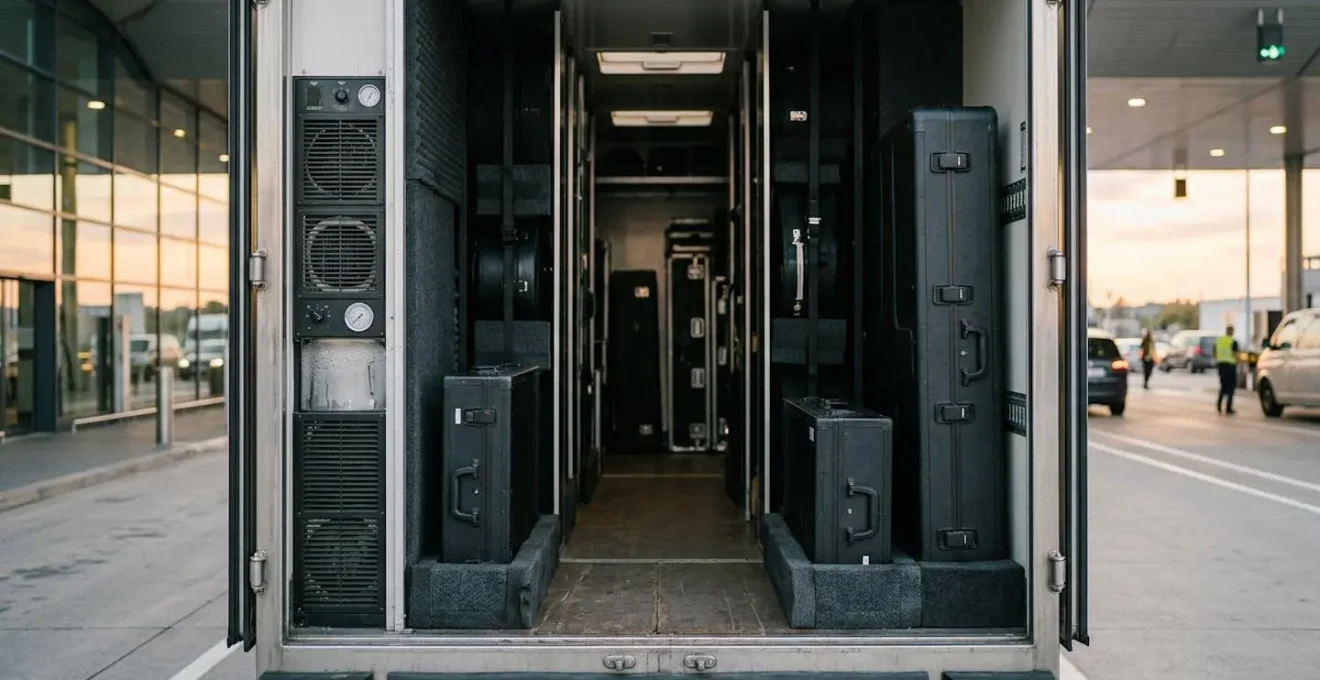
The primary concern for high-value classical instruments is environmental stability. As Hanna Madalska-Gayer of the Association of British Orchestras states, these instruments, which can be worth millions, “must be transported in air-conditioned, humidity-controlled lorries with a unique packing case for each instrument.” This is not a luxury; it’s a necessity to prevent catastrophic damage like cracks in wood or warping. Specialist road freight provides a sealed, climate-controlled environment from door to door, a level of consistency that is difficult to guarantee with air travel, which involves multiple transfers between different environments and handlers.
The image below highlights the level of technology involved in protecting these instruments. The custom foam, humidity sensors, and reinforced structure are the first line of defence against physical and environmental damage.
However, relying on UK-based specialist lorries has become a major financial burden due to cabotage rules. Post-Brexit, a UK-registered truck can only make a limited number of stops within the EU before it must return to the UK. This is often unworkable for a multi-city tour. The expensive workaround is to hire an EU-registered truck and crew for the European leg of the tour, a solution that can add an estimated £30,000 to the cost of a single tour. Therefore, while road haulage remains physically safer for the instruments, its financial and regulatory complexity now rivals the risks of air freight.
The trucking scheduling error that gets your equipment impounded in France
Of all the post-Brexit administrative tripwires, EU cabotage regulations are among the most easily misunderstood and severely punished. Cabotage is the transport of goods between two points within one country by a vehicle registered in another country. For UK orchestras touring Europe, this rule is a logistical minefield. Post-Brexit, a UK-registered truck entering the EU can perform a maximum of two internal movements (cabotage) after delivering its international load. An older, more generous interpretation allowed for three stops in total over seven days, but relying on this is now high-risk.
The critical scheduling error is planning a multi-city tour leg (e.g., Paris to Lyon, then Lyon to Marseille) using a single UK-based truck, exceeding the cabotage limit. French Gendarmerie and customs authorities are notoriously vigilant in enforcing these rules. A violation can result in the vehicle and its entire contents—your orchestra’s priceless instruments—being impounded on the spot. The process to release the vehicle involves significant fines and bureaucratic delays that would make continuing the tour impossible.
The experience of tour manager Ian Thompson with the band Porij in 2023 highlights another layer of jurisdictional friction at the French border. His successful crossing depended not just on perfect paperwork, but also on navigating the limited operating hours of the French customs ‘red channel’ (SIVEP) inspection facilities. Arriving at the wrong time could mean waiting until the next day, even with a flawless Carnet. This underscores the need for meticulous route and schedule planning that accounts for the specific operational realities of each border crossing, not just the regulations on paper. The “just-in-time” model of touring is now dangerously fragile.
When to apply for Schengen visas for non-UK/EU orchestra members?
The logistical focus on equipment often overshadows an equally critical element: the people. For an orchestra comprised of musicians from around the world, managing visas and entry rights is a complex matrix of nationalities and regulations. Post-Brexit, this has become a major administrative burden, particularly for non-UK and non-EU citizens who are part of a British orchestra, and now also for the British members themselves.
For UK nationals, touring in the EU is now governed by the Schengen Area’s 90/180 day rule. This dictates that they can only be present in the Schengen zone for a maximum of 90 days within any 180-day period. A tour manager must now act as a compliance officer, meticulously tracking each UK-based individual’s travel history to the EU. A single day’s overstay by a key musician or technician could result in fines, deportation, and an entry ban. As one tour manager noted, a significant part of their job is now to “make sure none of the musicians, technical crew or drivers has spent more than 90 days in the EU in the past 180 days.”
The situation is even more complex for non-UK/EU nationals (e.g., an American or Japanese musician) employed by the orchestra. They will likely need a specific Schengen visa for paid work, and the application process requires significant lead time. Applications should be submitted no later than 3 months before the tour commences, as processing times can vary wildly. This requires the orchestra’s management to have its personnel roster and tour dates locked in far earlier than was previously necessary. The symbolic arrangement of passports and documents below hints at this web of international bureaucracy.
This human logistics layer is a critical path. An equipment Carnet is useless if the principal violinist is denied entry at the border. According to Schengen area regulations for short-stay visits, the rules are applied strictly and without exception. Proactive and early management of all personnel travel documentation is absolutely essential.
How to choose a shipper who handles customs clearance documentation correctly?
In the post-Brexit environment, the role of a freight forwarder or shipper has evolved from a logistics provider to a critical compliance partner. Entrusting your orchestra’s tour to a generalist shipper is a significant risk. A specialist with demonstrable, recent experience in moving musical ensembles between the UK and EU is not a luxury, but a necessity. The cost of a cheap shipper is a tour cancelled at the border. The correct choice is made through rigorous vetting, focusing on their specific expertise in customs documentation for instruments.
Your vetting process should be forensic. Do not accept vague assurances of “Brexit expertise.” Demand concrete proof. Ask for a redacted ATA Carnet from a recent orchestra tour they have managed. This allows you to assess their attention to detail. Is every item listed correctly? Do they understand the specific terminology for musical instruments? Confirm if they have in-house customs brokers or if they subcontract this critical function; an in-house team often provides a more seamless and accountable service. Furthermore, verify their Authorised Economic Operator (AEO) status. This certification signals a trusted relationship with customs authorities, often leading to faster and fewer physical inspections.
The ultimate test is a “dry run.” Ask a potential shipper to prepare a mock Carnet using a sample of your own instrument inventory list. This practical test will quickly reveal their competence and procedural rigour. Inquire specifically about their experience with CITES-protected materials. A shipper who is not intimately familiar with the requirements for ivory, tortoiseshell, and rosewood is a liability. Finally, an experienced shipper will have a track record of success and should be willing to provide references from other symphony orchestras they have served recently.
Checklist: Auditing a Potential Orchestra Freight Shipper
- Request Carnet Sample: Obtain and review a redacted ATA Carnet from a recent, comparable orchestra tour to verify their level of detail and accuracy.
- Verify Broker Status: Confirm whether they employ in-house customs brokers or subcontract the service, and assess the implications for accountability.
- Check AEO Certification: Verify their Authorised Economic Operator (AEO) status with HMRC as an indicator of their trusted position with customs.
- Conduct a ‘Dry Run’: Task them with creating a mock/draft Carnet with a sample of your inventory to test their practical competence and workflow.
- Assess CITES Expertise: Question them on their specific procedures and experience in handling instruments containing CITES-regulated materials.
The contract oversight regarding ‘Grand Rights’ that stops you touring the work
While logistics managers are focused on the physical movement of instruments and people, a critical administrative tripwire exists entirely in the realm of intellectual property: ‘Grand Rights’. This legal distinction is a frequently overlooked detail that can render a portion of your tour program illegal to perform, even if all logistical arrangements are perfect. Grand Rights are the performance rights required for dramatico-musical works, such as operas, ballets, or any concert performance that includes a theatrical or narrative element.
The oversight occurs when it is assumed that securing performance rights from a collecting society like PRS for Music covers all eventualities. It does not. Grand Rights are licensed directly from the publisher or rights holder and are territorially specific. A licence to perform a work in the UK or even “the EU” as a bloc may not be valid post-Brexit, or it may not cover a specific non-EU country on the tour, like Switzerland. The logistics manager must work closely with the artistic planning department to verify that performance rights have been cleared for every single country on the itinerary.
The consequences of this oversight are severe. Arriving in a country without the legal right to perform a headline piece is a breach of contract with the promoter and a massive disappointment for the audience. As the Association of British Orchestras noted in a report in Symphony Magazine, “the orchestra will be in breach of contract” if a performance cannot go ahead for any reason. This applies as much to legal impediments as it does to a truck delayed at the border. It’s crucial to obtain written confirmation from rights holders that the territorial licenses cover all scheduled dates and to check if merchandise or broadcast rights require separate clearance in each territory. This legal due diligence must be completed long before the first flight case is packed.
Key Takeaways
- The ATA Carnet’s General List demands 100% accuracy; every single item must be listed to avoid catastrophic border delays.
- EU cabotage rules (limiting a UK truck’s stops within the EU) and the Schengen 90/180 day rule for personnel are major post-Brexit administrative tripwires.
- The loss of UK Orchestra Tax Relief for EEA performances has made many European tours financially unviable, fundamentally altering the business model of international touring.
Importing Art from International Talent: Navigating Brexit Customs and VAT?
The cumulative effect of these post-Brexit frictions is not just a series of logistical headaches; it represents a fundamental threat to the financial viability and cultural mission of UK orchestras. The new layers of bureaucracy are not a one-time cost but a permanent increase in the operational overhead of touring. Orchestras now report needing to hire what amounts to two extra full-time staff members just to manage the additional customs rules and paperwork for EU tours. This diverts precious resources away from artistic development and domestic programming.
The impact is starkly visible in the data. The August 2023 Independent Society of Musicians report found a 47.4% reported decline in EU work for UK musicians. This is not due to a lack of demand, but to a business model that is buckling under administrative and financial pressure. The most significant blow has been the loss of Orchestra Tax Relief (OTR) for performances within the European Economic Area, which took effect in April 2024.
This tax relief was a critical subsidy that made many European tours financially possible. As detailed in the case of the London Symphony Orchestra, its removal has rendered European touring “financially unviable” for many leading ensembles. This is the ultimate cascading failure: a series of administrative burdens culminates in a crippling financial blow, effectively severing or severely limiting the UK’s premier cultural exports from their closest and most important international stages. The challenge for tour managers is no longer just to execute a tour, but to build a financial and logistical model that can withstand this new, harsher reality.
Navigating this new era of international touring requires a shift in mindset from logistical planning to comprehensive risk management. To ensure your orchestra is prepared, the next logical step is to partner with a specialist freight forwarder who can audit your processes and manage these complex compliance requirements on your behalf.